
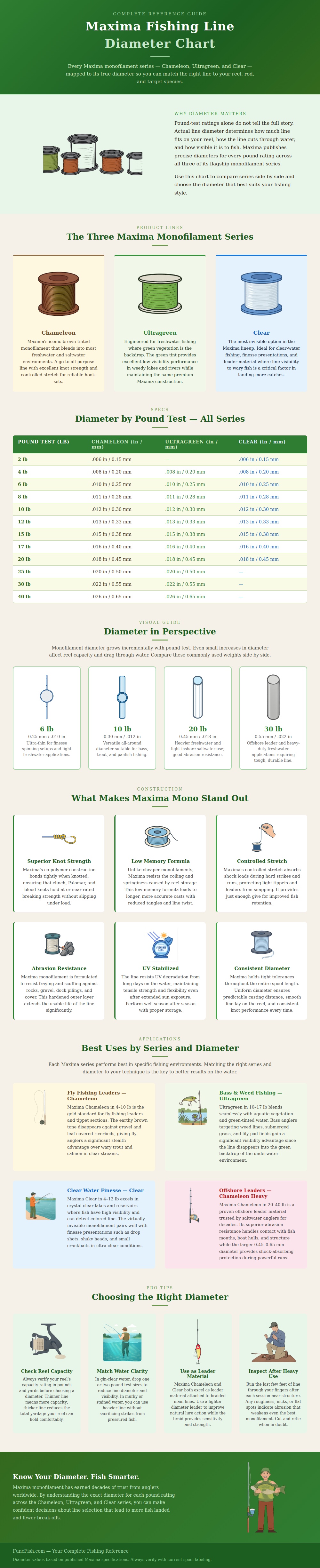
Fishing line diameter are another critical factor to consider when fishing. The diameter of the fishing line is critical to understanding how well the fishing line will fit on an fishing reel and how the line will move through the water. While many people thinks about pound test and the strength of the fishing line, the pound test does not describe the thickness of the fishing line.
The diameter of the fishing line is essential to understand whether the fishing line will slice through the water’s currents or whether it will scare the fish away from the bait. A reference chart can assist angler with finding the right fishing line diameter for there fishing rod and fishing reel. Maxima offers monofilament fishing lines in three different color that will blend into the water in different conditions.
How to Pick the Right Fishing Line Size and Color
The brown color of the monofilament line will blend into muddy bottoms of the water and rocky river. The green color of the fishing line will blend into weeds and lily pads. The clear color of the monofilament fishing line will remain invisible in clear water.
Because fish in clear water can see fishing line colors, this fishing line color is of great benefit when fishing in clear water. The construction of the Maxima monofilament lines use a co-polymer formula that makes these lines very toughly and resistant to UV damage. UV damage causes the fishing lines to become brittle when exposed to sunlight.
The co-polymer formula keeps these lines from ever becoming brittle. These lines is designed to hold their knot well. Fishing lines that have low memory will not tangle on the fishing reel.
Moreover, these lines have a controlled stretch that will absorb the shock of the fish biting on the line to prevent the fishing line or leader from snapping. Fishing line diameter is another essential factor that determine how much fishing line can be fitted onto the fishing reel. The thinner the fishing line, the more yard of fishing line can be fitted onto the fishing reel spool.
This is of great benefit for deep-water trolling for fish. A six-pound fishing line has a diameter of 0.25 millimeter. A six-pound fishing line is suitable for finesse fishing technique.
A ten-pound fishing line has a diameter of 0.30 millimeters. A ten-pound fishing line is suitable for bass fishing. A twenty- or thirty-pound fishing line has a diameter of 0.50 millimeters or more.
These thicker fishing lines is suitable for reeling in larger fish but take up more space on the fishing reel spool. When selecting the right diameter for a fishing line, angler must consider the conditions of the water in which the fish live. If the fish live in weedy bays, a green monofilament line will blend into the weeds.
If the fish live in clear streams and rivers, anglers must use clear monofilament lines or thinner diameter fishing lines because the fish will see the lines. If the water is muddy, the thicker and more visible the fishing lines, the better because the fish will have a harder time seeing the lines in the water. A common mistake that many angler make is ignoring the capacity of their fishing reel.
Fishing reels can hold different diameter of fishing lines but can only accommodate so much line on the spool. Using a fishing line with a larger diameter will allow less fishing line on the reel. Anglers must take time to check the specification of their fishing reel.
A second common mistake is the overlooking of the clarity of the water. Different types of water vary in how visible a fishing line will be to the fish. Finally, anglers must perform maintenance on the fishing line by inspecting the line after fishing in areas with many rock to ensure the fishing line does not have any nicks.
Any nicks in the fishing line will cause it to break when the fish take the line.