🎣 Fishing Hook Size & Length Calculator
Find the perfect hook size, gap width, and shank length for any species, bait, and technique
⚡ Quick Presets
⚙️ Calculator Inputs
✅ Hook Size & Specification Results
📊 Hook Style Quick Reference
EWG
Extra Wide Gap
Texas/Carolina rigs, soft plastics, weedless bass
Circle
Circle Hook
Live bait, catch-and-release, saltwater, catfish
Jig
Jig Hook
Walleye, bass, grub bodies, hair jigs
Aberdeen
Wire Hook
Panfish, crappie, minnows, light bait
Baitholder
Baitholder
Worms, cut bait, natural bait, trout
Octopus
Octopus Hook
Snelling, salmon eggs, live bait, drift fishing
Treble
Treble Hook
Lures, hard baits, crankbaits, trolling
Offset
Offset Shank
Soft plastics, wacky rig, creature baits
📋 Hook Size Reference Chart
| Hook Size | Gap Width (in) | Gap Width (mm) | Shank Length (in) | Shank Length (mm) | Best Applications |
|---|---|---|---|---|---|
| #32 – #20 | 0.08–0.18 in | 2–4.5 mm | 0.12–0.28 in | 3–7 mm | Midge, tiny dry flies |
| #18 – #14 | 0.18–0.28 in | 4.5–7 mm | 0.28–0.45 in | 7–11.5 mm | Dry flies, panfish, small trout |
| #12 – #8 | 0.28–0.45 in | 7–11.5 mm | 0.45–0.65 in | 11.5–16.5 mm | Trout, panfish, crappie |
| #6 – #2 | 0.45–0.65 in | 11.5–16.5 mm | 0.65–0.90 in | 16.5–23 mm | Bass (small), walleye, trout |
| #1 / 1/0 | 0.55–0.70 in | 14–18 mm | 0.75–1.05 in | 19–27 mm | Bass, walleye, striper |
| 2/0 – 3/0 | 0.70–0.90 in | 18–23 mm | 1.05–1.30 in | 27–33 mm | Bass (large), catfish, inshore |
| 4/0 – 6/0 | 0.90–1.20 in | 23–30.5 mm | 1.30–1.70 in | 33–43 mm | Catfish, salmon, pike |
| 7/0 – 10/0 | 1.20–1.65 in | 30.5–42 mm | 1.70–2.30 in | 43–58 mm | Large catfish, tuna, shark |
| 12/0 – 20/0 | 1.65–2.50 in | 42–63.5 mm | 2.30–3.50 in | 58–89 mm | Marlin, shark, billfish |
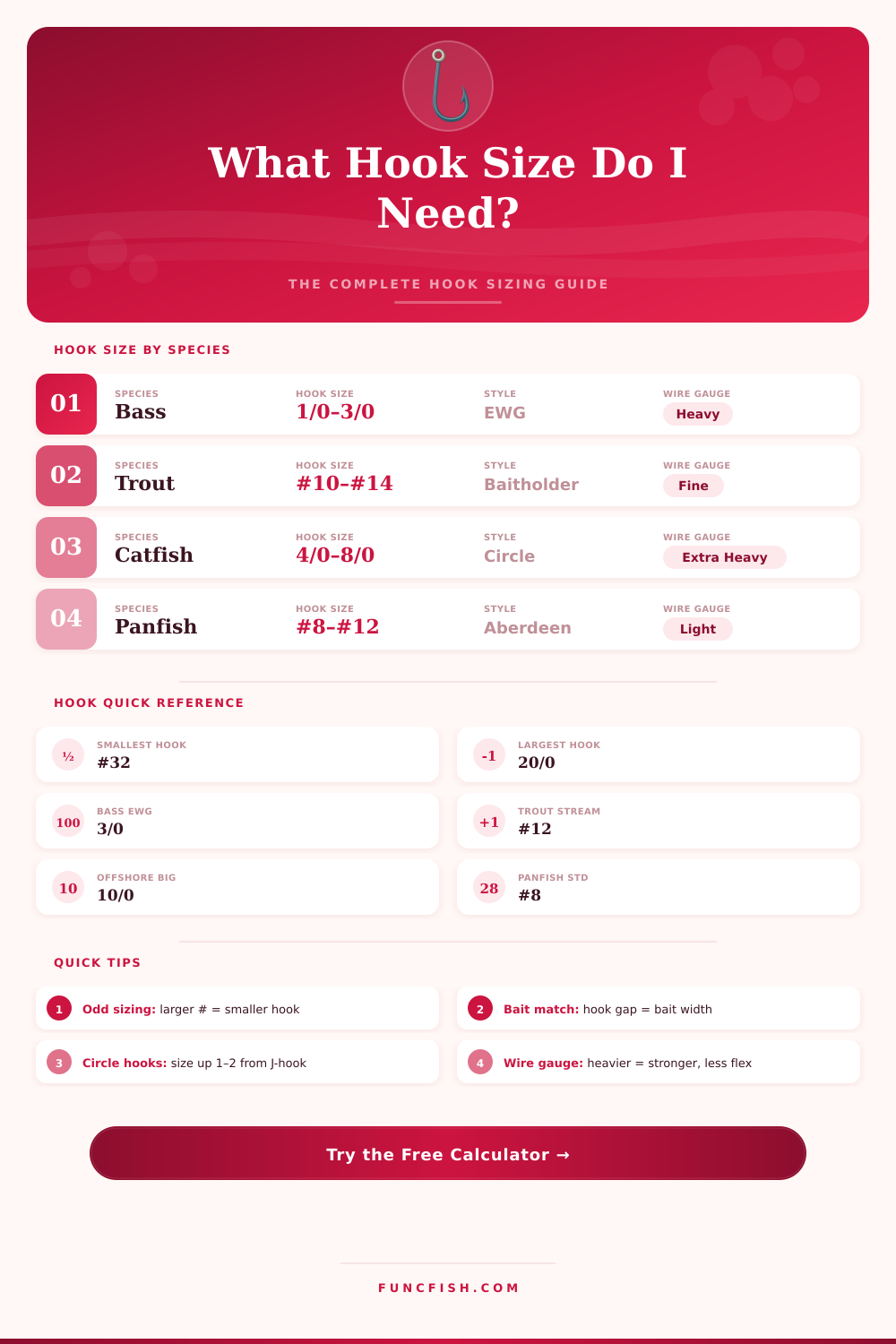
🐟 Species Hook Size Recommendations
| Species | Typical Weight | Recommended Size | Best Style | Wire Gauge | Shank (mm) |
|---|---|---|---|---|---|
| Bluegill / Panfish | 0.2–1 lb (0.09–0.45 kg) | #6 – #10 | Aberdeen / Baitholder | Fine – Light | 8–14 mm |
| Crappie | 0.3–2 lb (0.14–0.9 kg) | #4 – #8 | Aberdeen / Jig | Light – Standard | 10–16 mm |
| Trout (stream) | 0.5–5 lb (0.23–2.3 kg) | #10 – #14 | Baitholder / Fly | Fine | 7–12 mm |
| Bass (LM/SM) | 1–8 lb (0.45–3.6 kg) | 1/0 – 4/0 | EWG / Circle | Standard – Heavy | 20–30 mm |
| Walleye | 1–10 lb (0.45–4.5 kg) | #4 – 1/0 | Jig / Octopus | Standard | 12–22 mm |
| Pike / Muskie | 5–40 lb (2.3–18 kg) | 3/0 – 6/0 | Treble / EWG | Heavy – XH | 28–40 mm |
| Channel Catfish | 2–20 lb (0.9–9 kg) | 2/0 – 5/0 | Circle / Kahle | Heavy | 25–38 mm |
| Flathead Catfish | 10–60 lb (4.5–27 kg) | 5/0 – 8/0 | Circle / Octopus | Extra Heavy | 38–55 mm |
| Striped Bass | 5–50 lb (2.3–22.7 kg) | 2/0 – 6/0 | Circle / Baitholder | Heavy | 28–42 mm |
| Salmon / Steelhead | 5–30 lb (2.3–13.6 kg) | 1/0 – 4/0 | Octopus / EWG | Standard – Heavy | 20–32 mm |
| Tuna | 20–300 lb (9–136 kg) | 7/0 – 12/0 | Circle / Offset | Extra Heavy | 50–70 mm |
| Shark | 50–500+ lb (23–227+ kg) | 10/0 – 20/0 | Circle | Extra Heavy | 65–90 mm |
📏 Hook Style Comparison
| Style | Gap Multiplier | Best Bait Type | Hook-Up Rate | C&R Friendly | Circle Equivalent |
|---|---|---|---|---|---|
| EWG | 1.3x standard | Soft plastics | High | Moderate | Size up 1 |
| Circle | 1.15x standard | Live / cut bait | Very High (lip) | Excellent | — baseline |
| Jig | 1.0x standard | Soft plastics, hair | High | Good | Same size |
| Aberdeen | 1.25x standard | Live minnows, worms | Good | Good | Same size |
| Baitholder | 1.0x standard | Nightcrawlers, cut bait | Moderate | Moderate | Same size |
| Octopus | 1.1x standard | Salmon eggs, live bait | High | Good | Same size |
| Treble | 1.0x standard per point | Hard lures | Very High | Poor | Size down 2 |
| Offset Shank | 1.3x standard | Soft plastics (wacky) | High | Moderate | Size up 1 |
💡 Hook Gap Rule: The gap between the hook point and shank should be at least as wide as the widest part of your bait. For soft plastic lures, measure the bait diameter at its thickest point and match the hook gap to that measurement. A gap that is too narrow will result in missed strikes and poor penetration.
💡 Circle Hook Sizing: When switching from a J-hook or EWG to a circle hook, size up 1–2 sizes for equivalent gap coverage. Circle hooks are measured differently and have a naturally wider gap proportion. For live bait saltwater fishing, a circle hook sized at 5/0 replaces roughly a 4/0 J-hook while offering superior hookset geometry and catch-and-release survivability.
Selecting the correct hook size are a necessary part of fishing because using the wrong size hook will cause a person to lose the