Mono to Braid Backing Ratio Calculator
Estimate how much monofilament backing to load under braided main line using reel mono capacity, line diameters, fill target, braid pack behavior, and fishing scenario.
📌Backing ratio presets
⚙Reel, braid, and backing settings
Use one printed reel rating such as 8 lb / 140 yd, then enter that mono diameter below.
Capacity is modeled by line volume: length multiplied by diameter squared.
Backing ratio result
Calculation breakdown
📊Gear and species comparison grid
Bass Spinning
Surf Casting
Catfish Round
Offshore
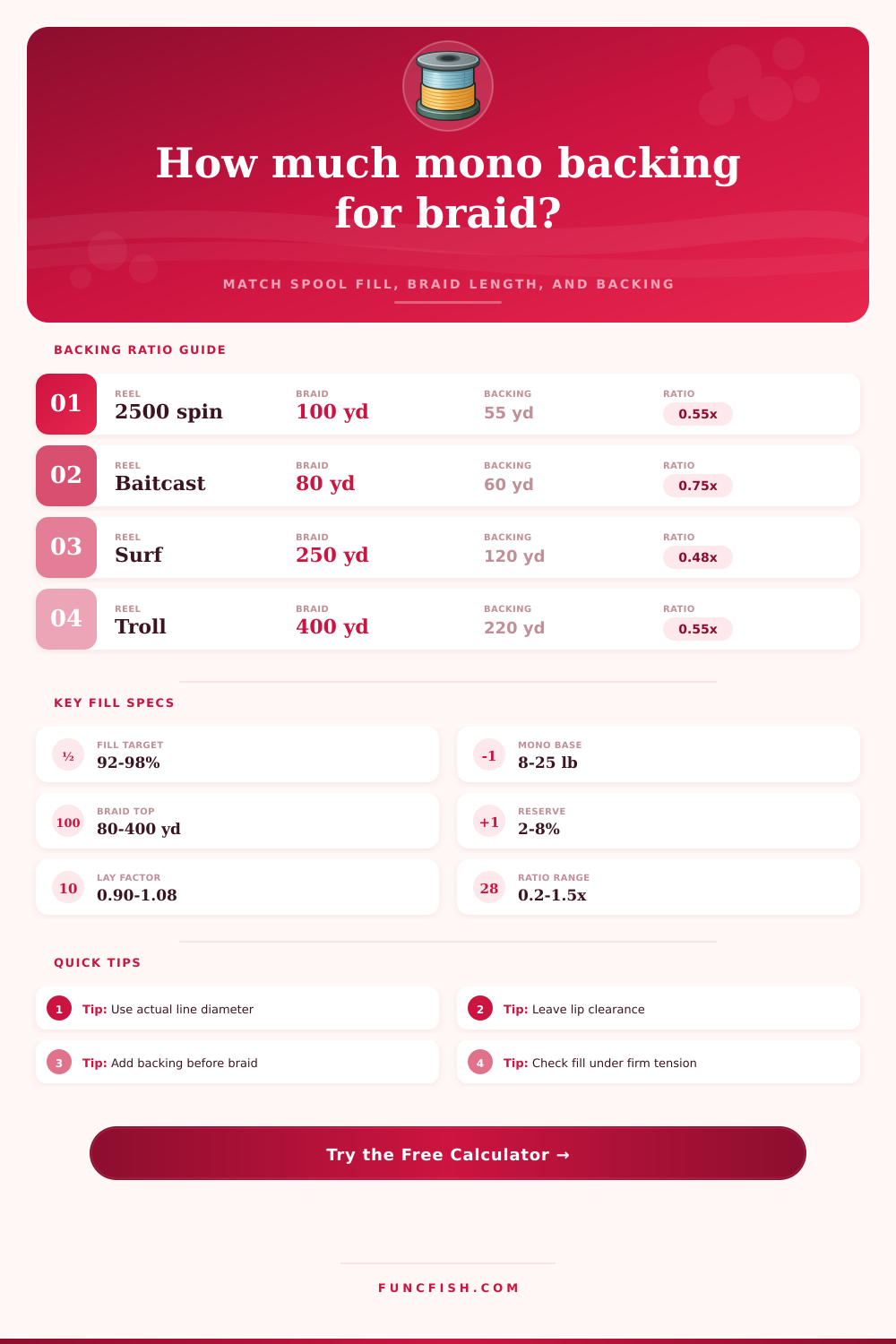
📐Typical mono-to-braid backing ratios
| Setup | Reel mono rating | Braid target | Typical mono backing | Backing to braid ratio |
|---|---|---|---|---|
| 1000 trout spinning | 4 lb / 110 yd | 75 yd of 6-8 lb braid | 25-45 yd of 4-6 lb mono | 0.33-0.60x |
| 2500 bass spinning | 8 lb / 140 yd | 100-120 yd of 10-20 lb braid | 35-75 yd of 6-10 lb mono | 0.30-0.75x |
| 150 baitcaster | 12 lb / 120 yd | 70-100 yd of 30-50 lb braid | 45-80 yd of 10-14 lb mono | 0.45-1.10x |
| 4000 inshore spinning | 12 lb / 200 yd | 150-200 yd of 20-30 lb braid | 35-90 yd of 10-15 lb mono | 0.18-0.60x |
| 6000 surf spinning | 20 lb / 240 yd | 220-300 yd of 30-50 lb braid | 60-150 yd of 15-25 lb mono | 0.20-0.68x |
| 30-class offshore | 30 lb / 450 yd | 350-500 yd of 65-100 lb braid | 130-300 yd of 25-40 lb mono | 0.30-0.75x |
🧵Line diameter reference
| Line class | Common mono diameter | Common braid diameter | Capacity effect | Backing note |
|---|---|---|---|---|
| 4-6 lb finesse | 0.006-0.009 in / 0.15-0.23 mm | 0.003-0.005 in / 0.08-0.13 mm | Braid can exceed 2x mono length | Use thin mono if the spool is shallow |
| 8-12 lb light bass | 0.010-0.013 in / 0.25-0.33 mm | 0.006-0.009 in / 0.15-0.23 mm | Backing often fills 25-45% volume | Match backing near rated mono size |
| 15-25 lb inshore | 0.014-0.019 in / 0.36-0.48 mm | 0.009-0.013 in / 0.23-0.33 mm | Braid gives long casting reserve | Use firm mono base to stop slip |
| 30-50 lb heavy cast | 0.022-0.031 in / 0.56-0.79 mm | 0.012-0.016 in / 0.30-0.41 mm | Deep spools need long backing | Leave room for shock leaders |
| 65-100 lb offshore | 0.036-0.047 in / 0.91-1.19 mm | 0.017-0.024 in / 0.43-0.61 mm | Braid greatly increases capacity | Pack under high tension |
⚖Fill target and reserve table
| Reel style | Practical fill target | Reserve allowance | Why it matters | Calculator adjustment |
|---|---|---|---|---|
| Spinning reel | 94-98% of rated full | 2-6% lip clearance | Too much line causes loops and wind knots | Spinning lip model subtracts extra volume |
| Baitcaster | 90-96% of spool edge | 4-10% thumb clearance | Overfill hurts braking and line control | Baitcaster model keeps more edge room |
| Conventional | 88-95% of rated full | 5-12% level-wind room | Line must build evenly across a wider spool | Deep spool model favors higher reserve |
| Surf spool | 95-98% if line lays cleanly | 2-5% casting lip room | Long casts benefit from a full spool | Wide spool model rewards firm packing |
| Fly reel | 85-93% rim clearance | 7-15% backing swell room | Wet backing can expand under pressure | Fly arbor model keeps larger rim reserve |
🎣Species and reel matching table
| Target species | Common reel class | Braid top layer | Backing strategy | Drag range |
|---|---|---|---|---|
| Trout, crappie, panfish | 1000-2000 spinning | 50-90 yd of 4-10 lb braid | Short mono base to prevent braid slip | 1-3 lb / 0.5-1.4 kg |
| Bass, perch, walleye | 2500 spinning or 100 baitcaster | 80-130 yd of 10-30 lb braid | Moderate backing for spool shape | 3-7 lb / 1.4-3.2 kg |
| Redfish, snook, schoolie striper | 3000-5000 spinning | 150-220 yd of 20-40 lb braid | Enough mono to tune lip clearance | 6-12 lb / 2.7-5.4 kg |
| Pike, muskie, catfish | 200 baitcaster or round reel | 100-180 yd of 50-80 lb braid | Thick backing for grip and volume | 8-18 lb / 3.6-8.2 kg |
| Surf, salmon, offshore pelagics | 6000 spin or conventional | 250-500 yd of 30-100 lb braid | Backing length depends on deep spool volume | 10-30 lb / 4.5-13.6 kg |
💡Backing calculation tips
Measure by diameter first. Reel ratings are only useful when the rated mono diameter is known. If the printed reel says 8 lb / 140 yd, use the actual diameter for that 8 lb mono, not only the pound-test label.
Pack braid under real tension. Loose braid sinks into itself during the first hard run and makes the spool look underfilled. The tension setting in this calculator adds reserve when the winding method is likely to settle later.
Standing next to a surf break or a bass boat, you notice that your spool is full. It’s piled up against the rim. Capacity? It might look full but it could just be an illusion hiding an empty arbor. No problem! You hook something big. Your drag slips. Your reel screams. Thirty seconds later, you look down at your arbor and see that it are completely empty. Hundreds of yards of empty space have been left below all that visible thin braided line. You look like a failure because you aren’t catching enough fish. You has also failed to manage your spool properly.
However, the main point is that reel companies only rate their reels in terms of monofilament volume and not braid volume. An eight pound spool of monofilament will have almost double the diameter than the same pound test braid. When you change from one type of line to another without reducing amount of backing, you are only filling half the capacity. However, you is acting as if you have filled it 100% just like before.
How to Fill Your Reel Properly
Enter the two diameters (the spool’s rated mono line size and then the braid specs) into the calculator above. It will convert those diameters into real-world cubic volume on the spool. This shows you how much mono backing it take to fill out the rest of reel without topping the lip.
The truth is most anglers never think about the backing at all until they has an issue. Then they’ll slap some old mono on there because it have something to grab onto braid’s surface, hook up their two-hundred-yard spool of mainline and cross their fingers hoping for the best. Sometimes that will work, purely by accident… But more times than not, it’s based off the laws of physics. The tool spells it out plainly. You may only be able to use a near one-to-one ratio of braid-to-backing if your reel have a shallow spool. However, having far less backing compared to huge spools of braid above will work fine on a deep offshore reel.
Also consider packing tension. Mono isn’t compressible like braid. When you wound it loosely on the reel at home, it settles down and packs tight after drag engages under actual fishing pressure. This settles the line and reduces its effective capacity. The tool compensates by allowing you to choose how you wound the line. Winding line tightly with a firm shop wind packs more onto the spool than winding it loosely by hand. Without considering this variable, your estimated capacity will always be higher then reality. Not a huge deal, but it makes a difference if you’re fighting a fish that requires every inch of retrieve.
And then there’s the issue of the connection point. It is the size of the knot where the braid connects to the backing. The double uni with excess wraps or a bulky FG knot will add millimeters of bulk right at the bottom. And those millimeter build up over hundreds of yards. Where some go too far leaving too much slack on their spools causing twist, others get them so full they cast poorly and have twist in their line.
Spinning reels is generally about ninety-five percent full, while baitcasters might have a little less because you want a bit of space from the sides of spool. It’s important because it directly relates to fight time. Too much slack equals tangles. Not enough lead to lost fish. So you have this line-to-spool ratio where each yard is purposeful.
A mechanical guess becomes a planned strategy. You can forget the depth gauge and pay attention to the water. Your backing isn’t filler; it’s the key to your whole retrieve system. Nail down the linchpin and everything else stay steady.