Multi-Day Trip Food Calculator
Estimate food weight, calories, meal counts, cooler space, cooking water, and reserve portions for fishing trips that run beyond one day.
📌Fishing trip presets
⚙Crew, food style, and trip inputs
Enter 0 to use the scenario and activity estimate.
The calculator separates dry food, cooler food, snacks, drink mix, hot meal water, and reserve meals so a multi-day fishing menu can be checked against pack and cooler limits.
Trip food estimate
Calculation breakdown
📦Food style data grid
Dehydrated
Freeze dried
Cooler fresh
Mixed pantry
MRE pouch
Sandwich
Base camp
High protein
📊Reference tables
| Food packing style | Best fishing fit | Typical calories per ounce | Cook water per hot meal |
|---|---|---|---|
| Dehydrated pouch meals | Backpack trout, canoe pike, kayak camp | 115 to 130 kcal/oz | 10 to 14 fl oz |
| Freeze dried ultralight | Long walk-ins and portages | 125 to 145 kcal/oz | 12 to 16 fl oz |
| Cooler fresh meals | Boat, cabin, ice shack, surf base camp | 60 to 85 kcal/oz | 0 to 6 fl oz |
| Mixed pantry and cooler | Most multi-day vehicle or boat trips | 95 to 115 kcal/oz | 6 to 12 fl oz |
| MRE style pouches | Rough weather and low-prep boat trips | 80 to 100 kcal/oz | 0 to 6 fl oz |
| Snack-heavy high protein | All-day casting and quick shore lunches | 105 to 125 kcal/oz | 0 to 4 fl oz |
| Fishing scenario | Daily calorie range per person | Dry food target | Reserve pattern |
|---|---|---|---|
| Bass boat weekend | 2600 to 3100 kcal | 1.4 to 1.9 lb/day | One spare lunch and snack block |
| Trout backpack stream | 3200 to 3900 kcal | 1.7 to 2.2 lb/day | One full day for remote water |
| Surf casting beach camp | 3000 to 3700 kcal | 1.8 to 2.4 lb/day | Extra salty snacks and breakfast |
| Offshore overnighter | 2800 to 3400 kcal | 1.6 to 2.2 lb/day | Compact shelf-stable meals |
| Ice shack long weekend | 3100 to 3800 kcal | 1.8 to 2.4 lb/day | Hot meal reserve preferred |
| Trip length | Meal planning checkpoint | Cooler checkpoint | Dry bag checkpoint |
|---|---|---|---|
| 2 days | Count departure and return meals separately | Use small cooler if fresh share is under 25 percent | Group by day bags |
| 3 to 4 days | Reserve meals become useful if weather delays travel | Check cooler capacity before adding drinks | Split snacks from hot meals |
| 5 to 6 days | Repeatable menus reduce packing errors | Limit fresh share unless resupply exists | Use two dry bags for access |
| 7 days or more | Plan appetite fatigue with varied textures | Fresh food should be early-trip heavy | Audit calories per ounce |
| Species or technique | Food emphasis | Common pack style | Calculator adjustment |
|---|---|---|---|
| Trout stream wading | Frequent small snacks | Freeze dried plus trail food | Higher active-hour calories |
| Surf casting | Salt, carbs, and quick lunches | Mixed pantry with cooler | Hot climate and reserve buffer |
| Offshore trolling | Easy-access portions | MRE pouches and cooler food | Moderate calories, compact reserve |
| Ice fishing | Hot meals and dense snacks | Base camp cook kit | Cold weather calorie bump |
| Canoe pike trip | High calories per ounce | Dehydrated or freeze dried | Pack weight limit check |
🚩Two planning tips
Reserve by meal type: Keep at least one no-cook meal set outside the main menu so a weather delay does not require unpacking every day bag.
Cooler reality check: Run the fresh-food percentage before adding drinks or bait cooler space; the calculator only estimates food volume.
It’s day three of your fishing trip. You open up a half-empty cooler and stand there looking at it. “Man, I brought plenty of ice for this trip,” you say, “but now I’m out of real food.” Everything in the boat cost a bunch of money, but the food consist of a protein bar and some sunburned, stale sandwiches.
That’s a common mistake anglers make. We pack for the fish and then we’re an afterthought for ourselves. We pack for the energy we need for the fish more then the other way around.
How to Plan Food for Your Fishing Trip
This calculator is meant to close that gap. It makes vague feelings of hunger into cold hard logistics. It break the problem into calories, cooler volume and dry weight. It makes you think like an expedition planner, not like a snacker.
Activity intensity are the biggest driver. When folks estimate caloric requirements, they tend to think about sitting in a boat. Guess what? Your body burns energy far faster while you’re standing up in the wind surf casting or wading through a trout stream different than it does while idling next to the dock. These “active” hours adjusts the target number for each day.
Why? Because not eating enough leads to bad casting mechanics and irritability. Do you want to know how many grain of rice you’ve eaten? No! Do you want to know if you are running a marathon or napping? Yes!
Once you choose your scenario, the calculator figure out your required intake. So no more conversions, no more fumbling with coefficients, it helps you avoid bringing too little or too much.
It is a matter of convenience versus weight. You need a dehydrated meal if every single ounce matters, like in a canoe trip. They’re very calorie dense per ounce. But you also need a cooking pot and some clean water.
Fresh coolers of meals are good because there’s less prep time and they taste better than dehydrated food but they need a lot more space and a bunch of ice. There’s a reference table on the page that lays out the density differences.
And there’s only so much room in the cooler. If it’s jam-packed with drinks and bait, there’s not room for all the fresh food you stashed away before. That’s what wrecks most trips: the physical constraint. Either you go heavy with a pack or you go heavy with a cooler. No free lunch. Literally or figuratively.
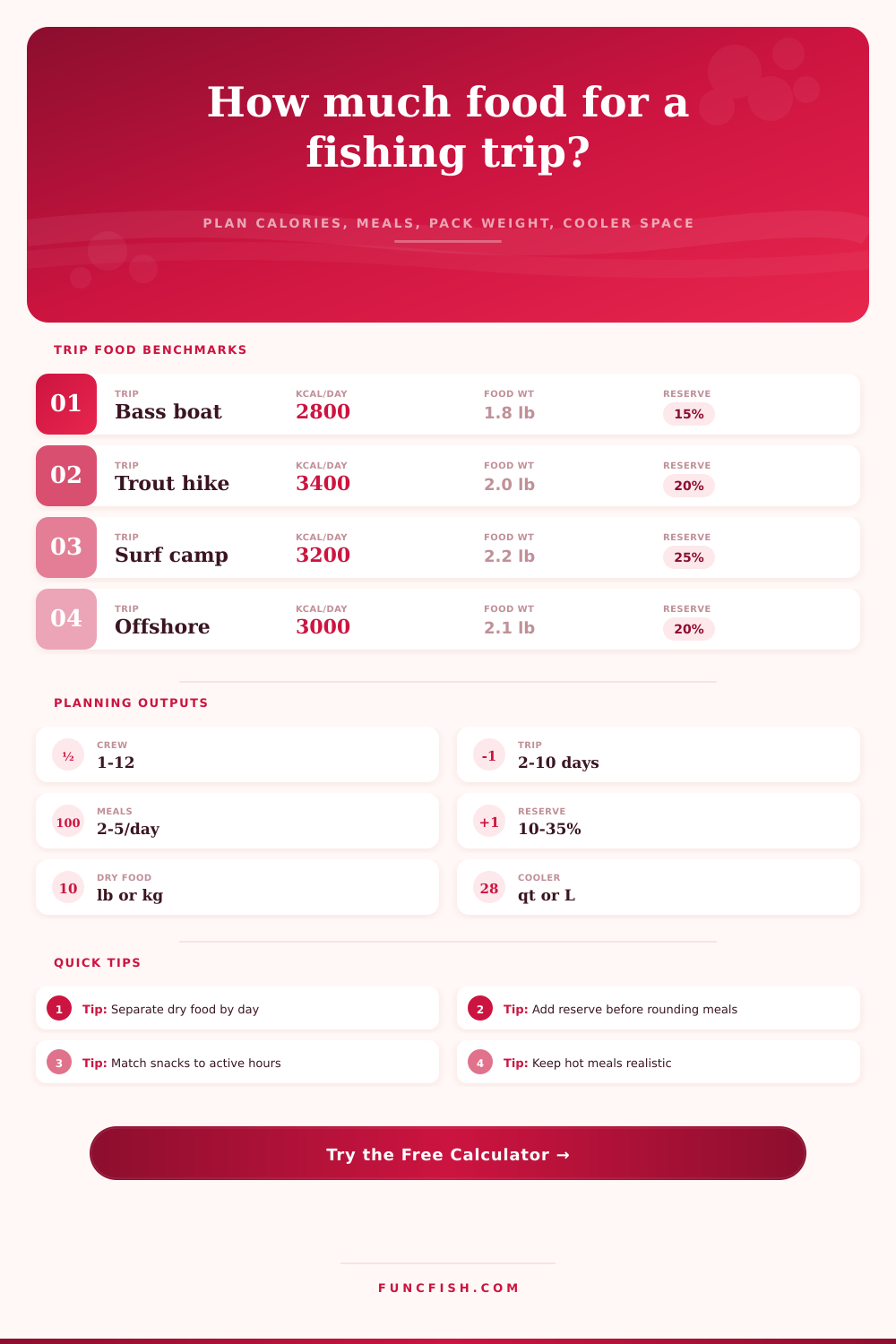
Experienced guides has a secret weapon: Reserve Portions. Tides change and weather delays occur. If your schedule goes south, having a fifteen to twenty percent reserve buffer means you won’t go hungry. This isn’t about efficiency, it’s about safety.
There’s a spot on the calculator for it; don’t cut meals too close, round up. That little bit makes a big difference when you’re thirty miles away from the nearest grocery store.
Another hidden variable is cooler space. Ice occupies space as well, something people tend to forget. Run out of both if you don’t account for the amount of ice you’ll need when calculating fresh food volume.
The tool also calculates cooler space required based off your fresh food percentage. That way you’re less likely to make the classic mistake of packing in perishables. Adjusting the fresh share percentage give you an idea of how it affects the overall space (and weight) required.
If things are looking tight, replace some fresh with shelf-stable snacks. This simple substitution saves precious cubic inches.
The snacking strategy matters too. Choosing high protein snacks will sustain your energy levels while keeping blood sugar in check (unlike eating something sugary that will spike and then crash). Fishing all day is no problem because you can match your snack times with when you are most active on the water. You’ll find a way to fuel up throughout the day without overdoing it, thanks to setting a “snack share” percentage within the calculator. That means avoiding the dreaded three-o’clock slump and staying productive all day while fishing.
In the end, making food for a multi-day outing boils down to a balance. You want it to be dense so you’re light, but varied so you don’t get sick of it. Practical, yet comfortablly food.
How do you accomplish all this? The calculator gives you a framework, and then it’s up to your judgement to fill in the blanks. Make sure to start with basic necessities. Add a little buffer. Check your cooler capacity early. Don’t leave it until the last minute to decide what you’ll eat.
A hungry crew doesn’t make a patient crew. And patience is how we catch those big ones.
Back to that half-empty cooler situation. With a little planning, you could of guaranteed that only the line will be empty, not your stomach.