Muskie Length Girth Weight Calculator
Estimate muskie or tiger muskie weight from length, girth, body depth, forage condition, season temperature, measurement type, and confidence range.
📌Muskie measurement presets
⚙Fish measurements
Muskie weight estimate
Weight, condition, and trophy class update as measurements change.
Calculation breakdown
📊Muskie body profile reference
Pure Standard
Heavy Lake
River Frame
Tiger Muskie
📏Muskie length and girth comparison grid
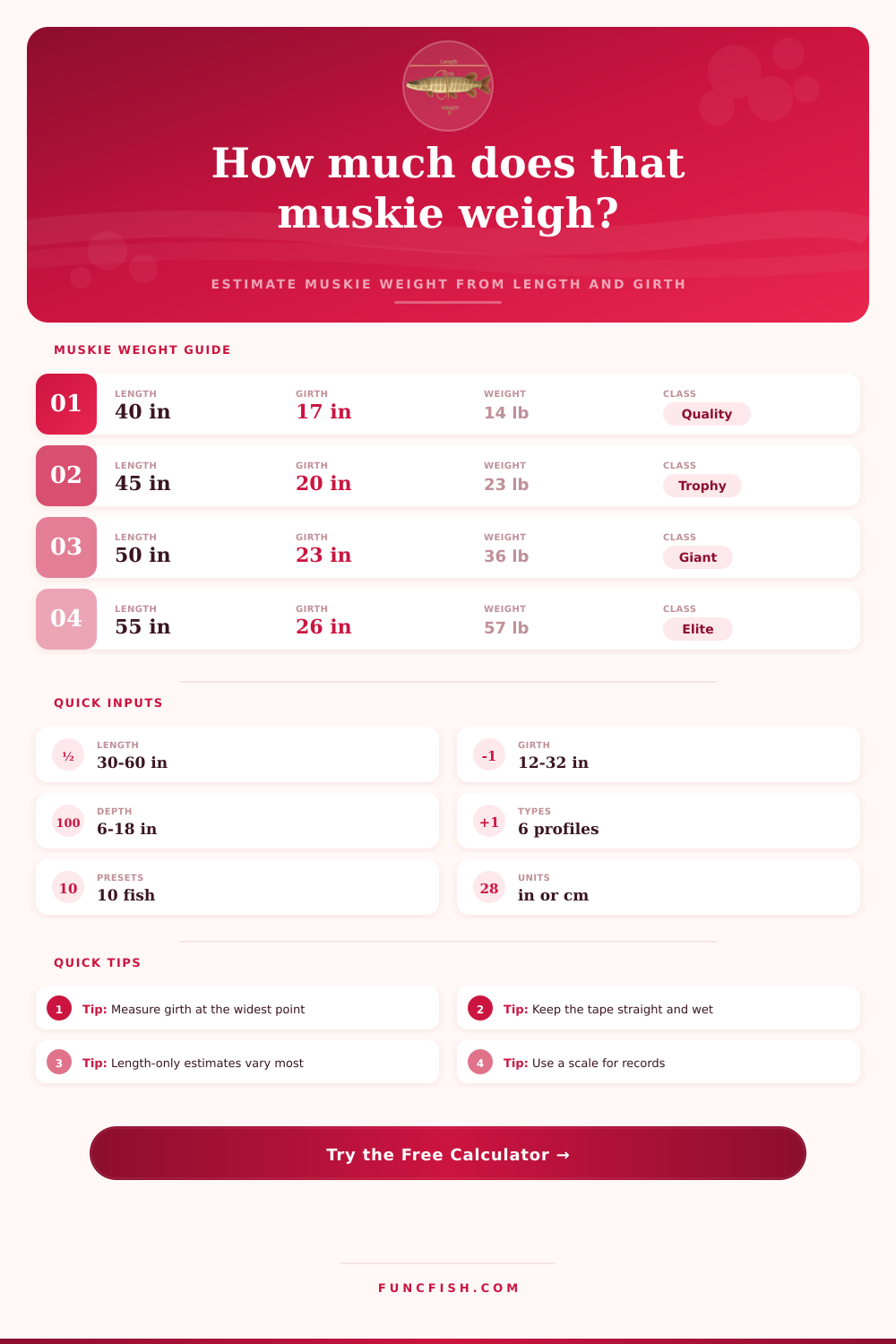
40 inch fish
Typical legal or quality muskie with moderate girth.
45 inch fish
Often a strong trophy marker when girth reaches twenty inches.
50 inch fish
Length alone is impressive; girth decides the true weight jump.
55 inch fish
Large-frame fish become exceptional when the belly passes mid-twenties.
60 inch fish
Rare length class where small girth differences change the estimate fast.
📋Reference tables
| Measurement type | Best input | Typical error band | Calculator handling |
|---|---|---|---|
| Taped length and girth | Wet tape, fish supported | About plus or minus 8 percent | Uses length and girth directly |
| Bump board plus girth | Board length and widest girth | About plus or minus 6 percent | Slightly tighter confidence |
| Length with estimated girth | Length plus profile estimate | About plus or minus 15 percent | Blends entered girth with profile girth |
| Photo release estimate | Fast tape or image notes | About plus or minus 20 percent | Widens final range |
| Scale checked fish | Certified or known scale | About plus or minus 4 percent | Closest formula range |
| Muskie length | Lean girth | Heavy girth | Weight window |
|---|---|---|---|
| 36 in / 91 cm | 14 to 15 in / 36 to 38 cm | 16 to 17 in / 41 to 43 cm | 9 to 13 lb / 4.1 to 5.9 kg |
| 40 in / 102 cm | 16 to 17 in / 41 to 43 cm | 18 to 19 in / 46 to 48 cm | 13 to 18 lb / 5.9 to 8.2 kg |
| 45 in / 114 cm | 18 to 19 in / 46 to 48 cm | 20 to 22 in / 51 to 56 cm | 18 to 27 lb / 8.2 to 12.2 kg |
| 50 in / 127 cm | 21 to 22 in / 53 to 56 cm | 23 to 25 in / 58 to 64 cm | 28 to 39 lb / 12.7 to 17.7 kg |
| 55 in / 140 cm | 23 to 24 in / 58 to 61 cm | 26 to 28 in / 66 to 71 cm | 38 to 54 lb / 17.2 to 24.5 kg |
| 60 in / 152 cm | 25 to 26 in / 64 to 66 cm | 29 to 31 in / 74 to 79 cm | 47 to 72 lb / 21.3 to 32.7 kg |
| Forage and season | Typical shape effect | Use in calculator | Best measured field |
|---|---|---|---|
| Cisco or tullibee rich lake | Deep shoulders and belly | Raises condition multiplier | Maximum girth |
| Sucker or perch forage | Steady average fullness | Small positive adjustment | Length plus girth |
| Lean forage base | Narrow belly for length | Trims estimate modestly | Body depth |
| Post-spawn period | Drawn belly and lower fullness | Reduces condition factor | Girth and season |
| Fall feeding window | Higher belly volume | Adds seasonal reserve | Girth and depth |
| Trophy class | Length marker | Weight marker | Calculator label |
|---|---|---|---|
| Sub-legal or juvenile | Under 36 in / 91 cm | Usually under 10 lb / 4.5 kg | Growing fish |
| Quality muskie | 36 to 43 in / 91 to 109 cm | 10 to 20 lb / 4.5 to 9.1 kg | Quality fish |
| Trophy muskie | 44 to 49 in / 112 to 124 cm | 20 to 32 lb / 9.1 to 14.5 kg | Trophy |
| Giant muskie | 50 to 54 in / 127 to 137 cm | 32 to 45 lb / 14.5 to 20.4 kg | Giant |
| Elite muskie | 55 in plus / 140 cm plus | 45 lb plus / 20.4 kg plus | Elite fish |
Weight estimates are measurement tools, not record certification. A certified scale and documented handling are required when exact weight matters.
💡Measurement tips
Tip: Girth drives the formula more than length because it is squared. A one inch girth error on a big muskie can move the estimate by several pounds.
Tip: For fast releases, measure length first, take one quick widest-girth reading, and use the wider confidence setting when the tape angle was rough.
A length girth weight calculator are a tool that help a person to calculate the weight of a muskie using only the length and girth measurement of the muskie. Muskies is large fish species, and it is often difficult to weigh a muskie. A person may wish to know the weight of the muskie to help with a decision as to whether to keep the muskie or to release the muskie back into it’s habitat.
The length measurement of the muskie are not enough to provide an accurate weight estimate of the muskie; the length girth weight calculator requires other information to provide an estimate that is as complete as possible regarding the muskies weight. The girth measurement is the most importently of the measurements for the length girth weight calculator because the girth measurement is squared in the equation. For example, a muskie with a length of 50 inches and a girth of 23 inches will weigh more then a muskie of the same length but with a 20-inch girth measurement.
Muskie Length and Girth Weight Calculator
The weight of the muskie is correlated with the girth measurement. Other information that the length girth weight calculator requires is the type of muskie. For example, a muskie may be a pure muskie or it may be a tiger muskie; each species has a different body structure then the other.
The length girth weight calculator account for this difference in body structure so that the estimate that is provided to the user is accurate. Additionally, you can enter the body depth of the muskie into the length girth weight calculator. The girth of a muskie can be large due to the muskie’s body depth, or due to the muskie’s belly.
By entering the body depth measurement into the length girth weight calculator, the calculator can distinguish between those two condition, and provide an accurate estimate of the muskie. The length girth weight calculator also accounts for the time of year that the muskie was weighed. For example, muskies typically lose weight during the spring when they spawn, but gain the most weight in the fall when they have eaten the most food throughout the water body.
By accounting for these change in muskie weight throughout the year, the length girth weight calculator can more accurately provide the muskie’s weight. The length girth weight calculator also accounts for the measurement type. For example, if you obtained the length and girth measurements using a tape measure, the measurement is precise.
However, if a photograph of the muskie provides the length and girth measurements, the measurement is merely an estimate. The length girth weight calculator account for these difference in measurement type, as well. Lastly, the length girth weight calculator will provide trophy class label for muskies.
The length and girth weight calculator does not create new classes of muskie. Rather, if the muskie’s length and weight fall within certain parameter of muskie sizes that are recognized by management agencies, the length girth weight calculator will provide a label indicating the trophy class of the muskie. Many people makes mistakes with a length girth weight calculator.
For example, many people may rely upon only one measurement to determine the weight of the muskie. Such an estimation is often inaccurate. For example, if the girth of the muskie is measured in the wrong location, or if the muskie is moving while measuring the girth, the weight estimate will be inaccurate.
To avoid such error in the measurement, it is best to use a wet tape to measure the muskie, to support the muskie on which the measurement is being taken, and to measure the girth at the widest point of the muskie. The length girth weight calculator also provides a condition index result for the muskie. The condition index indicate the weight of the muskie relative to its length.
For example, a muskie may be very long, but have a low condition index if the girth and depth of the muskie is small. Additionally, a muskie that is shorter than another muskie can have a higher condition index if its girth is very large. Thus, the condition index help to convey to the reader whether the muskie is healthy or if it is an unusual specimen of muskie from that specific water body.
A length girth weight calculator is a tool that remove one layer of uncertainty from the muskie fishing process. A person must still consider other factors that may impact the muskie (such as the temperature of the water and the time of year) before making any decision regarding the muskie. However, the length girth weight calculator can help a person to understand if the muskie that is being caught is average or exceptional for the water body in which the muskie is being caught.
Thus, the length girth weight calculator is helpful to muskie anglers, but only if the information that is entered into the weight calculator is of high quality.