Parasite Kill Freeze Time Calculator
Estimate fish parasite destruction freeze schedules, modeled time to solid, required holding time, release date, and validation flags for raw or lightly cooked seafood plans.
1Quick presets
Choose a realistic seafood batch, then adjust the fish thickness, freezer temperature, packaging, loading, and schedule before using the result for batch planning.
2Fish, freezer, and schedule inputs
Freeze schedule estimate
Calculation breakdown
3Species and material grid
Wild salmon
Cod family
Flatfish
Pelagic oily
Freshwater fish
Tuna loin
Roe skein
Stacked block
4Reference tables
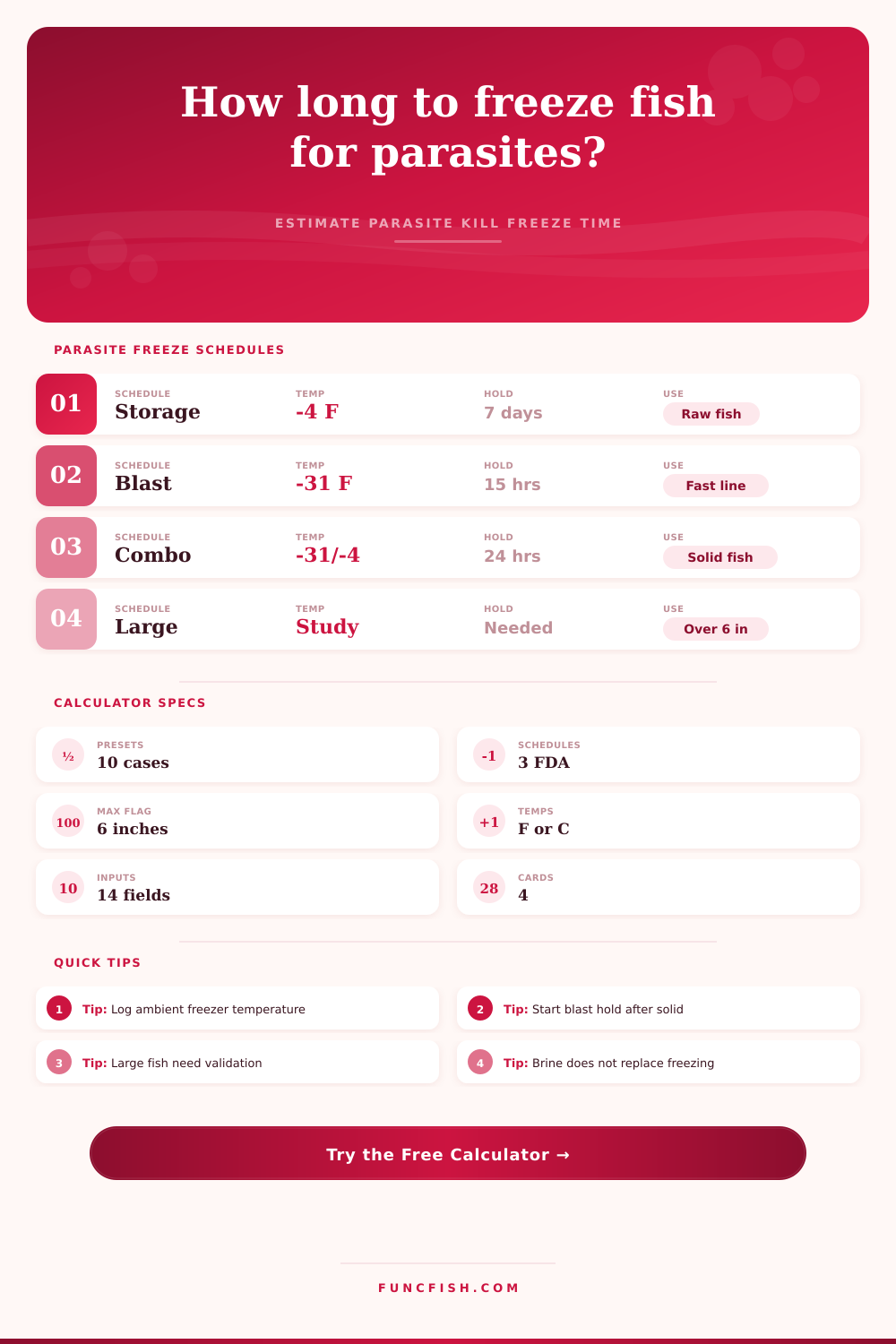
| Schedule | Freezer ambient | Required hold | Timing note |
|---|---|---|---|
| Storage schedule | -4 F / -20 C or below | 7 days total | Use total time at or below limit. |
| Blast schedule | -31 F / -35 C or below | 15 hours | Begin after fish is solid frozen. |
| Combination schedule | -31 F then -4 F | 24 hours | Begin -4 F hold after solid frozen. |
| Large fish exception | Any schedule | Validate | Thicker than 6 inches needs study. |
| Fish or source | Parasite concern | Calculator setting | Release caution |
|---|---|---|---|
| Wild salmon | Roundworms | High concern | Freeze for raw service. |
| Cod and pollock | Roundworms | High concern | Citrus marinade is not enough. |
| Freshwater fish | Flukes | High concern | Use extra validation for raw use. |
| Pellet-fed aquaculture | Lower if verified | Document source | Confirm feed and culture method. |
| Package style | Freeze lag | Best use | Watch point |
|---|---|---|---|
| Single trays | 1.00x | Fillets and portions | Keep airflow open. |
| Vacuum flat pouch | 0.94x | Uniform raw cuts | Avoid stacked warm packs. |
| Water block | 1.45x | Bulk storage | Ice mass slows the core. |
| Foam tray | 1.72x | Short transfer only | Insulation delays freezing. |
| Record item | Needed for | Good value | Deviation action |
|---|---|---|---|
| Ambient log | All schedules | Continuous | Restart or extend hold. |
| Solid-frozen time | Blast and combo | Recorded | Do not start hold early. |
| Thermometer check | Verification | Traceable | Recheck records. |
| Maximum thickness | Large fish flag | Under 6 in | Validate the process. |
5Practical tips
Separate freeze lag from hold time. The -31 F schedules require the fish to become solid before the 15-hour or 24-hour hold starts, so thick blocks need a measured core check.
Treat the result as a planning estimate. Use verified freezer records and local food-safety controls before raw service; brining, pickling, trimming, or candling can reduce parasites but does not replace a validated kill step.
There it sits: a slab of wild salmon on a plate. Looks good. Tastes great. You did a nice job with the plating. But biology doesn’t care how well you plate it.
There may be parasites, flukes or roundworms; that makes it through the net. Cooking kills them, but if you are serving fish raw, freezing is your only way to make sure they’re dead. When you prepare that same fish raw. In ceviche, sashimi, or sushi (there’s nothing else to fall back on). To protect yourself from making diners ill, there is one line of defence: the freezer.
How to Freeze Fish Safely
And freezers don’t preserve. They destroys. Time and temperature make all the difference between killing parasites and keeping your fish cold, something most kitchen staff (or home cooks) do incorrectly. Popping a big hunk of tuna into the freezer and expecting it to be fine an hour later isn’t going to happen. Freezing happens on the outside first; the inside remain warm. Parasites will lives during the lag time.
This calculator does the math for you. It factors in the ambient air temperature, the kind of freezer, and the thickness of the cut. It then separates actual freezing time from the holding time after freezing.
Parasites are resilient and so are FDA guidelines. Total time on a minus 4 degrees Fahrenheit storage schedule equals seven days or you can go into a minus 31 degree (blast) freezer and do it in fifteen hours, but only once fish’s core temp matches its freezer temp. That’s where the tool helps you visualize what’s happening: When your fish is thicker than what you can account for, it will flag an issue. A thin fillet validates different than a six-inch-deep loin. You’re never cheating physics here. Once there’s a chunk of ice in the middle, you haven’t even begun the kill step.
How you package also plays an important role that isn’t obvious. Freezing will be faster with vacuum sealed packaging because it eliminates air and allows heat to move easy between packages. However, piling up multiple pouches inside each other will cause them to insulate each other. The calculator factors in airflow as well as load density. Throwing fish in a chest freezer, then covering it with a bag of peas, doesn’t allow for air flow. Outer layer goes rock hard while center takes forever to freeze. That’s the danger zone.
Before deciding on a raw menu, know how much your system can take. Freezing doesn’t substitute brining/curing. Freezing kills parasites, but a salty environment doesn’t necessarily kill them, even though it may dry them out and alter their texture. And salt will only kill when combined with enough time and salt concentration to eliminate the organism. Not all salt, at any strength, or amount of time, will do that. That’s not the same as freezing. A lot of chefs believe that a strong cure will be enough protection. Nope. Freeze is the control point.
The table on the page above provide the details. Different species pose varying degrees of risk. Flukes can be especially problematic with freshwater fish, which may need more careful handling or should of been avoided entirely if served raw. Run your batch through the tool and check out the validation status. Don’t ignore warnings; they may flag something as a concern. Maybe it’s telling you that your freezer isn’t cold enough. Maybe it’s telling you that the thickness of your fish doesn’t work on the schedule you chose. Adjust your inputs. Try cutting the fish thinner. Or give yourself more hold time.
Safety is never a compromise. Safety is a calculated risk that you manage with data. It’s about serving safe, beautiful food, and doing so without any guessing. It’s about controlling heat transfer. As much as anything else.
Learn the lag. Honor the hold time. Let the numbers give you confidence. Don’t make it a roll of the dice. Make it a triumph of taste (every single time). Do it right and when your guest tastes it, the only thing they’ll be surprised by is how good it tastes.
Believe in the process. Check the temps. Serve confidently.