Puller Bung Tension Calculator
Estimate pole elastic preload, puller draw tension, tip-delivered pull, stretch margin, and the bung grip needed to hold a clean setting.
📌Scenario presets
⚙Bung, elastic, and puller inputs
Puller bung tension results
Calculation breakdown
🛠Elastic data grid
Solid 1.0 mm
Solid 1.4 mm
Hollow 2.1 mm
Power 2.8 mm
🐟Gear and species comparison grid
Canal Roach
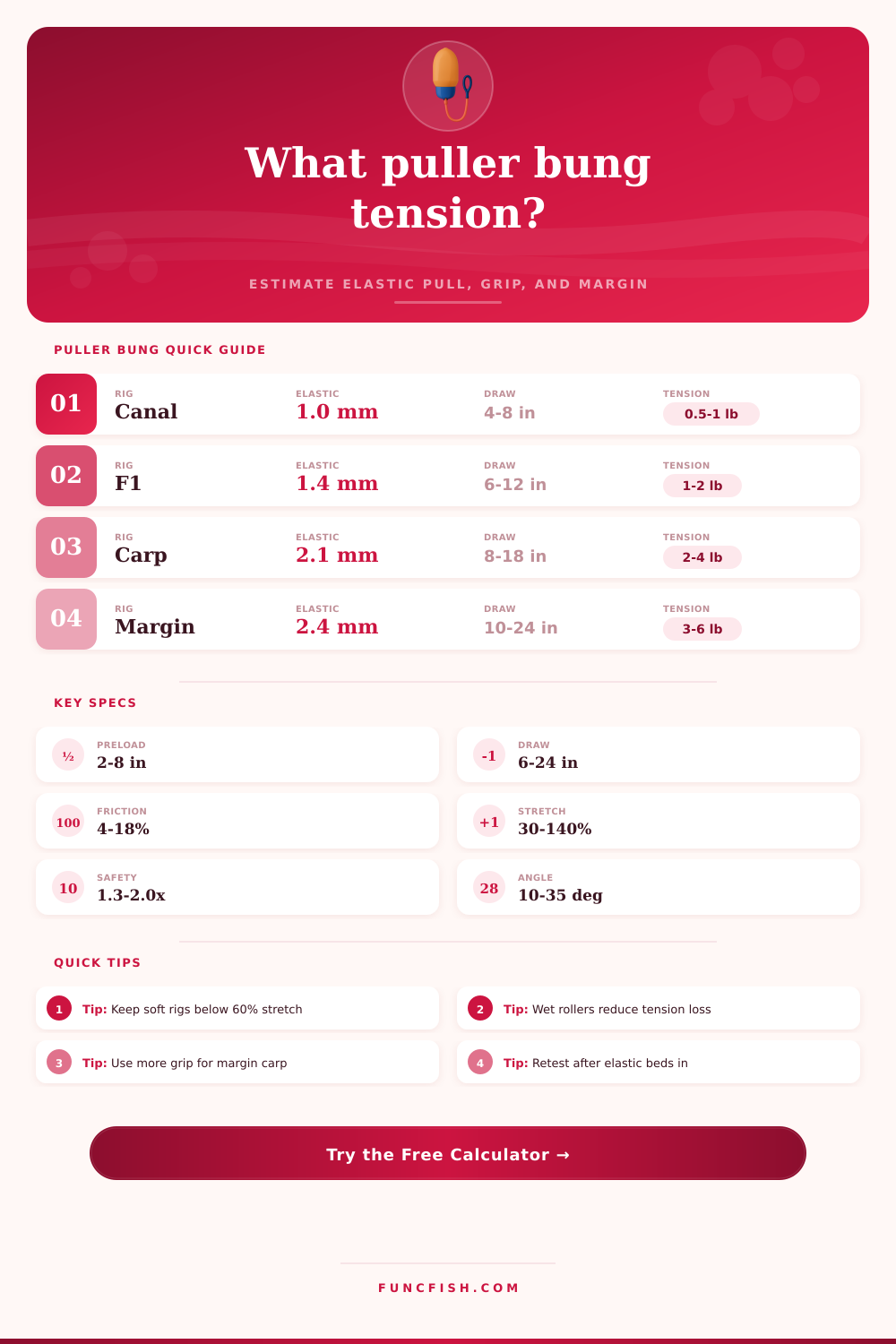
0.4-0.9 lbSolid 1.0-1.2 mm, low preload, short puller draw, and light bung grip for clean shipping.
Commercial F1
1.0-2.2 lbSolid 1.4 mm or hollow 1.8 mm, moderate draw, and smooth roller loss below 10%.
Tench or Bream
1.8-3.8 lbHybrid 1.6 mm to hollow 2.1 mm with enough bung grip for longer steady pressure.
Margin Carp
3.5-7.5 lbHollow 2.4 mm or power 2.8 mm, higher safety factor, and controlled short draw.
📊Puller tension reference tables
| Elastic rating | Tension at 50% stretch | Tension at 100% stretch | Comfort stretch band | Typical pole use |
|---|---|---|---|---|
| Solid latex 1.0 mm | 0.35 kg / 0.8 lb | 0.80 kg / 1.8 lb | 35-90% | Canal roach, small perch |
| Solid latex 1.2 mm | 0.50 kg / 1.1 lb | 1.10 kg / 2.4 lb | 35-95% | Roach, skimmers, light bream |
| Solid latex 1.4 mm | 0.72 kg / 1.6 lb | 1.60 kg / 3.5 lb | 40-105% | F1, bream, small carp |
| Hybrid 1.6 mm | 0.95 kg / 2.1 lb | 2.10 kg / 4.6 lb | 40-115% | Mixed commercial fishing |
| Hollow 1.8 mm | 1.15 kg / 2.5 lb | 2.55 kg / 5.6 lb | 45-120% | F1, carp, open water |
| Hollow 2.1 mm | 1.45 kg / 3.2 lb | 3.20 kg / 7.1 lb | 45-125% | Tench, carp, lilies |
| Hollow 2.4 mm | 1.86 kg / 4.1 lb | 4.10 kg / 9.0 lb | 50-135% | Margin carp, platform legs |
| Power hollow 2.8 mm | 2.50 kg / 5.5 lb | 5.50 kg / 12.1 lb | 50-140% | Short kit power work |
| Puller condition | Estimated loss | Where it comes from | Best tension use | Adjustment note |
|---|---|---|---|---|
| Polished PTFE slot, wet elastic | 4% | Very low side rub | Fine silverfish to F1 | Use when the elastic returns instantly |
| Clean puller bead, smooth roller | 7% | Small slot and roller drag | Most match pole kits | Good baseline for well-kept kits |
| Normal match-day puller | 10% | Average dirt and side angle | General commercial work | Default setting for mixed fishing |
| Dry bung or tight side slot | 14% | Elastic rub and bead pressure | Carp kits under load | Reduce angle or clean the side puller |
| Dirty roller or rubbing bush | 18% | High friction through the kit | Emergency estimate only | Service the kit before fishing heavy |
| Species or venue style | Typical fish weight | Elastic choice | Puller draw range | Bung grip target |
|---|---|---|---|---|
| Canal silverfish | 0.1-1 lb / 0.05-0.45 kg | Solid 1.0-1.2 mm | 4-8 in / 10-20 cm | 1.0-2.0 lb / 0.45-0.9 kg |
| F1 shallow | 1-3 lb / 0.45-1.4 kg | Solid 1.4 mm or hollow 1.8 mm | 6-12 in / 15-30 cm | 2.0-4.0 lb / 0.9-1.8 kg |
| Open-water carp | 3-8 lb / 1.4-3.6 kg | Hollow 1.8-2.1 mm | 8-18 in / 20-46 cm | 4.0-7.0 lb / 1.8-3.2 kg |
| Tench in weed | 3-7 lb / 1.4-3.2 kg | Hollow 2.1-2.4 mm | 10-18 in / 25-46 cm | 5.0-8.5 lb / 2.3-3.9 kg |
| Margin carp | 5-15 lb / 2.3-6.8 kg | Hollow 2.4 mm or power 2.8 mm | 12-24 in / 30-61 cm | 7.0-12 lb / 3.2-5.4 kg |
| Bung setting | Preload feel | Useful stretch range | Risk if too low | Risk if too high |
|---|---|---|---|---|
| Soft match | Elastic just seated | 25-70% | Slow line recovery | Bumped small fish |
| Balanced match | Positive but not tight | 40-105% | Late pressure at net | Reduced cushion on surges |
| Heavy fish | Firm puller response | 55-125% | Lost control near snags | Hook pulls on short line |
| Margin security | Strong first pull | 70-140% | Fish reaches cover | Flat spots in elastic life |
💡Puller bung calculation tips
Measure the draw path, not your hand movement. A side puller normally changes elastic length by less than the distance your hand travels, especially when the angle is steep.
Use the highest load for bung grip. Set the bung to hold the larger of planned puller draw tension or fish-run tension, then add the selected safety factor.
If the elastic is loose on a ten-pound carp when you grab its tip with your pole, how’s that going to feel? It lets go of your tension. The fish perceives freedom; now it’s bolting for the nearest snag. And there you are wrestling with something heavier then the fish, a pole section. In these moments most anglers fault their strength or nerves. Rarely do they test themselves first to see if they got physics right before stepping onto the peg.
This tool calculates your bung grip and elastic load so you know how much cushion and how much control to apply before bite.
How to Use Elastic Correctly
And what many people don’t realize: Elastic isn’t a linear spring; it’s not even close. The tension curve of the elastic vary based off friction in the puller slot, water temperature and amount of stretch. You are fishing for silverfish in a canal. A super-soft, one-millimeter solid latex with almost no preload is ideal. Because those little guys feed so cautiously, this rig keeps hooks out of hands while still having enough feel. But switch that same rig to margin carp without tweaking tension and prepare to lose every single fight. There is no soft progression to ease those first violent surges.
Draw tension and preload are two separate variable. Preload keeps the elastic slightly stretched while you are not actively fishing. Preload holds it just stretched out enough so line is tight when a fish picks up on the bait. It doesn’t let any slack get into the equation, which avoids a missed hook. This too is accounted for by the calculator along with the amount of draw you want from the puller. So if you drew the puller back 12 inches but only have four inches of pre-load instead of eight inches, the initial movement will feel different. That makes a difference more so on commercial water where fractions of second determine whether or not a fish gets hooked.
These setups also exhibit friction, which decreases tension. Fifteen to eighteen percent of force is wasted prior to the tip from a tight side slot or dirty roller. That’s a lot of force you’re losing; you’re effectively fighting with less strength then you think you have. This is where math comes into play as it factors in a loss coefficient according to equipment conditions. The next time you feel like your fish aren’t as heavy at the top end, inspect your rollers before assuming they’re too small. They could of been dirty instead.
In the end, selecting the appropriate level of safety factor depend upon your experience with a bung grip. If there is too little bung tension, the elastic slip back through the guide, which could cause a loss of tackle. Too much bung tension and you risk snapping hook hold when a fish makes an explosive but short run. The calculator multiplies your maximum anticipated load against a safety multiplier to give you the right setting. You can select a higher multiplier if you are fishing in gnarly conditions for large carp and want the bung to hold its ground when the fish is leaning into it.
Theory meets reality. Theory gives us context, but a spring day is different than an afternoon in fall. On warm days, the elastic might feel just right on the bank, but it change when it gets cold and goes under water. There’s no getting around a prematch test to see how your rig performs. The numbers should serve as your starting point, but they’re not gospel. If the math say two pounds of tension with a certain draw but you notice the fish slipping during that part of the fight, back down a bit.
Feel is everything. What the spreadsheet can’t quantify is what your hands do. Pole fishing isn’t about overpowering; it’s about managing energy. You need enough tension to help control the fish and lead them steadily towards the net. However, do not use too much, or you might lose concentration or break the fish mouth. The key is to get this balance correct, less stress on the line = more fish in the keepnet. What was once a chaotic struggle becomes a controlled process between fish and angler. You can go home having finished with your confidence intact and your tackle still tied on.