PVA Bag Size Calculator
Size solid PVA bags and mesh parcels from feed weight, bait displacement, lead weight, cast range, depth, water temperature, and packing style.
🎯 Fishing presets
⚙ Bag sizing inputs
PVA bag sizing result
📏 PVA material data grid
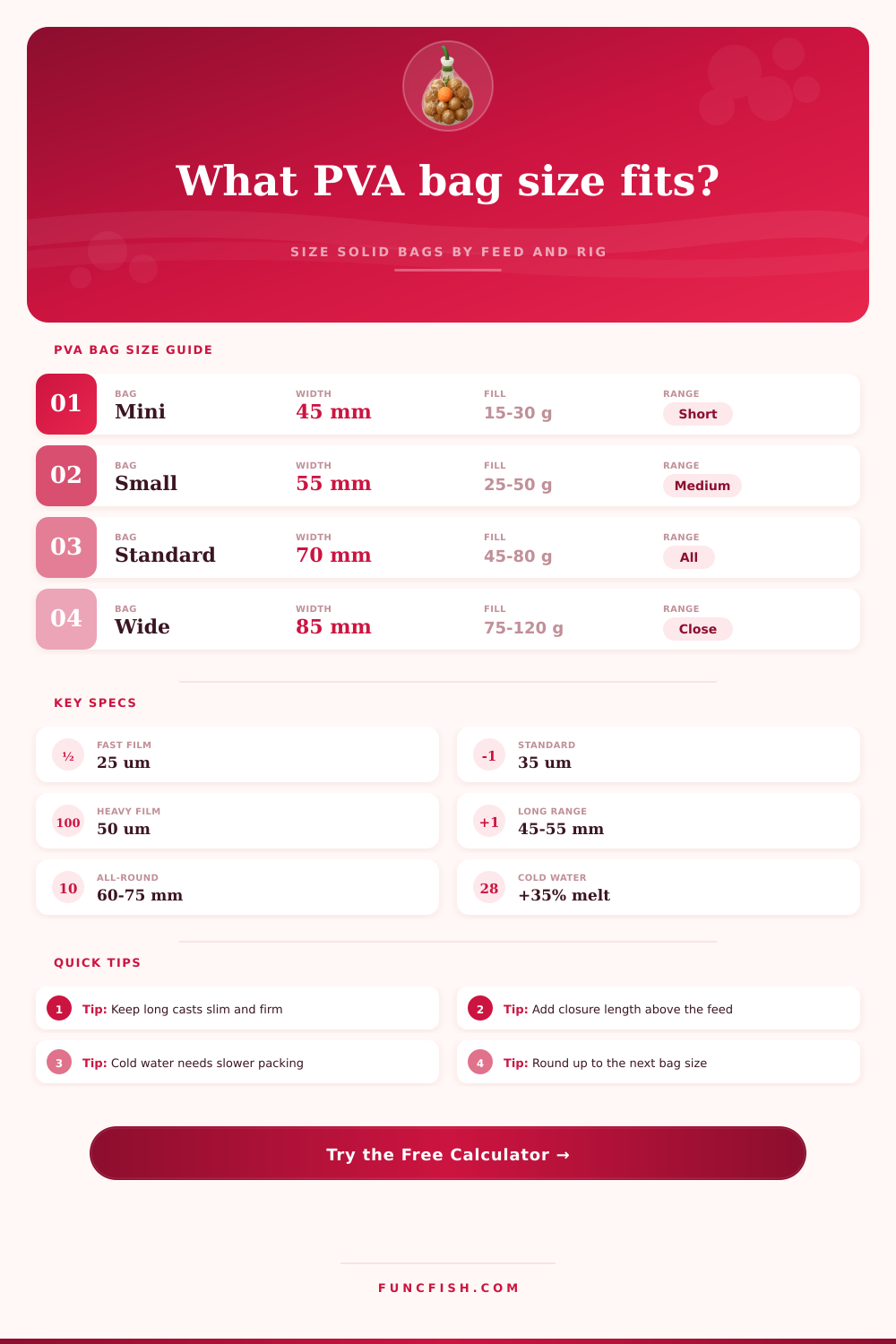
📋 Standard PVA bag sizing table
| Bag class | Flat width | Practical feed load | Best cast range | Typical use |
|---|---|---|---|---|
| Mini stick | 35-45 mm / 1.4-1.8 in | 12-30 g / 0.4-1.1 oz | Short to long | Single hookbait, crumb, low feed |
| Small solid | 50-60 mm / 2.0-2.4 in | 25-55 g / 0.9-1.9 oz | Medium | Compact carp bags and winter parcels |
| Standard solid | 65-75 mm / 2.6-3.0 in | 45-85 g / 1.6-3.0 oz | All-round | Lead and rig enclosed with pellet mix |
| Wide parcel | 80-90 mm / 3.1-3.5 in | 75-130 g / 2.6-4.6 oz | Close to medium | Margin work, big feed, catfish bags |
| River anchor | 75-90 mm / 3.0-3.5 in | 60-115 g / 2.1-4.1 oz | Short to medium | Heavy lead, firm profile, moving water |
🧪 Fill density reference table
| Feed mix | Bulk density | Volume for 50 g | Bag behavior | Size adjustment |
|---|---|---|---|---|
| Micro pellet blend | 0.58 g/ml | 86 ml / 2.9 fl oz | Flows and packs evenly | Use standard formula |
| Crushed boilie crumb | 0.52 g/ml | 96 ml / 3.2 fl oz | Angular pieces trap voids | Add slight closure margin |
| Oil-based stick mix | 0.46 g/ml | 109 ml / 3.7 fl oz | Light and compressible | Use longer bag than pellets |
| Drained hemp and maize | 0.66 g/ml | 76 ml / 2.6 fl oz | Dense but irregular | Round width up one size |
| Maggot and caster mix | 0.61 g/ml | 82 ml / 2.8 fl oz | Dense, moves as a mass | Keep bag short and firm |
🐟 Species and technique comparison grid
| Species | Common PVA approach | Feed load | Bag profile | Calculation note |
|---|---|---|---|---|
| Carp | Solid bag around lead and rig | 40-90 g / 1.4-3.2 oz | Small to standard | Count lead and hookbait displacement |
| Tench | Small method-style parcel | 25-60 g / 0.9-2.1 oz | Small or standard | Use a wider, flatter profile near weed |
| Bream | Crumb bag with small freebies | 30-70 g / 1.1-2.5 oz | Standard | Low-density crumb needs more volume |
| Barbel | PVA stick or river anchor bag | 20-60 g / 0.7-2.1 oz | Mini or river | Flow favors a dense, short parcel |
| Catfish | Large boilie or pellet parcel | 80-150 g / 2.8-5.3 oz | Wide parcel | Big baits may control minimum width |
| Roach or chub | Small crumb stick | 10-35 g / 0.4-1.2 oz | Mini stick | Keep melt time short and feed tight |
🌡 Water temperature and melt reference
| Water temperature | Fast 25 um film | Standard 35 um film | Heavy 50 um film | Calculator adjustment |
|---|---|---|---|---|
| 4 C / 39 F | 55-75 sec | 85-120 sec | 130-180 sec | Very cold factor, add about 90% |
| 8 C / 46 F | 45-60 sec | 70-95 sec | 110-145 sec | Cold factor, add about 50% |
| 14 C / 57 F | 30-45 sec | 50-70 sec | 75-105 sec | Normal all-round estimate |
| 20 C / 68 F | 22-35 sec | 38-55 sec | 60-80 sec | Warm factor, reduce about 20% |
| 24 C / 75 F | 18-30 sec | 30-45 sec | 48-70 sec | Fast melt factor, reduce about 35% |
💡 Calculation tips
All results are practical estimates for sizing bags and mesh parcels. Check the actual PVA product and water response before using a large feed load.
For me as a carp angler there’s nothing more frustating than dropping that PVA bag on the water and having it fail to dissolve. Now you’ve got an exposed rig, your feed is trapped in the plastic, and the fish walks all over it. Why? Because we do things traditionaly instead of paying attention to physics.
We pack what feels comfortable regardless of whether thickness of film or the water temperature alters results. You don’t just pack the sack to get it under your bait; you pack it so that it melts and looks fresh right when a fish swim through. By entering the rig details and feed weight, the calculator will do all the maths for you.
How to Use PVA Bags Better
No need to guess at how many grams of oilier groundbait or how many grams of micro pellets occupies the same amount of space. Scales tell us everything in weight terms. PVA bags is all about volume. Hemp grains that are packed tightly take up less room than a looser stick mix of the same weight. You’ll make a parcel that’s far too big to be cast accurately or one that won’t fit in your hand if you go purely based off weight in grams.
The tool transforms those weight figures into something usable. It takes account of volume occupied by your hookbait and lead so you have a comfortable-to-hold package ready to go. And here’s where that film size comes back into play.
The thinner the film, the quicker it melts. Seems like a good thing right? Except when you’re casting out seventy yards against a hard blow and it tear up from the strain. In warm summer water, a twenty-five micrometer film may be dissolved in mere seconds. On the other hand, heavier films like a fifty micrometer will not only withstand the journey but also resist abrasion along rocky bottoms. In cold winter weather they might requires minutes to break down. This leaves the fish plenty of time to get tired of waiting.
So again, it is a matter of weighing the factors of solubility and durability for certain circumstances different than applying a single size throughout the entire year. The one thing people forget about is water temp and how it can ruin presentation. Chemicals dissolves much slower in colder water. When we get down to below eight degrees Celsius, even regular sized thirty-five micrometer film will take longer then two minutes to completely dissolve. Now that’s an eternity in carp fishing.
As you can see from the table of references the melt time increases with the decrease in temperature. This is why it pays to use thinner film and not be as tight on your bag stuffers in winter. Packing your bag too tightly in cold water lead to air pockets that act as insulation around your feed. They don’t let the water through and they keep the bait encapsulated within the plastic. Packing more loosely allows water to hit the film faster and speed up the melt without ruining its structure.
Shape depends on cast distance as well. On long casts, you need something slender enough to slice through the wind cleanly. A fat wide bag functions almost like a parachute, reducing your delivery speed. And if it touches the water before opening up all the way, it will tear or break open mid-flight. You can get away with wider packages on short-range casts; they’ll fan out well on bottom and form a nice looking patch of food.
The farther you throw, the more the calculator fits its suggestions to a profile suited to your strength and ability to make accurate throws into your target area. Measuring the bait is only half the battle with successful PVA use. The other half is reading the water. You don’t want your package to look like someone just brought it back in a nice, shiny wrapper.
You should of wanted it to appear like it’s always been here. By adjusting things like film strength, density, and temperature, you go from hoping the bag melts to knowing when it opens. That leads to confidence which lets you concentrate on timing and presentation. This turns a frustrating variable into a precise presentation tool. You can now put the bait exactly where you want it.