Reel Inches Per Handle Turn Calculator
Estimate real line pickup per crank from gear ratio, usable spool diameter, fill level, line type, load, and retrieve cadence for fishing reels.
📌Scenario presets
⚙Reel pickup inputs
Reel pickup forecast
Formula breakdown
📊Reel platform data grid
Low-Profile Bass
Spinning 2500-3000
Surf Spinner
Conventional
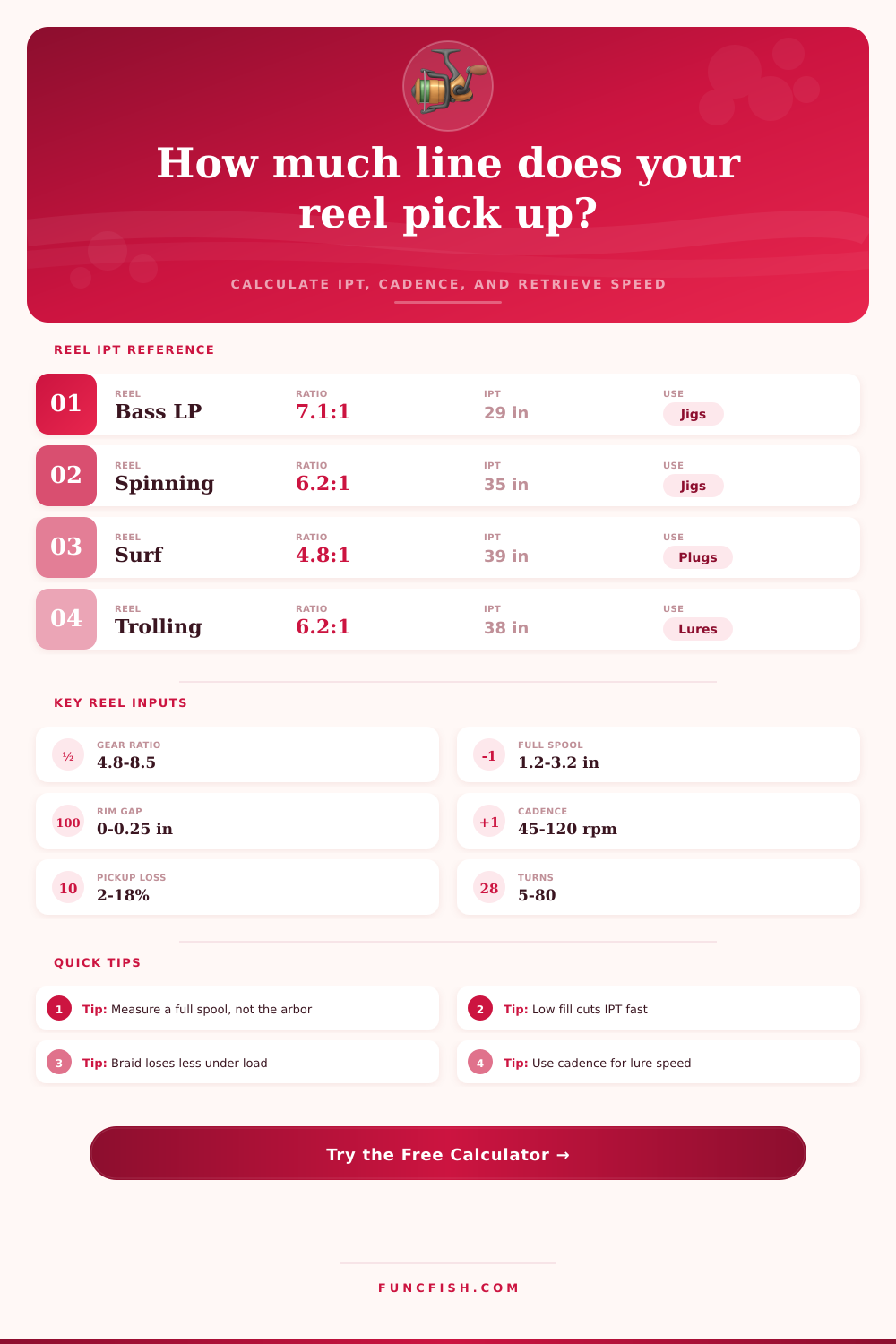
📐Typical IPT by reel and gear ratio
| Reel class | Typical ratio | Typical IPT | Metric pickup | Where it fits |
|---|---|---|---|---|
| Low-profile bass 6.3 | 6.2-6.4:1 | 24-28 in/turn | 61-71 cm/turn | Crankbaits, spinnerbaits, chatterbaits |
| Low-profile bass 7.1 | 7.0-7.3:1 | 28-32 in/turn | 71-81 cm/turn | Jigs, worms, swim jigs, general casting |
| Low-profile bass 8.1 | 8.0-8.5:1 | 32-37 in/turn | 81-94 cm/turn | Frogs, pitching, slack-line pickup |
| 2500 spinning reel | 5.2-6.2:1 | 28-35 in/turn | 71-89 cm/turn | Finesse bass, trout, walleye jigging |
| 4000-5000 spinning reel | 5.6-6.2:1 | 35-43 in/turn | 89-109 cm/turn | Inshore jigs, plugs, light surf |
| Surf long-cast reel | 4.8-5.8:1 | 37-49 in/turn | 94-124 cm/turn | Metal lips, tins, bucktails, distance work |
| Round musky reel | 5.1-6.3:1 | 27-38 in/turn | 69-97 cm/turn | Bucktails, rubber, large plugs |
| Conventional trolling | 4.0-6.2:1 | 22-40 in/turn | 56-102 cm/turn | Divers, leadcore, bottom recovery |
🧵Line diameter and load factors
| Line type | Typical diameter examples | Stretch/load behavior | Pickup factor used | Calculation note |
|---|---|---|---|---|
| Braid | 20 lb 0.009 in, 50 lb 0.014 in | Very low stretch, cuts water well | 0.985-0.998 | Closest to measured spool math |
| Monofilament | 10 lb 0.011 in, 20 lb 0.018 in | More stretch and thicker stack | 0.940-0.985 | Load can hide some line pickup |
| Fluorocarbon | 12 lb 0.012 in, 20 lb 0.016 in | Dense line, moderate stretch | 0.935-0.978 | Sinks and pulls harder on moving baits |
| Copolymer | 12 lb 0.012 in, 17 lb 0.015 in | Middle-ground stretch | 0.950-0.986 | Useful for reaction baits |
| Wire or leadcore | 27 lb leadcore, 30 lb wire | Heavy drag under water | 0.900-0.960 | Line angle and load matter a lot |
| Fly line backing stack | 20-30 lb backing plus fly line | Large diameter changes fast | 0.965-0.995 | Large arbor pickup drops as backing leaves |
🎯Gear and species comparison grid
| Species or use | Preferred pickup | Useful cadence | Gear style | Why it matters |
|---|---|---|---|---|
| Largemouth bass jigs | 28-34 in/turn | 55-85 rpm | 7:1 low-profile baitcaster | Fast enough to collect slack before hookset |
| Frog fishing | 32-37 in/turn | 60-95 rpm | 8:1 low-profile baitcaster | Quick pickup helps move fish from cover |
| Deep crankbait bass | 21-27 in/turn | 45-70 rpm | 5:1 or 6:1 casting reel | Lower pickup keeps torque and bait depth |
| Trout stream spinner | 22-30 in/turn | 50-85 rpm | 1000-2500 spinning reel | Moderate speed controls small inline spinners |
| Walleye vertical jig | 27-34 in/turn | 45-75 rpm | 2500 spinning reel | Recovers slack without over-moving the jig |
| Surf striped bass plugs | 36-46 in/turn | 45-75 rpm | 5000-8000 surf spinning reel | Long casts need fast line recovery |
| Musky bucktails | 30-42 in/turn | 70-110 rpm | Power round or large low-profile reel | Big blades need pickup plus torque |
| Catfish sinker recovery | 20-30 in/turn | 45-80 rpm | Levelwind round reel | Steady pickup beats high-speed fatigue |
📏Spool fill effect reference
| Line below lip | Diameter loss | Approx IPT loss | What anglers notice | Best check |
|---|---|---|---|---|
| Flush to 1/32 in | 0-0.06 in | 0-5% | Reel fishes near published IPT | Measure after line packs evenly |
| 1/16 in below lip | 0.12 in | 7-12% | Long casts feel slightly slower | Good normal working fill |
| 1/8 in below lip | 0.25 in | 14-22% | Slack pickup and lure speed drop | Consider adding backing or line |
| 3/16 in below lip | 0.38 in | 22-32% | Fast reels start feeling average | Re-spool before judging gear ratio |
| 1/4 in below lip | 0.50 in | 30-40% | Retrieve speed is clearly reduced | Refill for casting distance and IPT |
💡Practical IPT checks
Tip: Published IPT usually assumes a full spool. A baitcaster that is 1/8 inch below the lip can lose enough pickup to feel like a lower gear reel.
Tip: For lure speed, cadence matters as much as reel ratio. Two reels with different IPT can move a bait identically if handle rpm changes.
There you are on the water, rod in your hands holding a bass jig, reel set to a high gear ratio but feeling like something isn’t right. You wind the fire out of it, yet the bait can hardly crawl through the vegetation. Do you have a problem with how you’re fishing? Or is your equipment just misleading you?
The truth about line pickup, what really happens; is told in inches per turn (IPT) rather than what’s marketed as gear ratios which can hide it under shiny gloss. That realization; that a spool is a dynamic shrinking cylinder when you cast, rather than a static thing; separates anglers who purchase reel from those who actualy fish with them.
Why Gear Ratio Is Not The Only Thing That Matters
So how does it work? Because the faster you retrieve, the greater the circumference. Each wrap around the spool decrease its effective diameter. Consequently, every bit of line taken off the reel makes a difference. Depending on spool design and line thickness, sometimes as much as 20% or more is picked up with each revolution of a full reel compared to an empty one.
The calculator takes all this into account and allows you to input how full your reel is. This way, you aren’t depending on the manufacturer’s assumption that the reel is filled perfectly to the rim, which isn’t ever the case when you go fishing. You’ll rarely be winding from a fresh new spool all snug to the lip of the reel. Knowing exactly what your pickup will be allow you to get even better at setting your hook when the line is down deep in arbor.
A crucial part of how far you move that bait underwater depends on line type as well. Monofilament’s stretch absorbs energy. It takes much more retrieved line (about a foot), to get just six inches of forward movement when your crankbait are loaded up. Braid, however, doesn’t stretch at all, so what comes off the spool is pretty much exactly what moves the lure. So the tool uses its pickup to adjust for these load characteristics. It uses real pickup and factors in water resistance or drag to calculate a theoretical pickup. This is another small adjustment. It explains why many guys feel they upgraded to a higher gear ratio by switching to braid, even though they didn’t change reels. Line dynamics make the difference, more then gears.
What Cadence does is take those cold hard numbers and make them relate to actual speed. How many times it turns doesn’t matter nearly as much as how quickly and forcefully you crank it. So for example, a high-speed reel cranked slowly won’t move as much water as a low-speed reel cranked aggressively. That is what the RPM of your reel handle mean.
They’ve got a great table on the page that relates common reels to their respective “classes” based off average retrieve speeds. What it shows is that although a surf reel might have a huge spool size, it will actualy be able to outrun a compact bass caster if they’re both turned at a normal pace. I think most anglers focus too much on how many more inches of line they’ll get on a single turn without realizing that we all need to be able to keep up with the RPMs necessary to keep our baits in the strike zone.
All the gear in the world won’t help if you can’t keep up the RPMs needed to hold a bait in the strike zone. Some lures like deep-diving cranks require steady torque rather than frantic speed; others like frogs need lightning-fast slack pickup or the cover will eat the hookset. By matching the IPT profile of your reel to the behavior of the lure, you don’t lose aggression when facing an attack or overpower finesse presentations with too much power. It isn’t as much about following the biggest number on the spec sheet… It’s about making the tool fit the task.
If you understand how your body rhythm, line stretch, and spool diameter works together, you won’t have to guess if you are retrieving fast enough. Instead, it becomes a feeling; you start getting it and every cast becomes less of a hope-based guess and more of a predictable exchange. The entire process comes back around to this simple measure of line moving through your fingers, the sense of control… That makes the difference between a frustrating day on the water and a good one.
You should of known that earlier.