Reel Line Capacity by Fill Rate Calculator
Estimate how many yards or meters a reel will hold at a chosen fill percentage by comparing spool volume, published capacity, line diameter, backing volume, and material packing efficiency.
📌Fill-rate presets
⚙Spool, line, and fill settings
Measure the outer filled diameter at the spool lip or line guard.
Large-arbor reels hold less line than deep narrow spools of the same lip diameter.
Use the reel label capacity, normally stated for mono at a near-full factory fill.
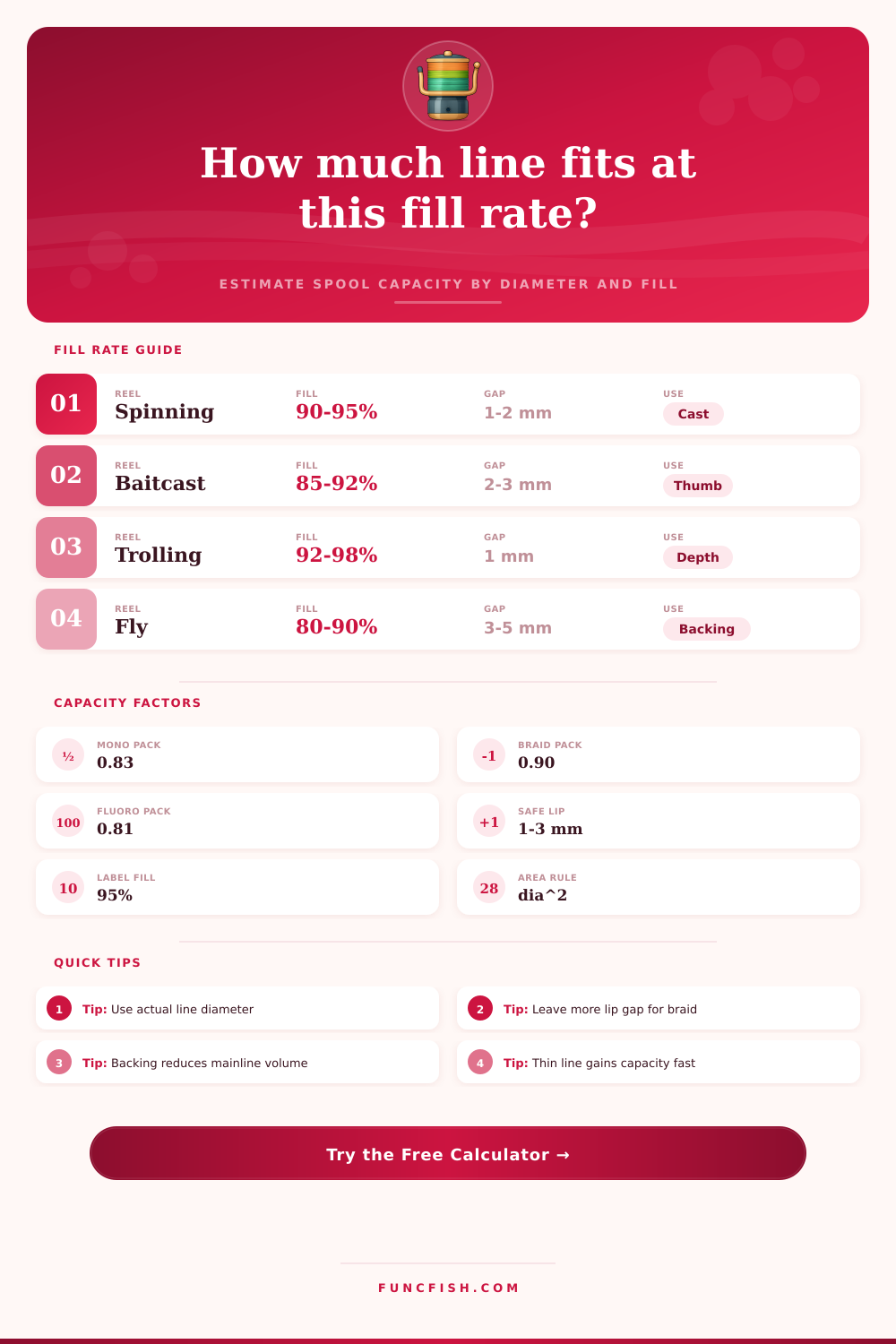
Capacity changes with diameter squared; small diameter changes matter a lot.
Reserve covers leader knots, trimming, line bedding, and minor spool measurement error.
Reel capacity estimate
Calculation breakdown
📊Line packing factors
Nylon Mono
Fluorocarbon
8-Carrier Braid
Dacron Backing
📏Reference tables
| Line type | Common rating | Typical diameter | Capacity effect vs .010 in mono |
|---|---|---|---|
| Monofilament | 6 lb / 2.7 kg | .009 in / 0.23 mm | About 123% of .010 in length |
| Monofilament | 10 lb / 4.5 kg | .011 in / 0.28 mm | About 83% of .010 in length |
| Fluorocarbon | 12 lb / 5.4 kg | .012 in / 0.30 mm | About 69% before stiffness loss |
| 8-carrier braid | 15 lb / 6.8 kg | .006 in / 0.15 mm | About 278% before packing gain |
| 8-carrier braid | 30 lb / 13.6 kg | .011 in / 0.28 mm | About 83% with tighter packing |
| Dacron backing | 20 lb / 9.1 kg | .018 in / 0.46 mm | About 31% because backing is bulky |
| Reel style | Usual fill rate | Practical lip gap | Capacity note |
|---|---|---|---|
| Spinning reel, mono | 90-95% | 1/16 in / 1.5 mm | Overfilling can shed coils |
| Spinning reel, braid | 88-93% | 1/16-1/8 in / 2-3 mm | Extra gap helps wind knots |
| Low-profile baitcaster | 85-92% | 1/8 in / 3 mm | Lower fill improves startup control |
| Line-counter trolling reel | 92-98% | 1/32-1/16 in / 1-2 mm | Fill level affects counter accuracy |
| Conventional offshore | 90-97% | 1/16 in / 1.5 mm | Reserve room for level lay and knots |
| Large-arbor fly reel | 80-90% | 1/8-3/16 in / 3-5 mm | Needs clearance for fly line coils |
| Target use | Common reel | Main line range | Useful capacity target |
|---|---|---|---|
| Trout streams | 1000-2500 spinning | 2-6 lb mono or 6-10 lb braid | 70-120 yd / 64-110 m |
| Bass spinning | 2500-3000 spinning | 10-20 lb braid | 100-160 yd / 91-146 m |
| Bass baitcaster | 100-150 low profile | 12-17 lb mono or fluoro | 80-120 yd / 73-110 m |
| Surf casting | 5000-8000 spinning | 20-40 lb braid | 200-350 yd / 183-320 m |
| Catfish bottom rigs | Round caster | 20-40 lb mono or 50-65 lb braid | 120-250 yd / 110-229 m |
| Offshore trolling | 20-50 size conventional | 50-80 lb braid backing | 300-700 yd / 274-640 m |
| Fill rate change | Volume impact | Why it matters | Example on 150 yd reel |
|---|---|---|---|
| 100% to 95% | About 5% less volume | Small lip gap for casting safety | 150 yd becomes about 143 yd |
| 95% to 90% | About 5.3% less volume | Common braid or baitcaster margin | 150 yd becomes about 135 yd |
| 90% to 85% | About 5.6% less volume | More control, less maximum distance | 150 yd becomes about 128 yd |
| 20% backing volume | Main line volume drops 20% | Reduces main line needed | 150 yd main space becomes 120 yd |
| .010 to .008 in line | About 56% more length | Diameter squared controls capacity | 150 yd becomes about 234 yd |
| .010 to .012 in line | About 31% less length | Thicker line fills faster | 150 yd becomes about 104 yd |
🎣Gear and species comparison grid
| Species or technique | Reel type | Line and fill target | Backing guidance |
|---|---|---|---|
| Panfish and brook trout | Ultralight spinning | 2-4 lb mono at 90-94% | Usually none; small spools fill quickly |
| Bass finesse | 2500 spinning | 10-15 lb braid at 90-93% | 10-25% mono backing prevents slip |
| Walleye jigging | 2500-3000 spinning | 8-12 lb braid or fluoro at 90-94% | Use backing to keep braid top shot fresh |
| Redfish and snook | 3000-4000 spinning | 15-30 lb braid at 90-94% | 15-30% backing balances capacity |
| Surf stripers | 5000-8000 spinning | 20-40 lb braid at 88-93% | Minimal backing if long runs are possible |
| Catfish | Round baitcaster | 20-40 lb mono at 88-94% | Backing rarely needed with mono |
| Trolling salmon | Line-counter reel | 20-30 lb mono at 95-98% | Keep fill consistent for counter accuracy |
| Offshore tuna | Conventional reel | 50-80 lb braid at 92-97% | Use measured top shot over braid backing |
💡Capacity tips
Measure diameter, not only pound test. Reel labels compare capacity by line diameter. Two lines with the same breaking strength can differ enough to change capacity by several dozen yards on deep spools.
Treat fill rate as usable volume. A 90% fill is not just cosmetic; it removes real spool volume before line diameter is applied, then backing and trim reserve reduce the main line amount again.
You get out of line and when you drop your hook in deep water, the drag screams and then you feel the tug. It’s not some unlucky fluke, chances are you failed to do the math on the dock.
When most people looks at the spool of their reels and see the printed line capacity, they think it relates to their own configuration. The truth is, the actual amount that can fit on a spool depends on a math formula involving line diameter, material packing and how tightly you cinch down the spool, which all change each time you change line.
How to Measure Fishing Line for Your Reel
So why does it matter? Since line are flexible and a spool is a fixed cylinder, space becomes the key variable. Eight tightly packed carriers of braid form a nearly solid mass, whereas air sits between nylon monofilament coils. Stiff fluorocarbon is more like storing springs than rope.
So how do we account for that when we wind a reel full? Enter the Spool Size Calculator (above), which eliminates all the guesses at conversions and coefficients for you. Simply input your line type and spool dimensions, and it will do the math for you. You enter the arbor size and lip diameter, and the calc calculates amount of annular space volume available.
This means it accounts for actual diameter of your fluoro or braid vs the published mono capacity. Next it deducts the space needed for any backing and then leaves enough space for leader knots. That’s why the answer isn’t some unrealistic max, but rather a reasonable yardage count.
Most capacity estimates fail at backings, as mono or dacron is frequently used below the braid. You don’t get the volume your main line can take up, and even if 20 percent backing seems trivial, that’s dozens of yards wasted on a big spool before you’re ever starting to wind in the braided line. This tool allows you to set the backing diameter and share it, and it will calculate how much space is left for what’s touching the water.
A baitcaster works better with some air between the lip and the spool to allow for thumb control while a trolling reel may need to be nearly filled up in order to maintain an accurate line counter. Use the fill percent to set a target based off your preference so you don’t go too far one way or the other.
The other thing about capacity is that manufacturers don’t rate reels for pound test but instead rate them for capacity based upon line diameter. So just because they say they hold 10-pound test doesn’t mean two different lines of that strength will hold the same amount of yardage. It could be thicker or thinner. Thinner line has more yardage, but it’s not a direct relationship. Capacity is the square of the diameter, so a tiny decrease in line thickness results in a large increase in length.
So if you go from a point zero one two inch mono to a point zero zero six braid, you’re talking almost triple the capacity here. On the page where I’ve laid it all out in a simple chart, you can see what I’m talking about. It’s a lot less yarn in a spool when you start with monofilament versus a braided spool of the same pound test, because they are literally different physical sizes.
But it’s also good to keep in mind that filling out a spinning reel to 100% full of braid is asking for trouble, both backlash and wind knots. So most folks will leave some margin (a millimeter or two) under the lip. This is an optional entry on the calculator where you specify how far below the lip the reel should be filled. There’s also an option to select the reel type: casting or spinning. Presets adjust the volume calculation.
This allows for maximum safe fill on a trolling reel and max fill for a bass fishing cast. When you’re planning a surf trip and want to know whether you’ve got enough line for a forty yard run plus the leader, it makes a difference. It also matters that every time you tie on a knot, trim off old line, or bed new line down onto the spool, you lose yards. But this tool allows you to input a working reserve to ensure you don’t subtract those yards from your available capacity.
At the end of the day though, understanding your actual ability takes the unknown out of the equation in times when you need it most and makes panic unnecessary. Now you have the confidence to know just how much water you can keep up with before the line is gone. That knowledge allows for concentrating on the fight instead of monitoring the spool getting lighter and lighter.
Set your fill, measure your lip, check your diameter and let the math handle the rest. Your next big one should of been met by guesswork.