Fishing Reel Spool Fill Percentage Calculator
Estimate spool fill from reel geometry, line diameter, backing, and target rim clearance so your reel is neither short-filled nor overpacked.
📌Scenario presets
⚙Spool and line settings
Spool fill forecast
Calculation breakdown
🧵Line material packing data
Mono
Fluoro
8X Braid
Dacron
📊Fill target reference table
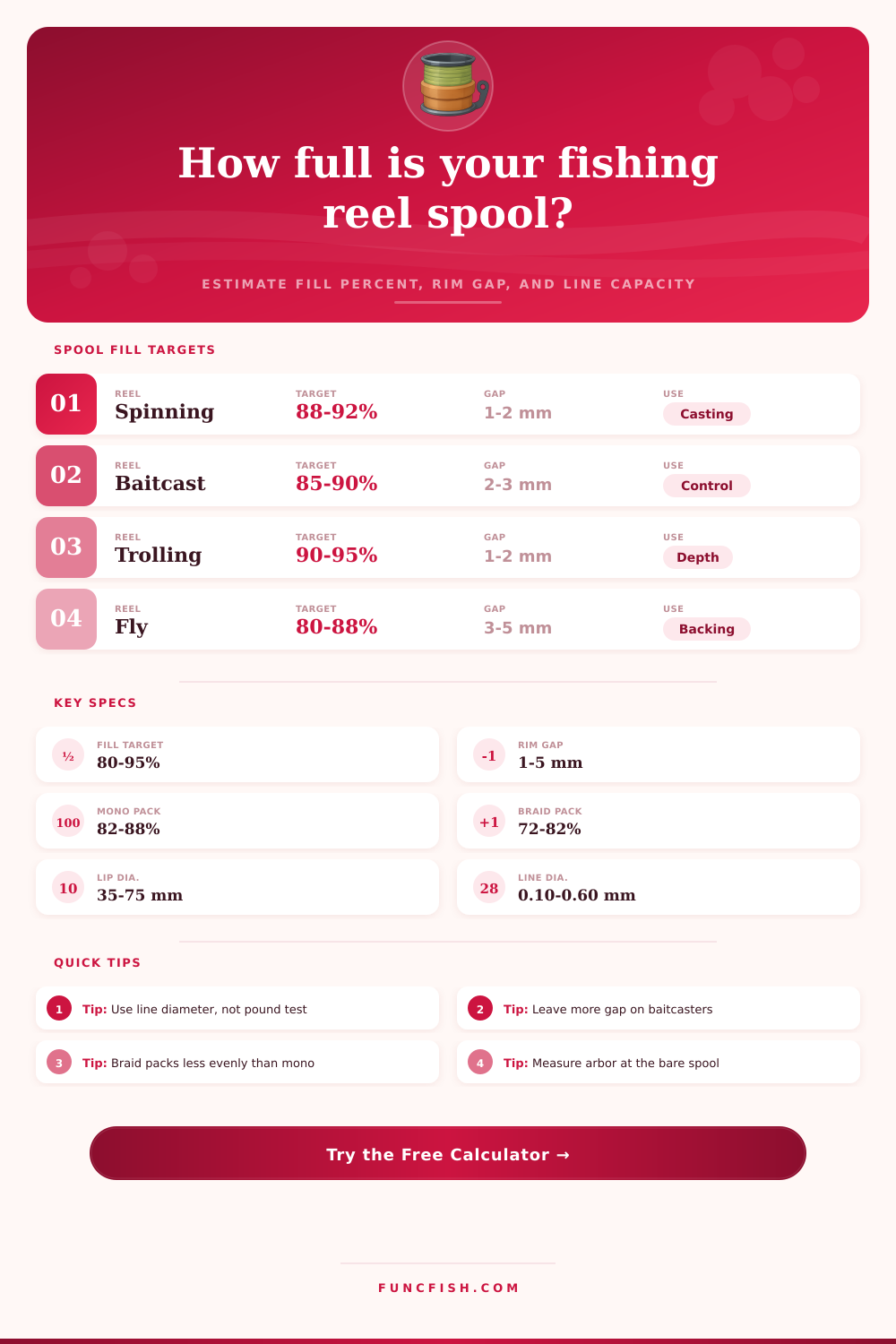
| Reel type | Common target fill | Typical rim gap | Why it matters |
|---|---|---|---|
| Spinning reel | 88-92 percent | 1-2 mm below lip | High enough for casting distance, low enough to reduce loops. |
| Baitcasting reel | 85-90 percent | 2-3 mm below rim | Slight underfill improves spool control and braking behavior. |
| Conventional reel | 88-93 percent | 1.5-3 mm below rim | Balances retrieve rate, drag startup, and thumb control. |
| Trolling reel | 90-95 percent | 1-2 mm below rim | Fuller spool preserves line counter accuracy and retrieve rate. |
| Fly reel | 80-88 percent | 3-5 mm below frame | Extra clearance leaves room for fly line diameter and uneven backing. |
| Centerpin reel | 88-92 percent | 1.5-3 mm below rim | Even fill helps free spool startup without rim rub. |
🎣Species and technique spool notes
| Scenario | Line diameter range | Fill target | Spool priority |
|---|---|---|---|
| Bass spinning braid | 0.13-0.20 mm | 89-92 percent | Distance with controlled loops. |
| Trout stream mono | 0.14-0.22 mm | 86-90 percent | Light line memory control. |
| Surf casting shock leader | 0.22-0.35 mm main | 90-94 percent | Long cast diameter and clean release. |
| Catfish bottom braid | 0.28-0.45 mm | 85-90 percent | Room for knots and heavy tension. |
| Walleye jigging fluoro | 0.20-0.30 mm | 86-90 percent | Manage stiffness and cold-weather coils. |
| Offshore trolling mono | 0.45-0.70 mm | 92-95 percent | Line counter and retrieve consistency. |
📏Geometry formulas used
| Step | Formula | Input needed | Output |
|---|---|---|---|
| Usable volume | pi x width x (lip radius squared - arbor radius squared) | Lip, arbor, width | Total line space |
| Line volume | line area x length / packing factor | Diameter, length, material | Space consumed |
| Fill percent | used volume / usable volume x 100 | Loaded line and backing | Current fill |
| Rim gap | lip radius - current line radius | Fill radius | Clearance at lip |
| Target capacity | remaining target volume / main line volume per length | Target fill, backing | Main line length |
ℹPractical calculator notes
Measure diameter carefully. Spool lip diameter, arbor diameter, and usable width drive the volume estimate. Small caliper errors can move the fill estimate several percent on shallow spools.
Line packing is real. Braid, wire, and loosely wound mono leave air space between wraps. The calculator adjusts capacity with material and tension factors instead of assuming a solid cylinder.
Spool capacity and line filling is important topics to learn about fishing reel maintenance because incorrect line filling can cause casting problem. If you fill a spool with too much line, it can cause the fishing line to catch on the lip of the spool. If you fill a spool with too little line, it can cause the line to not come off of the spool smooth.
To avoid these problems, you have to understand how each component of the spool can impact the amount of line that can sit on that spool. The geometry of the spool will impact the capacity of the spool. The spool will have a specific lip diameter, arbor diameter, and the width of the flanges of the spool.
How to Fill a Fishing Reel Spool
These measurement will determine the volume of the spool. The volume of the spool is the amount of space that the line will occupy on the spool. The line will occupy the space between the arbor of the spool and the outer rim of the spool.
You must measure the arbor on the bare spool, without any backing that may be placed on the spool. If the arbor increase in diameter due to the addition of backing, the volume of the spool that is available to the main fishing line will decrease. The material of the line will impact the way in which the line occupies the volume of the spool.
Monofilament lines is round in shape, and will lay evenly on the spool. Braided lines are flat in shape in comparison to monofilament lines, and will leave air gap between the braided line wraps. Fluorocarbon lines are stiffer than monofilament lines, and often will create even layer of line on the spool only if the line is weighted proper during winding onto the spool.
Therefore, because different line material have different shapes, they will occupy the space on the spool different than one another. The material that is placed on the spool before the main fishing line is added is referred to as the backing for the spool. This backing will increase the diameter of the arbor of the spool.
Because the diameter of the arbor will increase, the amount of main fishing line that can be placed on the spool will decrease. Despite these disadvantage for using backing on the spool, the backing can help to protect the expensive braid from being damaged, and it can prevent the formation of knots in the braid. Therefore, individuals has to weigh the benefits of using backing against the cost to the main line capacity.
As a result, individuals can calculate the volume of the backing to compare with the main line volume. Each type of reel will have a target line fill percentage. For spinning reels, the line should be filled in such a way that the line sits a little below the lip of the spinning reel.
If the line is filled below the lip, it will come off the spool smoothly without catching on the lip. For baitcasting reels, the line should be filled to leave a slightly larger gap from the lip of the spool. This gap allow the brakes on the reel to manage the speed of the spool.
For trolling reels, the line can be filled to the spool, as trolling line remain under constant tension and stays consistent in the water. Each type of reel require a different line fill percentage to function efficient. A spool capacity calculator will output specific information regarding line management for the fisherman.
The calculator will indicate the percentage of the spool that is to be filled with line. Additionally, you can determine the amount of gap between the line and the lip of the spool. Furthermore, the calculator can indicate the adjustment of the line capacity on the spool.
Each of these outputs will allow the fisherman to decide if he needs to purchase additional backing for the reels, or if he needs to strip some of the main line from the spool. Environmental factor can play a role in how the fishing line sits on the spool. Factors such as temperature and water will impact the memory of the line.
Water can cause monofilament lines to swell. Additionally, the tension with which the line is wound onto the spool will play a role in the lay of the line on the spool. Each of these factors will change the diameter of the line, so the line should be checked frequent.
In order to maintain the reel properly, there are a few steps that can be followed. First, you should measure the spool. Second, it is important to ensure the material of the line is consistent.
Third, line load can be calculated to determine if any adjustment is needed to the line load for the reel. By following these steps, line will be ensured to leave the spool without hesitation.