Roach Weight Calculator
Estimate common roach weight from length, girth, body depth, river, lake, canal, or drain habitat, water productivity, body condition, seasonal feeding index, confidence, and unit system.
📌Named roach presets
⚙Roach measurements and water factors
Model: common roach are deep-bodied coarse fish, so this estimator starts with a cyprinid length x girth squared relationship, then corrects for body depth, habitat, productivity, condition, season, and measurement confidence.
Roach weight estimate
The estimate will appear after calculation.
Full calculation breakdown
📊Roach shape factor cards
Small Silver Roach
Adult Average Roach
Pound-Class Roach
Specimen Roach
🔀Roach and coarse-fish comparison grid
Common Roach
Deep silver body, moderate girth, and a compact shoulder for its length.
Rudd
Often deeper through the flank with a higher back and rounded belly.
Dace
Slim, fast-water shape means equal length usually weighs less than roach.
Chub
Longer, rounder cylinder shape with heavier shoulders at larger sizes.
Bream
Much taller slab body; depth carries more weight than roach length alone.
📘Roach reference tables
| Roach class | Typical length | Typical girth | Body depth cue | Expected weight |
|---|---|---|---|---|
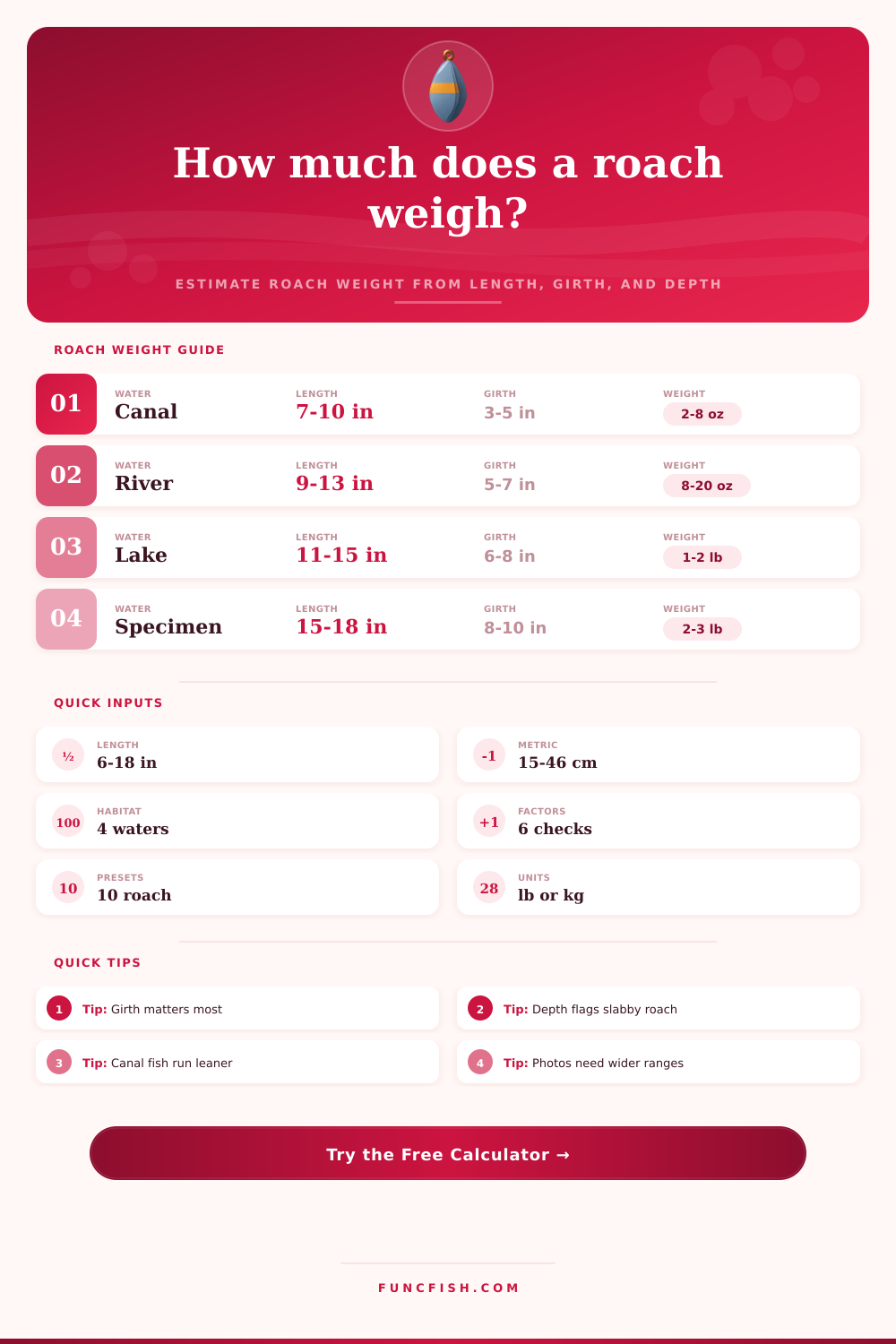
| Small silver roach | 6-9 in / 15-23 cm | 3-4.5 in / 8-11 cm | Flat to modest | 1.5-6 oz / 40-170 g |
| Adult average roach | 9-12 in / 23-30 cm | 4.5-6.2 in / 11-16 cm | Even shoulder | 6-14 oz / 170-400 g |
| Pound-class roach | 12-15 in / 30-38 cm | 6-8 in / 15-20 cm | Deep flank | 1-2 lb / 0.45-0.91 kg |
| Specimen roach | 15-18 in / 38-46 cm | 8-10 in / 20-25 cm | Slabby frame | 2-3 lb / 0.91-1.36 kg |
| Habitat | Shape tendency | Productivity cue | Estimator adjustment | Range effect |
|---|---|---|---|---|
| Clear canal or cut | Slim, silver, shoal fish | Often modest food | Small lean correction | Moderate band |
| Steady lowland river | Balanced shoulder and belly | Natural drift and weed | Neutral baseline | Standard band |
| Weedy lake margin | Deep flank, good belly | Snails, weed, larvae | Fullness correction | Slightly tighter |
| Deep stillwater or pit | Slow-grown but heavy frame | Variable open water food | Depth-sensitive correction | Wider band |
| Drain or tidal channel | Seasonal, sometimes lean | Pulsed food supply | Flow and salinity caution | Wider band |
| Rich estate pond | Thickset, rounded belly | Very high natural food | Heavy condition correction | Moderate band |
| Season index | Feeding state | Likely roach look | Multiplier cue | Use when |
|---|---|---|---|---|
| Winter shoal, compact and full | Slow but dense feeding | Rounded belly, firm flank | Small lift | Cold stillwaters and deep glides |
| Spring lean or pre-recovery | Food rising, body rebuilding | Cleaner flank, lighter belly | Small trim | Early spring observations |
| Post-spawn light frame | Recovery period | Thin belly, softer frame | Largest trim | After spawning signs |
| Summer even feeding | Stable daily feeding | Balanced shape | Neutral | Typical warm-season captures |
| Autumn peak feeding | High intake before winter | Deep flank and full belly | Largest lift | Late-season heavy fish |
| Confidence level | Input quality | Default band | Best use | Watch point |
|---|---|---|---|---|
| Measured length, girth, and depth | All three dimensions taped | About 8-11% | Careful unhooking mat estimate | Do not compress girth tape |
| Measured length and girth only | Depth inferred from size class | About 11-15% | Most quick coarse fish checks | Deep slab fish may be under-read |
| Length measured, body estimated | Photo or memory for shape | About 18-24% | Logbook reconstruction | Perspective can distort girth |
| Photo estimate only | No reliable tape data | About 28-36% | Rough comparison only | Hands and lens angle mislead |
Reference values are practical coarse-fish estimate ranges for common roach shape. Use actual scales when a precise record, match total, or scientific measurement is needed.
💡Roach measurement tips
For roach, a half-inch of girth can change the estimate more than an extra inch of length. Measure the widest shoulder-belly point whenever possible.
A deep winter or stillwater roach may look shorter than its weight suggests. Body depth helps separate true specimen thickness from simple camera perspective.
Roach fishing require that you understand how much a roach weigh. A roach of a certain length can weigh quite differently than another roach of the same length. For instance, a roach can be 12 inch in length and weigh only 0.5 pound, but another roach of the same length can weigh 1.5 pounds.
The weight of a roach can vary depending on the food supply in the water, the strength of the water current, and the time of year that the roach is caught. In order to determine the weight of a roach, it is necessary to measure the dimension of the roach. The length of the roach is one measurement of the fish, but the length dont necessarily indicate the weight of the roach.
How to Measure a Roach to Find Its Weight
Additionally, you must also measure measurements of the girth of the roach at the shoulder of the fish, as well as the depth of the body of the roach through the side of the fish. Each of these measurements can help to indicate the weight of the fish. For instance, the girth of the shoulder and the body depth through the flank can help to determine how much food the roach has eaten during it lifetime.
The girth and body depth can also change depending upon whether the roach live in a canal or a lake. The online calculator of the weight of a roach takes each of these measurements of the roach and calculates the weight of the fish by employing a formula that account for the water type in which the roach lives, the productivity of the water where the roach lives, the condition of the roach, and the time of year in which the roach is caught. The measurements of a roach can correspond to different weights depending upon where and when the roach is caught, and the calculator makes these adjustments to the formula.
The habitat of the roach can impact the weight of the roach. For instance, a roach that lives in a lowland river often has access to more food than a roach that lives in a mountain stream, and the abundance of food in a lowland river ensures that the roach has a balanced shoulder and belly. Additionally, an estate pond may have an abundance of food for the roach, which allow the roach to develop a thick body.
The productivity level of the water accounts for these difference in habitats and the food availability within those habitats. For example, if the productivity level is set to high, the calculator will account for the fact that the roach has eaten more food and will return a higher calculated weight for the roach. Additionally, if the productivity level is set to low for a canal that may have limited food availability for roach, the calculated weight of the roach will reflect this lower level of food availability for the roach.
The condition of the roach in relation to it’s habitat and the time of year that the fish is caught will impact its weight. For instance, a roach may appear to weigh more when it is winter months than in the summer months when the fish may have stored more food before the winter months. Additionally, a roach that has just spawned its eggs may weigh less than a roach that did not spawn its eggs, as it has lost some of its weight in the process of spawning its eggs, even though its skeleton may still be of the same size as a roach that did not spawn.
The calculator can account for the time of year that the roach is caught in the form of a season index. Because a roach can have different weight during the year due to the time of year that the fish is caught, the calculator provides a range of possible weights rather than a specific weight for a roach. Body depth is one of the measurements of a roach that is important for calculating the weight of that fish.
A roach that has a deep flank will tend to be heavier than a roach that has a more slender flank of less depth, but that same roach will have the same length as other roach of the same length. The calculator accounts for the body depth when the user enters the depth of the body of the roach through the side of the fish. If the user does not enter the body depth of the roach, the calculator will still calculate the weight of the roach for the user.
However, the calculator will provide a wider range of possible weights for that roach. The reason for this wider range of possible weights is that the calculator is guessing at the body depth of the roach. The reference table for the weight of roach include tables that list the typical length of the roach, its typical girth, and the weight of roach of those lengths and girth.
The user does not have to memorize these tables, but it is important to be aware of whether or not the roach that is being measured is within the typical ranges. If the roach is outside of the typical range in terms of its weight, then it may be of a different condition or a different shape than typical roach of similar lengths and girth. The calculator will display such differences once the user enters the length, girth, and body depth measurements of the roach.
The factor of the confidence in the measurements of the roach is another factor that must be considered. Not everyone has a tape measure when they are fishing for roach. Furthermore, it is more reliable to measure the length and girth of the roach while it is on an unhooking mat than it is to attempt to take a photograph of the roach.
The calculator for the weight of a roach provides for the possibility of less certainty in the measurements of the roach; the calculator widens the range of weights that may be provided for a roach if the length, girth, and body depth of the roach are not enter with certainty. Using these number will allow a fisherman to turn a feeling about the weight of the roach that they caught into a recorded number. Furthermore, the recorded number of the weight of the roach will allow a fisherman to compare the weight of that roach to other sessions that they fished.
Over time, fishermen will be able to recognize which waters produce deeper roach than others, as well as to recognize the effect that the season can have upon the weight of the roach that are caught during those seasons. These measurements can be used to compare the weight of a roach to other species of fish. For instance, a rudd of the same length as a roach will have a deeper flank than the roach.
Additionally, a dace of the same length as a roach will have a more slender body than the roach. While the calculator is made for roach only, the ratio of the depth of the body of the roach to the length of the roach may help the user to recognize the differences between the various species of fish. Additionally, should a user employ this calculator a significant number of times, they will begin to consider the weed growth in the area in which they are fishing for roach, as well as the speed of the water current in those areas.
The fisherman will be able to use these factors to determine the likelihood that a roach will be lean or full of fish flesh.