🐟 Rock Bass Weight Calculator
Estimate rock bass weight from length and girth using proven fish weight formulas
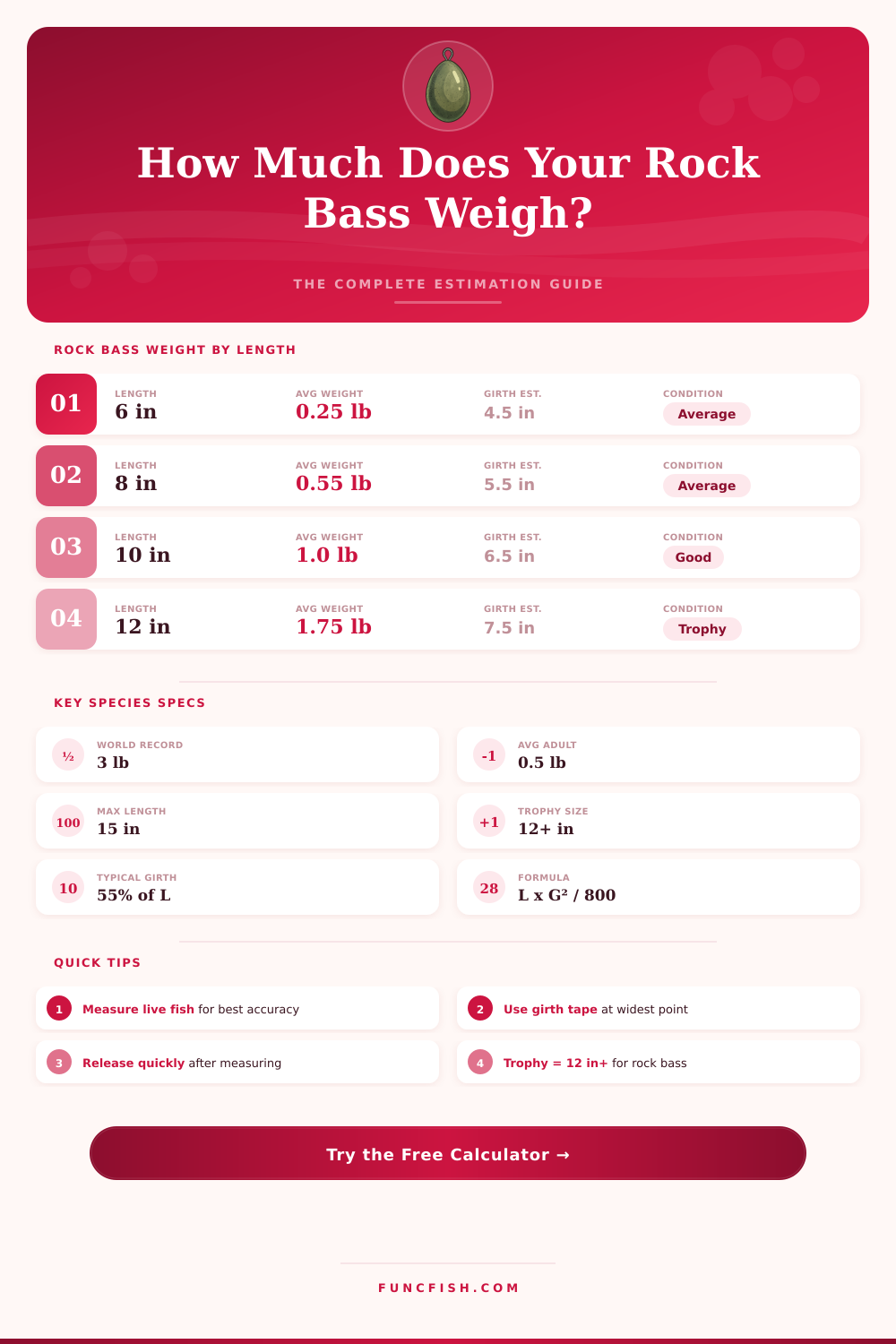
| Length (in) | Length (cm) | Est. Girth (in) | Weight (lb) | Weight (kg) | Classification |
|---|---|---|---|---|---|
| 5 | 12.7 | 3.5 | 0.08 | 0.04 | Juvenile |
| 6 | 15.2 | 4.5 | 0.15 | 0.07 | Sub-adult |
| 7 | 17.8 | 5.0 | 0.22 | 0.10 | Sub-adult |
| 8 | 20.3 | 5.5 | 0.37 | 0.17 | Adult |
| 9 | 22.9 | 6.0 | 0.61 | 0.28 | Adult |
| 10 | 25.4 | 6.5 | 0.84 | 0.38 | Adult |
| 11 | 27.9 | 7.0 | 1.34 | 0.61 | Large Adult |
| 12 | 30.5 | 7.5 | 1.69 | 0.77 | Trophy |
| 13 | 33.0 | 8.0 | 2.25 | 1.02 | Trophy |
| 14 | 35.6 | 8.5 | 2.80 | 1.27 | Trophy+ |
| Habitat Type | Condition Factor | Typical Size | Notes |
|---|---|---|---|
| Clear Lake | 1.05–1.15 | 8–12 in | High forage, good growth |
| River / Current | 0.95–1.05 | 7–11 in | Leaner, active body type |
| Rocky Reservoir | 1.05–1.20 | 9–13 in | Excellent forage, top size |
| Small Stream | 0.85–0.95 | 5–9 in | Slower growth, thinner body |
| Pond | 0.90–1.05 | 6–10 in | Varies with forage base |
| Great Lakes | 1.10–1.25 | 10–14 in | Large forage, premium size |
| Species | Avg Weight | Typical Length | Formula Divisor |
|---|---|---|---|
| Rock Bass | 0.5–1.0 lb | 6–12 in | 800 |
| Bluegill | 0.25–0.75 lb | 5–10 in | 1200 |
| Yellow Perch | 0.25–0.75 lb | 6–11 in | 1050 |
| Crappie | 0.5–1.5 lb | 8–14 in | 900 |
| Pumpkinseed | 0.2–0.5 lb | 5–9 in | 1200 |
| Green Sunfish | 0.25–0.5 lb | 5–9 in | 1100 |
| Warmouth | 0.3–0.75 lb | 6–10 in | 1000 |
| Formula | Equation | Best For | Accuracy |
|---|---|---|---|
| Standard | L x G² / 800 | General use, most species | ±10% |
| Length-Only | L³ / 1200 | No girth measurement available | ±15–20% |
| Modified Anderson | L x G² / 750 | Heavier-bodied fish | ±10% |
| Wege-Anderson | L² x G / 900 | Research-grade estimation | ±8% |
Rock bass can be measured by two different method to determine the weight of the bass. Measuring the rock bass is important in that measuring the length of the bass alone will not provide an accuracy weight for the rock bass. For example, a rock bass may have a long body but a thin body, or a rock bass may have a long body and a thick body which would weigh more then a rock bass with a long body but a thin body.
To measure the length of the bass, one must measure from the nose of the bass to the tip of the tail. One can measure the girth of the rock bass at the deepest point of the body of the rock bass, and the girth is usually located right behind the pectoral fins of the fish. Measuring the girth of the bass is necessary to indicate how much fat or egg are within the body of the fish.
How to Measure Rock Bass Weight
The type of water in which the rock bass lives can change the body shape of the rock bass. For example, rock bass that live in rivers may have less body mass than rock bass that live in ponds. Rock bass that live in rivers has an athletic body due to the current of the river requiring the rock bass to be continual in movement.
Rock bass that live in ponds have more body mass because they dont have to have as much muscle to swim against the current. Additionally, the season in which the rock bass live can change the body composition of the rock bass. For example, rock bass may have less body mass during the ice out season of the lake in which they live, but have more body mass during the prespawn season when the female rock bass is carrying eggs.
One can use a weight estimation tool to calculate the weight of the rock bass if the length, girth, season, and lake class are entered into the tool. The lake class of the water where the rock bass live can help to provide a more realistic estimate of the weight of the rock bass. If a bump board is used to measure the length of the rock bass, the measurements will be more accurate than if a person use a tape measure or photo of the rock bass in measuring the length of the bass.
Because the measurements will be less accurate, the confidence band for the weight of the rock bass will be wider. A wide confidence band indicates the weight is less certain to be accurate compared to a narrower confidence band. Common mistakes include only using the length of the rock bass as a method of calculating the weight of the fish.
Using only the length of the rock bass will result in an inaccurate weight. Another common mistake is to ignore the profile of the rock bass. The profile of the rock bass may be different if the rock bass is a female with eggs or a juvenile rock bass.
Additionally, using photos to measure the size of the rock bass may result in inaccuracies because the photo may make the rock bass look larger then it actualy is due to the angle of the picture of the bass. Certain size benchmarks can be used to determine the age of the rock bass. For example, a rock bass that is seven inches in length is typically a young rock bass with less body mass.
A rock bass that is eleven inches in length is likely to be an adult rock bass. A rock bass that is thirteen inches in length is considered to be a trophy rock bass, and because trophy rock bass are rare, you must measure the girth of the rock bass careful to determine the weight of the fish. Finally, being able to accurately measure the rock bass will assist in determining whether to keep or release the rock bass from it’s home in the lake.