Rockfish Weight Calculator
Estimate whole rockfish weight from species group, length, girth, body depth, nearshore or deep reef habitat, condition, maturity, and measurement confidence.
🎯Named rockfish presets
📏Rockfish measurements
Use total length, widest girth, and vertical body depth. If girth or depth is estimated from a photo, choose a lower confidence setting so the range widens.
Rockfish weight estimate
Enter measurements and calculate to estimate rockfish weight.
Calculation breakdown
📊Rockfish profile cards
Black rockfish
Vermilion rockfish
Yelloweye rockfish
Bocaccio rockfish
🐟Rockfish and groundfish comparison grid
Rockfish
Deep-bodied reef fish with weight strongly tied to belly girth and shoulder depth.
Lingcod
Longer frame, larger head, and lower girth ratio than many rockfish at the same length.
Cabezon
Heavy head and blunt body make depth useful when girth is hard to measure.
Pacific cod
Longer, rounder groundfish profile; belly girth matters more than body depth.
Halibut
Flatfish weight scales differently because width and thickness replace classic girth.
📐Rockfish reference tables
| Species group | Typical habitat style | Girth ratio | Depth ratio | Body coefficient |
|---|---|---|---|---|
| Black rockfish | Kelp and nearshore reef | 0.49 | 0.25 | 780 |
| Blue/deacon rockfish | Nearshore to shelf reef | 0.47 | 0.24 | 820 |
| Vermilion rockfish | Rocky shelf reef | 0.51 | 0.27 | 755 |
| Canary rockfish | Shelf and deeper reef | 0.50 | 0.26 | 775 |
| Yelloweye rockfish | Deep reef and boulder fields | 0.54 | 0.29 | 715 |
| Copper rockfish | Nearshore rock and kelp | 0.50 | 0.26 | 770 |
| Quillback rockfish | Craggy nearshore reef | 0.52 | 0.28 | 745 |
| Bocaccio rockfish | Shelf and slope reef | 0.46 | 0.23 | 845 |
| Chilipepper rockfish | Deeper open reef | 0.45 | 0.23 | 875 |
| Reference fish | Length | Girth | Depth | Approx weight |
|---|---|---|---|---|
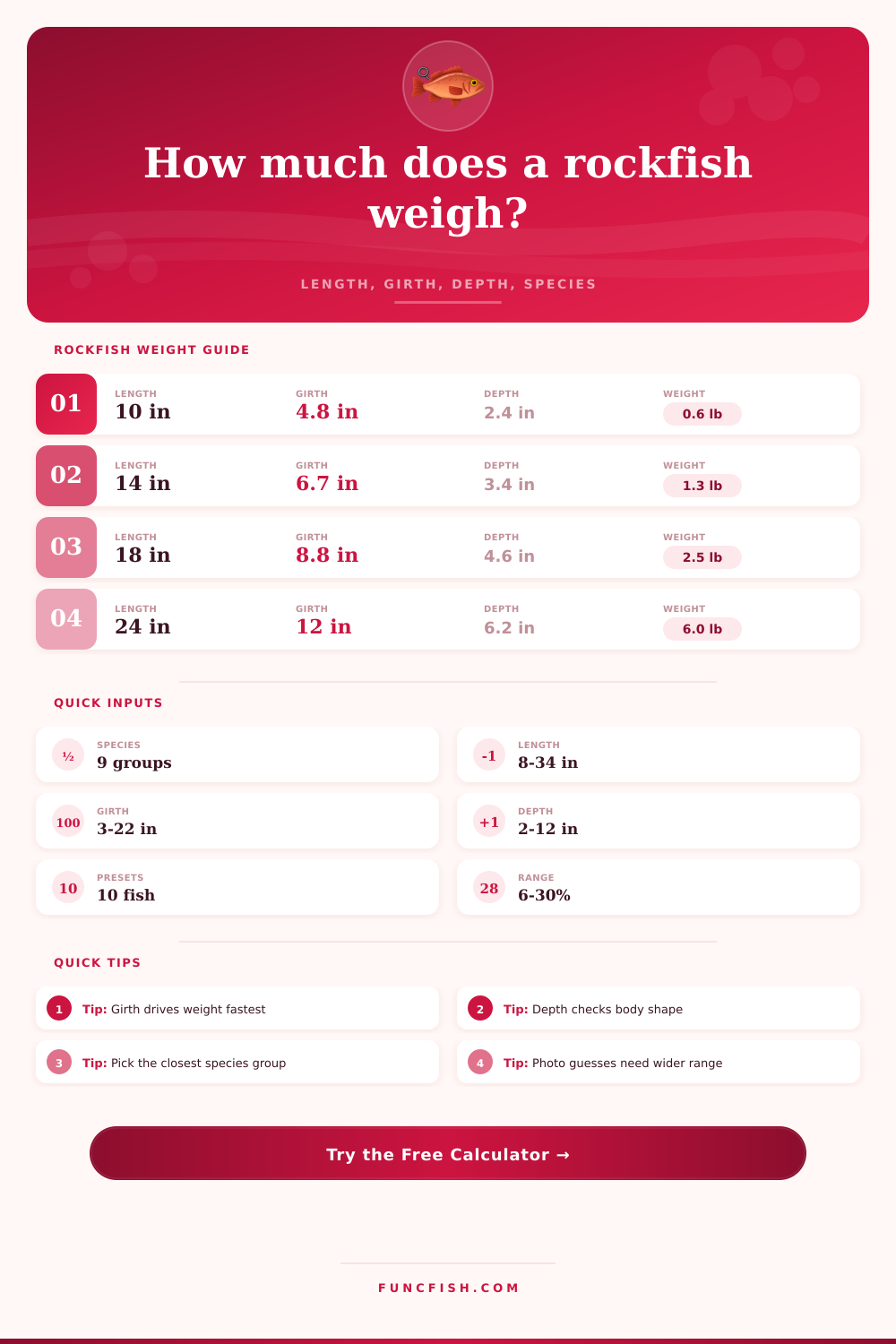
| Small nearshore rockfish | 10 in / 25 cm | 4.8 in / 12 cm | 2.4 in / 6 cm | 0.5-0.7 lb / 0.2-0.3 kg |
| Average black rockfish | 16 in / 41 cm | 7.8 in / 20 cm | 4.0 in / 10 cm | 1.8-2.3 lb / 0.8-1.0 kg |
| Broad vermilion rockfish | 20 in / 51 cm | 10.4 in / 26 cm | 5.4 in / 14 cm | 3.4-4.5 lb / 1.5-2.0 kg |
| Large deep reef rockfish | 26 in / 66 cm | 14.0 in / 36 cm | 7.3 in / 19 cm | 7.5-10.5 lb / 3.4-4.8 kg |
| Very large yelloweye-style body | 32 in / 81 cm | 17.2 in / 44 cm | 9.2 in / 23 cm | 14-20 lb / 6.4-9.1 kg |
| Habitat or condition | Multiplier | Range effect | Calculator interpretation |
|---|---|---|---|
| Kelp edge nearshore | 0.96 | +2% | Often compact with moderate belly depth |
| Rocky nearshore reef | 0.99 | +2% | Neutral nearshore rockfish profile |
| Mixed reef shelf | 1.02 | +3% | Balanced shelf fish with fuller frame |
| Deep reef ledge | 1.07 | +4% | Heavier deep-reef profile at length |
| Canyon edge reef | 1.10 | +5% | Broad adult body expectation |
| Lean to full condition | 0.86-1.14 | +1-4% | Visible belly condition changes final blend |
| Confidence or maturity | Weight effect | Range band | Best use |
|---|---|---|---|
| Board and snug tape | No change | 6% | Best when length, girth, and depth are measured |
| Hand tape on deck | No change | 9% | Good normal field measurement |
| Quick dock measure | No change | 15% | Use for hurried girth or depth numbers |
| Photo estimate | No change | 24% | Use when one measurement is inferred |
| Juvenile to large adult | 0.84-1.08 | +1-3% | Accounts for age-related body shape |
💡Measurement tip boxes
For rockfish, a one-inch girth error can move the estimate more than a one-inch length error. Measure around the thickest body point.
Body depth is a useful backup when a fish is deep-bodied, compressed, or photographed at an angle that makes girth hard to judge.
This calculator estimates whole fish weight from measurements and profile factors only.
Due to the fact that the length of a rockfish do not always correlate to the weight of that same rockfish, it is difficult to provide an accurate estimation of the weight of a rockfish. Two rockfish of the same length may contain different weights due to the difference in depth and belly fullness of the two fish. For example, a bocaccio rockfish may possess a slim body while a yelloweye rockfish may have a broad body and mass, indicating the difference in the weight of the two rockfish species.
A weight calculator for rockfish allow for the estimation of the weight of a rockfish by employing different measurements of the fish instead of using only one measurement to calculate the weight. Length is one baseline measurement for a rockfish. However, girth is a more important measurement of the body mass of the rockfish.
How to use the rockfish weight calculator
Most of the body mass of a rockfish are located at the thickest portion of its body, so measuring this girth will provide an accurate measurement of the mass of the rockfish. Depth is another measurement that can be used to determine the weight of a rockfish, which may be helpful if the girth of the rockfish is difficult to measure. The rockfish weight calculator uses the length, girth, and depth of the rockfish, as well as the species profile of the rockfish, to provide different weight estimates for copper and chilipepper rockfish, even if the dimensions of the two types of rockfish is the same.
Additionally, the habitat in which the rockfish lived and its state of maturity will impact its weight; rockfish from deep ledge habitats contain more weight per inch than rockfish from kelp lines habitats, and mature rockfish will contain more body mass than juvenile fish. The output of the calculator allows for an indication of whether the weight of the rockfish is expected or not to the parameters calculated. For example, if the weight of the rockfish is outside of the expected weight for that species, then it is possible that the rockfish ate alot of food during its lifetime, or that its belly fullness is the result of its age.
Alternatively, if the weight is less than the expected weight for that rockfish, it may be that the fish is lean, possibly due to having just spawned, or due to inaccuracies in the measurements. The range for the calculated weight of the rockfish indicates the quality of the measurement provided. For instance, measurements made with a board and tape measure will be more accurate than measurements made from a photograph of the fish.
Therefore, the range of weights for the rockfish from a photograph will be more extensive than measurements made in person. The shape and species of the rockfish will impact the weight that is calculated. Black rockfish are more compact than bocaccio rockfish, for instance, meaning that the dimensions of a bocaccio will be different than those of a black rockfish.
Additionally, rockfish like yelloweye and quillback have deep bodies, meaning that the girth of these types of rockfish must be measured more careful than others. The rockfish weight calculator includes profile cards that display these ratios to help demonstrate which dimension of the rockfish will have the most impact upon its weight. With an understanding of each of these ratios, you will understand that not all rockfish are created the same, and that each dimension has a purpose in determining the weight of the fish.
Many individuals make mistakes when measuring the rockfish. For instance, they may not perform all of the measurements of the fish. The length of the fish can be easily measured, but measuring the girth of the fish requires that the fish is still and that the tape measure is appropriately place on the fish.
You should place the tape measure behind the gill plate or across the thickest part of the belly of the fish to account for its girth. Additionally, the depth of the rockfish must be measured vertically; if this measurement is not taken vertically, it will be incorrect. The rockfish weight calculator cannot fix sloppy measurements of the rockfish, but it can demonstrate the range of the weight of the rockfish with incorrect measurements.
It is also possible that individuals may input the wrong species into the rockfish weight calculator. For instance, if they treat all rockfish as if they are the generic rockfish species, they are ignoring the differences in the body coefficients of each of the different species of rockfish. A 20-inch vermilion rockfish will weigh more than a 20-inch chilipepper rockfish, for instance.
Additionally, depending upon the habitat of the rockfish and its maturity, adjustments must be made to the weight calculations. Rockfish that live in deep structures will have more weight than those that live in different habitats. Fish that are mature will have more weight than young fish of the same species and size.
These factors are visible to the user in the rockfish weight calculator. It is common for individuals to use the rockfish weight calculator with rockfish that are on ice or in a photograph. While this is acceptable, they must use the confidence setting to account for the fact that the weight of the rockfish based off memory or a photograph will have a wider range than one that was measured in person.
The output of the rockfish weight calculator should be a bracket of weights rather than a single number that represents the weight of the rockfish. This bracket of weights is the more honest representation of the weight of the rockfish given the incomplete information. The calculations from the rockfish weight calculator are not an alternative to using a certified scale to weigh the rockfish.
Therefore, this tool should not be used to determine the official weight of the rockfish. Instead, the tool can be used to understand the weight of the rockfish that you caught, or to compare the weight of the caught rockfish to other fish. Additionally, through using the rockfish weight calculator, individuals can begin to notice any patterns in the weight of rockfish from specific reefs or of specific species.
Thus, the rockfish weight calculator can help transform a weight estimation into an opportunity to recognize any patterns in the weights of rockfish that are caught.