Salinity PPT to Specific Gravity Converter
Convert salinity in ppt to specific gravity with sample temperature, reference temperature, density, SG normalization, and salinity adjustment for fishing, bait, and marine holding water.
📌Scenario presets
⚙Converter settings
Salinity conversion results
Full breakdown
📋Water class reference grid
Fresh / Trace
Brackish
Coastal
Marine
📐Reference tables
| Salinity | SG 25C / 25C | Density at 25C | Common water description |
|---|---|---|---|
| 0 ppt | 1.0000 | 997.0 kg/m³ | Fresh water at 25C |
| 5 ppt | 1.0038 | 1000.8 kg/m³ | Very low brackish |
| 10 ppt | 1.0076 | 1004.6 kg/m³ | Low brackish |
| 15 ppt | 1.0113 | 1008.3 kg/m³ | Mid brackish |
| 20 ppt | 1.0151 | 1012.1 kg/m³ | High brackish |
| 25 ppt | 1.0188 | 1015.8 kg/m³ | Coastal mix |
| 30 ppt | 1.0225 | 1019.5 kg/m³ | Near marine |
| 35 ppt | 1.0264 | 1023.3 kg/m³ | Open ocean average |
| 40 ppt | 1.0301 | 1027.0 kg/m³ | Concentrated saltwater |
| Sample temperature | 35 ppt density | SG vs 25C water | Temperature effect |
|---|---|---|---|
| 10C | 1026.9 kg/m³ | 1.0300 | Cold sample reads higher |
| 15C | 1025.9 kg/m³ | 1.0290 | Still above warm reading |
| 20C | 1024.8 kg/m³ | 1.0279 | Moderate correction |
| 25C | 1023.3 kg/m³ | 1.0264 | Aquarium reference point |
| 30C | 1021.7 kg/m³ | 1.0247 | Warm sample reads lower |
| Reference style | Water reference | Best match | Calculator setting |
|---|---|---|---|
| Aquarium hydrometer | 25C / 25C | Marine tanks and live wells | Aquarium 25C |
| Lab density sheet | 20C / 20C | Bench samples and calibration | Lab 20C |
| Older field hydrometer | 15C / 15C | Outdoor field readings | Field 15C |
| 60F hydrometer | 15.56C / 15.56C | Legacy salt and brine tools | Hydrometer 60F |
💡Practical checks
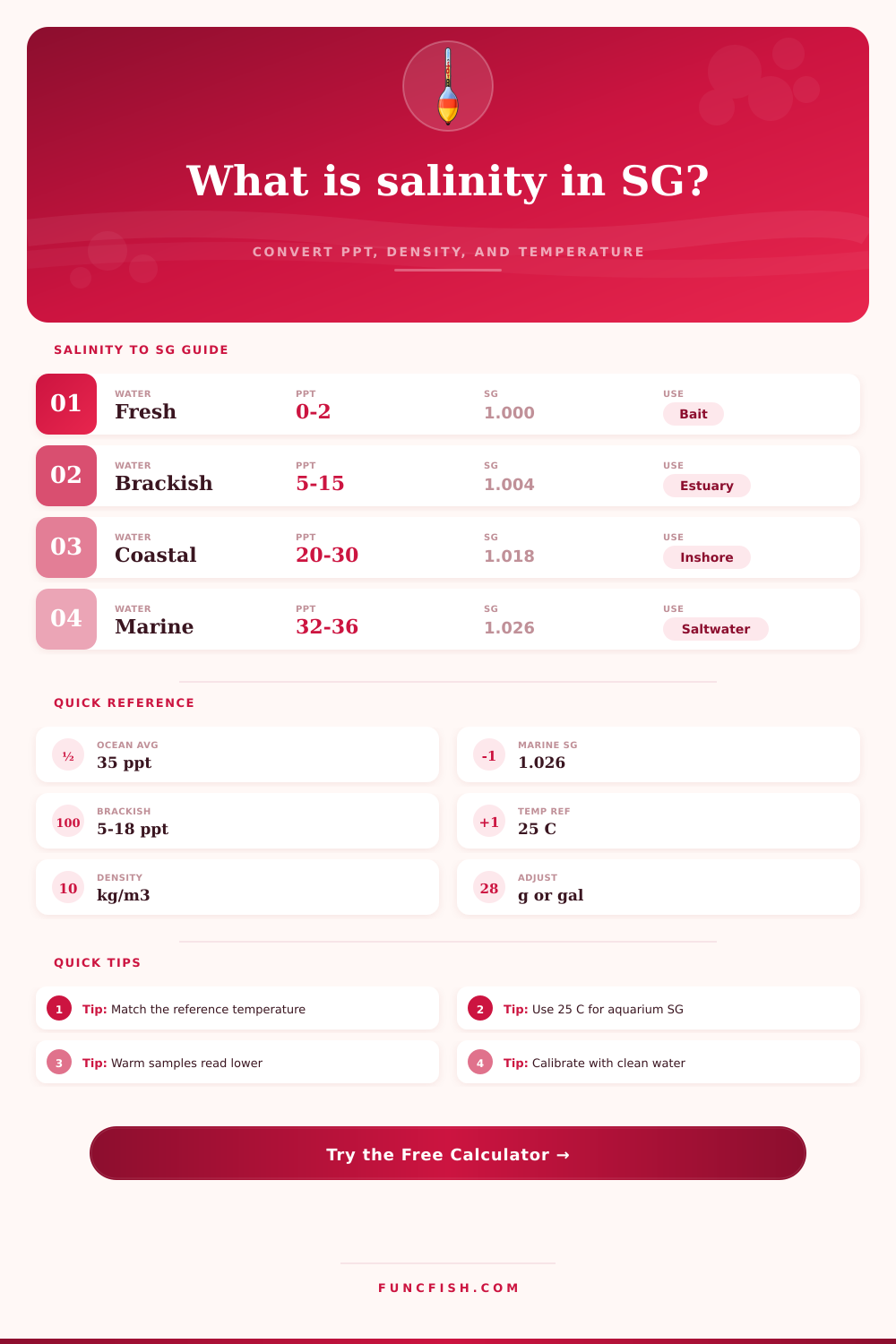
Tip: Specific gravity is a density ratio, so the reference temperature matters. A 35 ppt sample does not show the same SG at 10C, 25C, and 30C.
Tip: For target changes, treat the adjustment result as a planning estimate and confirm with a calibrated meter or hydrometer after the water fully mixes.
Salinity is a measurement of an amount of salt in the water. Salinity can cause stresses to the fish or invertebrates if the salinity of the water are not managed correctly. These problems may not be noticed until the fish or invertebrates begin to experiencing stress from the high or low salinity of the tank.
In order to manage the salinity in the tank, the person must understand the relationship between salinity, specific gravity, and temperature. Salinity and specific gravity is two different ways to describe the same water in the tank. Salinity and specific gravity provide different informations about that water.
How to Measure and Adjust Salinity in Your Tank
Salinity is measured in parts per thousand, and salinity tells you how many salt is dissolved in the water. Specific gravity is a measurement of how the salt change the density of the water. Density changes based on the temperature of the water.
The higher the temperature, the less dense the water. If the water is warmed up, its density will decrease. If the water is cooled, its density will increase.
These measurements can occur even if the amount of salt in the water remains the same. A person may encounter problems if they measures the salinity of the water at different temperatures. For instance, if a person measures the salinity of a tank when the water is warm, but then measures the salinity again once the water has cooled, there may be differences between those measurements.
These differences in specific gravity is due to the change in the water’s temperature, not because the amount of salinity in the water has changed. To avoid these issues, a person must establish a reference temperature for measuring the salinity of the water. Marine aquarists often use 25 degrees Celsius as the reference temperature for salinity measurements.
However, older field instrument use 15 degrees Celsius (or 60 degrees Fahrenheit) as their reference temperature. Using these two different reference temperatures will lead to inaccuracies in the measurements taken with those instruments. The salinity calculator that is available on this page will allow a person to account for the shifts in temperature that may occur in the water.
The calculator will provide the user with information regarding the salinity of the water at the chosen reference temperature. In addition, the calculator will also provide a figure for the density of the water in units of kilograms per cubic meter. The density of the water can be used to aid the understanding of what type of adjustments in salinity should be made.
For instance, the density of the water will change if salt is added to the water, or if freshwater is added to the water. Thus, the calculator will estimate the amount of salt or freshwater that should be added to the water in order to reach the desired salinity level. Different types of environments requires different salinity levels.
For instance, freshwater bait requires a salinity level that are near zero to two parts per thousand. Salinity levels for brackish estuary water range from five to eighteen parts per thousand. Coastal inshore water range between twenty and thirty parts per thousand, and open ocean water has a salinity that averages around thirty-five parts per thousand.
These levels are not exact because the water from these environments may be mixed. However, these levels can provide a starting point for the determination of the salinity of an environment. The use selector will allow a user to load these different salinity ranges, and to determine whether the salinity of their system is within the correct range for their type of water.
The temperature of the water also has an effect upon the environment of the fish and invertebrates that live within the water. Water that is cooler contains more dissolved oxygen than warm water. However, warm water is less dense than cold water.
Therefore, warm water contains less dissolved oxygen than cold water. These effects of temperature upon the water should be taken into consideration when determining the salinity of the water. Thus, the sample temperature field will be useful for recording the temperature of the water where the fish or shrimp live.
In addition to using the salinity calculator, a person also must ensure that the measuring instruments are properly calibrate. For instance, if a hydrometer is not properly calibrated to distilled water, the measurements will not be accurate. If a hydrometer measures one point too high for distilled water, the salinity of all other water samples will be too high by that same measurement.
Thus, the salinity calculator cannot account for miscalibrated instruments, but it can help in determining if the error in the measurement is due to temperature shifts in the water, or due to an error with the instrument that was used to measure the salinity of the water. When adding salt or freshwater to an environment, it is best to make conservative adjustments to the salinity of the water. For instance, if the person is to increase or decrease the amount of salt, the person should make the change in salinity and allow the environment to mix before measuring the salinity of the water again.
The water mixing process is a function of water circulation in the environment. Thus, while the calculator will estimate the amount of salt or freshwater that should be added, it is essential to calibrate the salinity of the water after allowing for the system to mix. The reference tables located on this page provide a detailed look at the relationship between salinity, density, and specific gravity.
These tables can be used to determine how salinity and specific gravity relate to one another. Furthermore, the tables can reveal how the temperature of a water sample affects the specific gravity of that sample at a given level of salinity. For instance, a water sample that is colder will have a higher specific gravity than a water sample that is warmed to the same level of salinity.
These tables can be of great assistance to the person that is attempting to transport shrimp, create mixes for reef tanks, or to examine the salinity of estuaries. Overall, salinity is a unit that provides information regarding the amount of salt that is contained within the water. Specific gravity provides information regarding how that salt affects the density of the water at a specific temperature.
In order to avoid problems caused by errors in measuring the salinity or specific gravity of the water, the effect of the temperature of the water must be corrected for. Thus, if salinity and specific gravity are kept in mind and if the effect of temperature is corrected for, the small changes in salinity will be prevented from becoming a great problem for the animals that live within the water.