🐟 Raw to Cooked Salmon Weight Converter
Calculate exactly how much cooked salmon you'll get from any raw weight, cut, and cooking method
| Species | Fat Content | Avg Yield % | Moisture Loss | Notes |
|---|---|---|---|---|
| Atlantic (Farmed) | High (13–17%) | 72% | 28% | Fattier; retains more moisture |
| King / Chinook | High (10–14%) | 71% | 29% | Rich flavor; good moisture retention |
| Coho / Silver | Medium (5–9%) | 69% | 31% | Mild; moderate shrinkage |
| Sockeye / Red | Medium (6–10%) | 68% | 32% | Firm flesh; loses moisture faster |
| Pink / Humpback | Low (3–6%) | 65% | 35% | Lean; highest moisture loss |
| Chum / Keta | Low (4–7%) | 66% | 34% | Mild; slightly dry when cooked |
| Steelhead Trout | Medium (7–11%) | 70% | 30% | Similar to Atlantic farmed salmon |
| Cut Type | Raw Description | Yield Adjustment | Best Methods | Serving Notes |
|---|---|---|---|---|
| Fillet (boneless) | Side of fish, skin optional | Base yield | Bake, grill, poach, sear | Most accurate calculation |
| Steak (bone-in) | Cross-cut with backbone | -5% edible | Grill, broil, pan sear | Bone adds ~5% raw weight |
| Whole (gutted) | Dressed, head-on or off | -40% to -45% | Bake, steam, poach | Large loss from bones/skin/head |
| Portion Cut | Pre-cut serving piece | Base yield | Any method | Same as fillet yield |
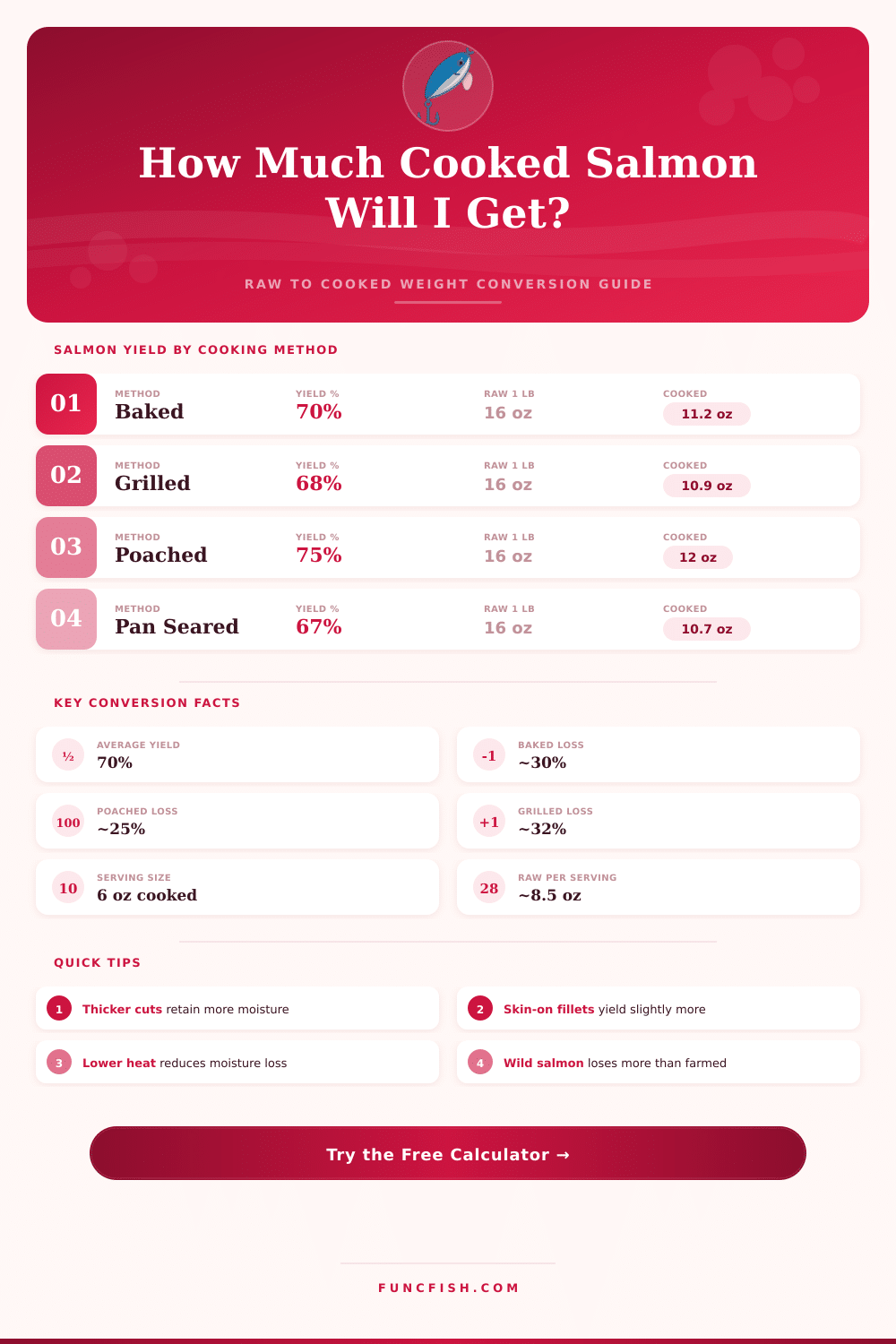
| Raw Weight | Cooked Weight (Baked) | Cooked Weight (Grilled) | 6 oz Servings | 4 oz Servings |
|---|---|---|---|---|
| 0.5 lb (227g) | 5.6 oz (159g) | 5.4 oz (153g) | 0.9 | 1.4 |
| 1.0 lb (454g) | 11.2 oz (318g) | 10.9 oz (309g) | 1.9 | 2.8 |
| 1.5 lb (680g) | 16.8 oz (476g) | 16.3 oz (462g) | 2.8 | 4.2 |
| 2.0 lb (907g) | 22.4 oz (635g) | 21.8 oz (618g) | 3.7 | 5.6 |
| 3.0 lb (1.36kg) | 33.6 oz (953g) | 32.6 oz (924g) | 5.6 | 8.4 |
| 4.0 lb (1.81kg) | 44.8 oz (1.27kg) | 43.5 oz (1.23kg) | 7.5 | 11.2 |
| 5.0 lb (2.27kg) | 56.0 oz (1.59kg) | 54.4 oz (1.54kg) | 9.3 | 14.0 |
Thin fillets (under 0.75 in) can lose an extra 3–5% moisture compared to thick cuts cooked to the same internal temperature. For the most accurate result, always measure your fillet thickness and adjust accordingly. The calculator applies a thickness modifier automatically.
For meal planning, start with your desired cooked portion (typically 5–6 oz per adult) and divide by the yield percentage to find raw weight needed. Example: 6 oz cooked ÷ 0.70 yield = 8.6 oz raw per person. The calculator does this math automatically in the results.
Most fishermen find themselves in the same trouble: how does one exactly estimate the Weight of Salmon when one does not have a proper scale? There are many ways to settle that. Some simply use only the length, while others also add measures of girth, those extra details help to arrive more close to the real value.
Here is a formula that commonly goes around between fishermen. One multiplies the length by the girth, later that result again by the girth and then divides everything by 740. For instance for fish long at 52 inches with girth of around 30.5 inches, the calculation gives roughly 65 pounds.
How to Estimate Salmon Weight Without a Scale
That is a fast and simple method, that works well, when one caught a terrific catch and simply wants an rough number without too much thinking about it.
Currently, a growing number of fishermen release the fishes rather than keep them, also because of the decline of wild Salmon populations. Here is the problem: one can not easily weigh a live fish on a scale. Hence length-based formulas became this practical; they allow to estimate the Weight quite well, without putting the fish under any stress.
There also exist charts to convert length into Weight, and they surprisingly are useful. One such chart for Chinook Salmon points out, that a 25-inch fish weighs around 6.5 pounds. At 30 inches, one already has more then 11 pounds.
A 40-inch catch reaches 25 pounds, while a 52-inch Salmon comes to around 54 pounds. Another chart gives a bit different values, a 22-inch fish is at roughly 4 pounds, a 30-inch at 10 pounds, and a 44-inch Salmon weighs around 35 pounds. Those numbers count in most cases, although exceptions certainly happen.
For actual samples from life: a real 10-pound Salmon has around 29 inches of length with girth at roughly 16.5 inches. A common 5-pound silver Salmon from Puget Sound measures roughly 25 inches with 13-inch girth. Add only 2 inches to the girth, and suddenly you have a chunky 7-pound fish.
One fisherman that I know, caught a Salmon where the numbers matched perfectly, 54 inches and 54 pounds.
There does not exist something like a standard size for Salmon. Wild and farm-raised fishes are entirely different creatures, and even between wild species the sizes change strongly according to the origin of the fish. For instance, red Salmon ranges between 6 and 14 pounds.
When one fillets a Salmon, one receives 40 to 45 percent of the whole Weight, so a 10-pound catch gives roughly 4 to 4.5 pounds of usable meat.
After Salmon reaches the oven, it loses between 20 and 25 percent of its Weight during cooking. Weigh it before and after some time, and that ratio stays steady. The skin alone equals about 1 ounce, which is 6 to 8 percent of the whole round.
Blood andbowels make up roughly 10 percent of the whole fish.