Salt Cod Curing Time Calculator
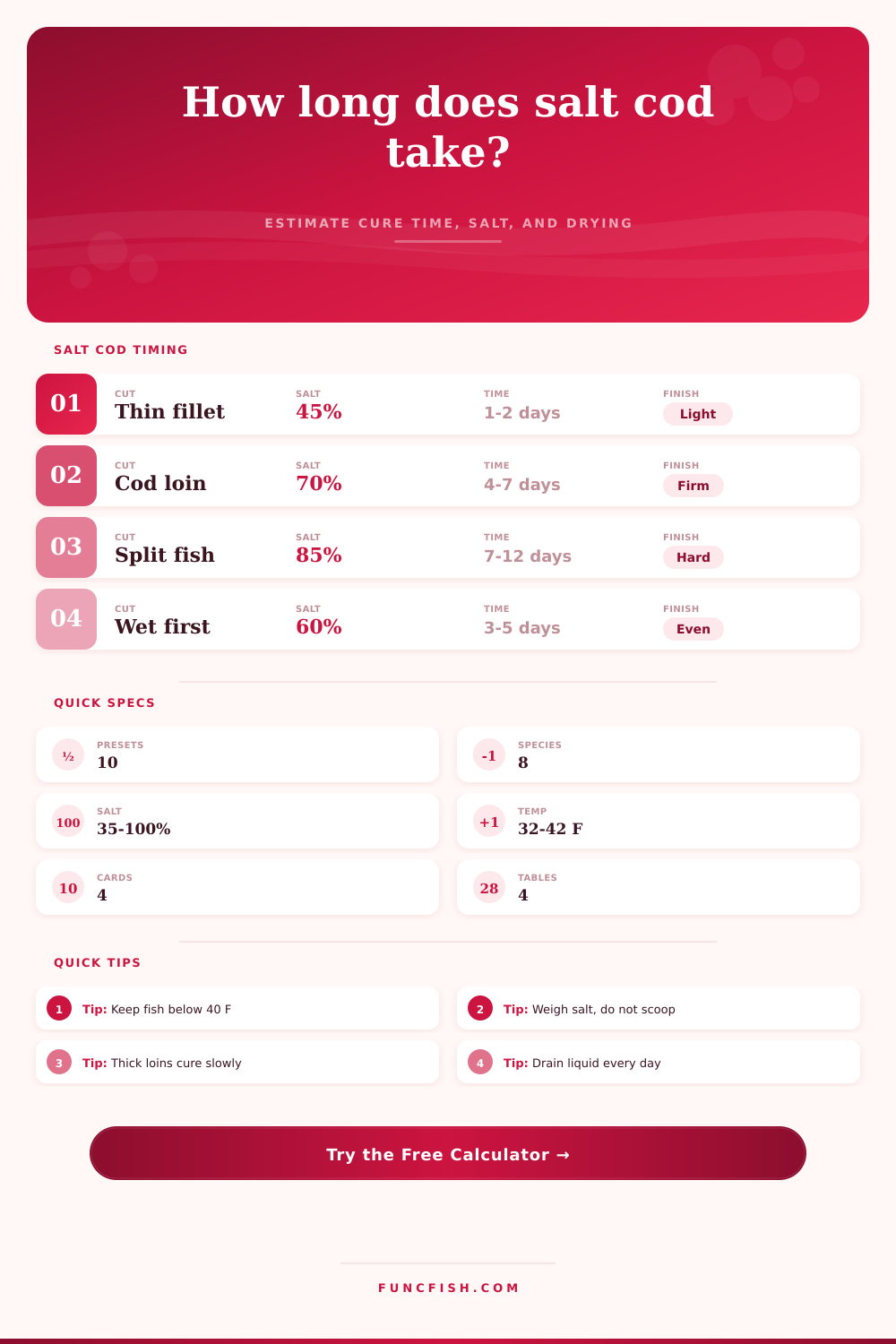
Estimate a refrigerated salt cod curing window from species, cut thickness, salt load, brine start, stacking depth, draining schedule, target firmness, and planned desalting.
📌Salt cod presets
⚙Cure inputs
This calculator plans salt load and timing. Keep fish cold, use food-grade salt, and verify safe handling with a qualified process when preserving fish for storage.
Salt cod cure estimate
Calculation breakdown
🐟Material and species grid
Atlantic cod
Pacific cod
Haddock
Pollock
Ling or cusk
Hake
Whiting
Mixed lean fish
📊Salt cod reference tables
| Cut form | Typical thickness | Salt ratio | Base refrigerated cure | Handling check |
|---|---|---|---|---|
| Thin fillets | 0.3-0.7 in / 0.8-1.8 cm | 35-55% | 24-48 hr | Turn once and drain liquid |
| Standard cod fillets | 0.7-1.3 in / 1.8-3.3 cm | 50-75% | 2-5 days | Drain daily |
| Thick center loin | 1.3-2.3 in / 3.3-5.8 cm | 65-95% | 4-8 days | Repack salt at midpoint |
| Split whole fish | 1.0-2.0 in / 2.5-5.1 cm | 80-110% | 7-12 days | Salt belly and collar pockets |
| Drying-rack finish | Any salted cut | 70-110% | Cure plus dry rest | Move air around each piece |
| Salt material | Crystal behavior | Calculator adjustment | Use note |
|---|---|---|---|
| Coarse sea salt | Slow dissolving, good drainage | Baseline | Reliable for heavy dry salting |
| Kosher salt | Open crystal, fast surface brine | Slightly faster | Weigh it; volume varies widely |
| Fine sea salt | Fast dissolve, strong contact | Shorter cure, higher surface bite | Mix carefully to avoid hot spots |
| Pickling salt | Clean, fine, no additives | Fast and even | Good for brine starts |
| Flake salt | Large but low-density flakes | Slower if not packed | Use by weight only |
| Target finish | Expected moisture loss | Saltiness level | Typical desalting | Best use |
|---|---|---|---|---|
| Light kitchen salt cod | 12-20% | Mild to medium | 4-12 hr | Short-term refrigerated cooking |
| Medium bacalao-style cure | 22-32% | Medium strong | 18-36 hr | Traditional soaked salt cod |
| Firm salt cod slab | 30-42% | Strong | 24-48 hr | Firm flakes after soaking |
| Hard cure | 40-52% | Very strong | 36-72 hr | Longer holding after proper validation |
| Drying-rack finish | 45-60% | Strong and dry | 48-96 hr | Dry-style salted fish |
| Variable | Faster cure | Baseline | Slower cure | Why it matters |
|---|---|---|---|---|
| Temperature | 39-40°F / 4°C | 35-38°F / 2-3°C | 31-34°F / 0-1°C | Cold slows salt diffusion |
| Drainage | Rack drain | Daily drain | Sealed tub | Standing brine changes surface salt |
| Stacking | Single layer | Tray layer | Deep stack | Pressure and contact alter brine movement |
| Brine start | 20-26% brine | Dry only | No contact pockets | Brine wets cavities before dry salt |
| Thickness | Under 0.75 in | About 1 in | Over 1.5 in | Salt must reach the center |
💡Curing calculation tips
Use the thickest point: salt cod timing is controlled more by center thickness and salt contact than by total batch weight.
Drain and repack deliberately: liquid in the tray dilutes surface salt, while dry pockets leave uneven sections that need more time.
Making salt cod at home is largely a battle against physics. You’ve got a block of meaty Atlantic cod, a bag of coarsely ground sea salt, and an under-refrigerated fridge that can’t even save your milk from spoilage. All you’re looking for is that rich, flakey character that we associate with true bacalao. But what’s the right amount of alone-time? Not long enough and the inside are still raw; risky! Too long and you’ve created a brick that’ll make the bottom of the ocean taste good.
That’s where the above calculator comes in: It’ll crunch numbers to give you a clear timeline for your unique set of circumstances (i.e., ambient conditions + cut). It’s all about diffusion: Salt ions diffuse inward; water diffuses outward. It only works based off time and differences in concentration.
How to Cure Salt Cod at Home
The key variable here is thickness, specifically how thick is your fish? Thickness matter far more than overall weight of the fish. Five pounds of very thin fillets will cure much quicker then one block of two pounds. Why? Because there isn’t as much distance for salt to diffuse to get to the center. That is why it asks for the thickness of the thickest part of your piece, instead of just the weight of the batch.
If you have one uneven piece, such as a thick bellied fish with a thin tail section, you’re going to need to plan for the belly. By the time the belly is ready, the tail section would of been too salty. But at least now the entire piece should be safe to consume.
What sort of salt are you using? That determines the pace of the cure as well. Coarse sea salt is forgiving because it dissolves gradually. It forms a consistent layer of brine between you and meat without an initial sodium jolt. Fine table salt makes a hyper-concentrated outer layer that can pulls moisture too fast, sealing up surface before the inside gets properly preserved. It is a fine balance that most home cooks overlook. They think ‘more salt = quicker,’ but they often get uneven results, just quicker. The chart on the page breaks it down nicely, explaining how different-sized crystals changes the rate at which the process occurs.
The other half of this equation is temperature. Your silent partner: Keep the fish between thirty-two and forty degrees Fahrenheit. This keeps bacterial growth slowed down enough to ensure safety during the cure, but it also slows down movement of salt ions. When you put them into the fridge, if it’s running warm (say forty-five degrees), then the salt will penetrate faster, but so will spoilage.
That’s where the delay in temperature comes into play on the calculator; it makes sure you don’t yank the fish out too soon based solely on how dry the surface appears. It compensates for that equalizing rest period… The key interval when you take the fish out of the salt bed and let it balance, getting the salt concentration even across its salty outer shell to mild interior. Skipping this phase result in a raw center and a harsh, inedible crust.
The final act is redemption. Even if you cured perfectly, salt cod are meant to be desalted before eating. The calculator provides an estimate for the number of times you should change the water depending on moisture lost and salt present. If the salt content was higher (a heavier cure), or if there was significant moisture loss, that means longer soak times and more changes. That’s not a defect in curing; it is just part of preserving food. You want to get rid of enough salt to eat it without getting to little so it goes bad while waiting around.
Make mistakes. Underestimate the thickness. Forget to empty the liquid brine pooling at the bottom of the tray, diluting the salt and slowing down the cure. When brine sits, it doesn’t just fill up with water and pull it out of the meat; it also loses strength. If you top off with fresh salt and repack the fish, you restore the gradient and get things back on track.
There’s no magic number here; everything depends on the situation, so a static recipe isn’t going to work very well. There is simply too many variables. Adjust for your particular salt, your particular fish, your particular fridge and you transform a risky experiment into a reliable technique.
Precision in the culinary sense isn’t necessary. But precision in the moddern chemical sense is what the cure is all about. When you realize that the cold and the salt are doing the heavy lifting, you stop guessing and start waiting. Waiting, as any good curer knows, is hardest part of the job.