San Diego Jam Turns Calculator
Estimate San Diego Jam knot wraps, tag allowance, knot bite, retained strength, and hook-eye clearance from line material, diameter, lure load, drag pressure, and tying conditions.
Package diameter is best. The calculator uses diameter to estimate knot stack and eye crowding.
Use the drag you expect during the fight, not the reel maximum.
| Line class | Typical diameter | San Diego Jam turns | Notes |
|---|---|---|---|
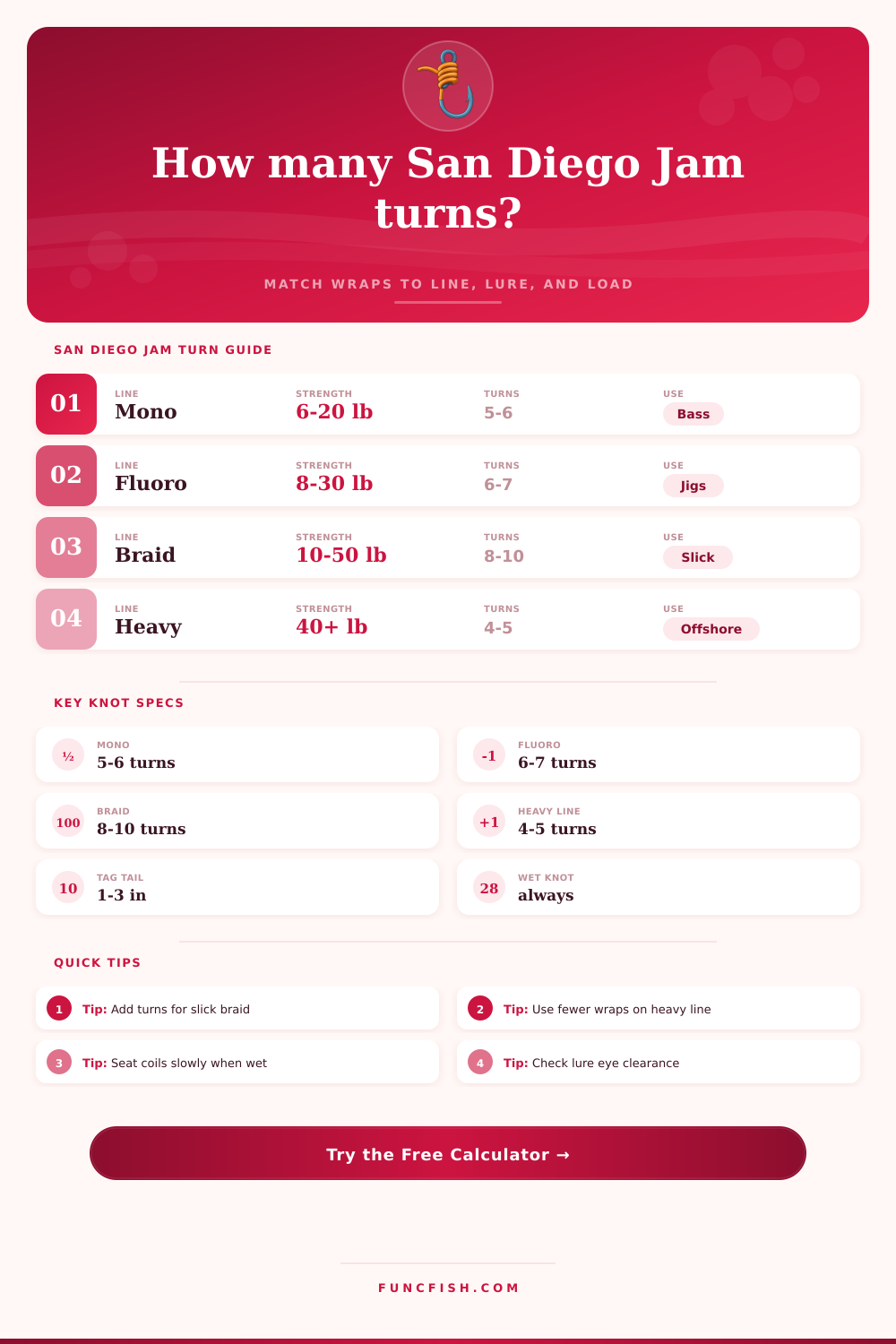
| 4-8 lb trout mono or fluoro | 0.006-0.010 in / 0.15-0.25 mm | 6-7 turns | Small eyes need neat stacked wraps and a short trimmed tag. |
| 10-17 lb bass mono or copoly | 0.011-0.015 in / 0.28-0.38 mm | 5-6 turns | Common range for jigs, spinnerbaits, chatterbaits, and plugs. |
| 12-25 lb fluorocarbon leader | 0.012-0.020 in / 0.30-0.51 mm | 6-7 turns | Lubricate heavily and pull the tag plus standing line to seat evenly. |
| 30-50 lb braid direct to lure | 0.011-0.014 in / 0.28-0.36 mm | 8-10 turns | Use a double eye pass when the eye has room and the lure action still swings. |
| 30-60 lb mono or fluoro leader | 0.022-0.032 in / 0.56-0.81 mm | 4-6 turns | Reduce turns as diameter grows so the knot can compact without kinking. |
| 80-100 lb heavy leader | 0.035-0.045 in / 0.89-1.14 mm | 3-4 turns | Large leader can crowd small rings; test pull before trimming close. |
| Terminal connection | Usable opening | Best line range | Clearance note |
|---|---|---|---|
| Tiny spoon or trout hook eye | 0.035-0.055 in / 0.9-1.4 mm | 2-8 lb | Single pass is usually cleaner than doubled line. |
| Bass jig, worm hook, or spinnerbait | 0.055-0.090 in / 1.4-2.3 mm | 8-20 lb | Five or six turns normally leave room for lure movement. |
| Split ring on plug or spoon | 0.075-0.130 in / 1.9-3.3 mm | 10-40 lb | Ring diameter helps the jam knot seat without choking the lure eye. |
| Solid ring or ringed live-bait hook | 0.110-0.180 in / 2.8-4.6 mm | 25-80 lb | Good match for heavier leader and fewer compact wraps. |
| Large offshore jig ring | 0.150-0.240 in / 3.8-6.1 mm | 40-100 lb | Leave more starting tag because thick leader consumes line quickly. |
| Species or technique | Common line | Lure or hook style | San Diego Jam setup |
|---|---|---|---|
| Largemouth bass jig fishing | 12-20 lb fluoro or copoly | Jig, Texas rig, chatterbait | 6 turns, wet seat, trim tag around 0.25-0.40 in. |
| Spotted bay bass and redfish | 10-20 lb mono or fluoro | Spoon, jighead, swimbait | 5-7 turns depending on fluoro stiffness and eye size. |
| Yellowtail or school tuna casting | 30-50 lb mono or fluoro leader | Surface iron, stickbait, metal jig | 4-6 turns with a long start tag and hard test pull. |
| Surf striper plugs | 20-40 lb shock leader | Swimmer, pencil, bucktail | 5-6 turns; add tag allowance for hard casting shock. |
| Pike or musky heavy mono | 50-80 lb hard mono | Large spinner, glide bait | 4 turns on large eye or ring; avoid crowding small lure eyes. |
| Trout spoons and spinners | 4-8 lb mono or fluoro | Micro spoon, inline spinner | 6-7 tidy turns; inspect for crossed wraps before cinching. |
| Condition | Adjustment | Why it matters | Calculator effect |
|---|---|---|---|
| Fluorocarbon stiffness | Add 1 turn | Stiff line can leave open coils if underwrapped. | Raises wrap count and starting tag length. |
| Braid slickness | Add 2-3 turns | Slick fibers need more surface contact to resist slip. | Raises turns and flags double-pass value. |
| Heavy mono over 50 lb | Subtract 1-2 turns | Thick leader kinks if the coil stack gets too long. | Reduces turns and checks eye crowding. |
| Dry cinch or rushed seat | Lose 6-10% | Heat and crossed coils reduce retained strength. | Lowers estimated knot efficiency. |
| Extreme casting load | Add safety | Heavy lures spike load during cast and hookset. | Increases minimum break strength target. |
You know that familiar sensation of your braid gliding between your fingers as you attempt the jig head on for the third time in 10 minutes. We’ve all been there at some point; typically just as the fish begin biting or your hands is trembling from standing knee deep in frigid water. Enter the San Diego Jam knot; the solution to your slick fiber problem…or so they say.
If you don’t nail the number of wraps, however, it’s game over. Too many and your line will slide free under load, sending your offering to bottom of ocean. The problem with too many turns is they stack up and make a sloppy spring that will jam into your hook eye and form a big wad of a knot that bite itself in two during the first hard pull.
How to Tie the Perfect Fishing Knot
So it’s all about managing friction; there needs to be some sort of system other than guesswork about how many times to coil it each time. So what’s the answer? Enter the knot tying calculator. It does all that math for you based off your drag setting and line type. In other words, it helps to equalize two competing factors, how much space you have available to allow the coils to seat fully without being blocked by the knot grip.
So if you choose braid or fluorocarbon line, it changes again because those lines act different than soft mono. Braid is super slick like glass and require some more space to grab onto itself. Heavy monofilament is also pretty stout and bulks up fast so there isn’t much room left either. And if you attempted to wrap a chunky leader line around ten times, you’d of been left with such a big knot you couldn’t pass it through the split ring of your lure. The chart on the page outlines this well. Thicker lines needs fewer turns because each loop or coil is larger then the next and takes up more of the remaining space around the standing line.
Consider also the terminal tackle itself. Sometimes eye on a lure is very small, like a little trout spinner, where only a few wraps around a hook shank are possible before they’re cinched up too tightly to slide along freely. This is not good when you are fishing something that requires a lot of action like a topwater plug, but it is not such a big deal for something fished close to the bottom.
Eye clearance is also critical. You don’t want too many turns, or the knot won’t slide freely and will choke the eye of the hook. You do need some turns for friction, but not so many that they stops the lure from working properly. That’s where the calculator helps. It takes that into account and lets you know if you have enough gap in the hook eye (based on average) to fit the turn count you’ve selected along with specific line size you’ll be using. It will tell you if you should avoid fishing something that ties strong in theory, but isn’t really functional due to the mechanical makeup of the knot itself.
Sure, folks mostly ignore this one but lubrication makes all the difference in the world. As the fibers of your braided knot slide along each other while drying out, they create heat, literally burning tiny little channels into the structure of the line before you’ve even pulled it tight. If your knot is dry, it’ll reduce your effective strength by up to 10 percent or even more. This means the difference between landing a good fish and watching her swim away on the reel spool. Wet the knot with water or your saliva so the coils can slide into place without harmful friction. This ensures that the pressure you apply when cinching it down compacts the coils evenly instead of frying the line. Trust us on this one.
Knots fail under load and rushing the seat because you’re so eager to get a cast off or you’re cold ain’t gonna help. So in conclusion, learning to tie a good knot isn’t so much remembering some random number as it is knowing the combination of hardware and the material itself. This trusted tool gives you a head start by adjusting for tackle shape and new types of line; then it’s up to you to finish the job with your own hands.
Use the suggested number of turns as a guideline, not gospel, and adjust slightly if the wraps look uneven or if the knot feels stubborn during seating. When you’ve learned how the line wants to lie on the hook shank, you won’t second guess yourself anymore. Just get enough to grip, enough to slide around and a little bit of water to prevent it from burning out. Then you can set the hook and go fishing instead of fiddling with the knot.