Sea Anchor Size Calculator
Estimate sea anchor, drift sock, or para-anchor diameter from boat size, loaded weight, windage, current, sea state, and your target fishing drift speed.
⚓Fishing presets
📏Boat, water, and anchor inputs
The drag model uses wind pressure, underwater current load, sea-state multiplier, canopy drag coefficient, and the target speed through water. Use the larger result when a manufacturer chart calls for a bigger parachute or sock.
Sea anchor sizing result
🧰Sea anchor style data
📊Reference sea anchor sizes
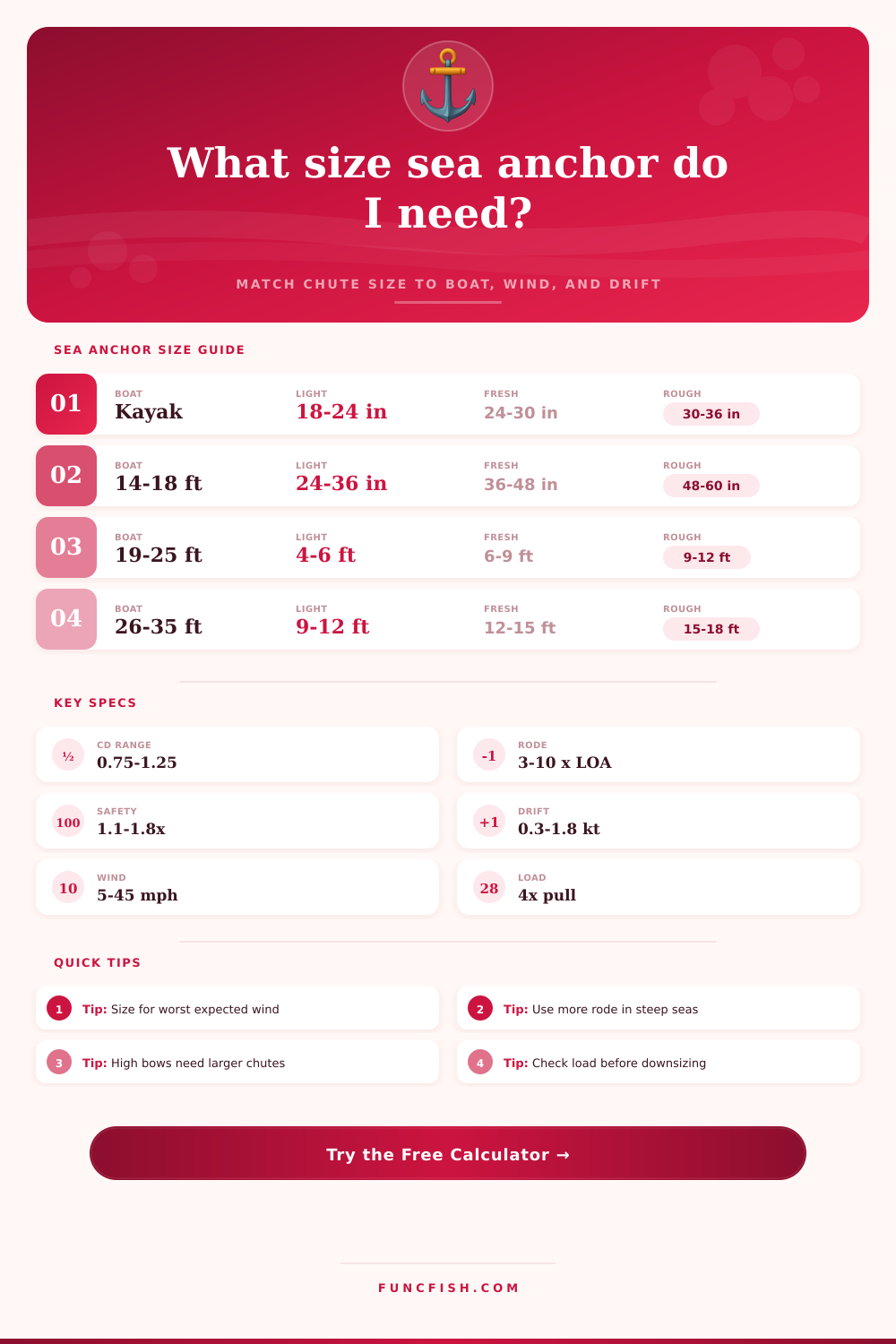
| Boat / platform | Typical fishing use | Common diameter | When to step up |
|---|---|---|---|
| Kayak or canoe | Lake drift, flats, slow river | 18-36 in / 46-91 cm | High seat, sail kit, broadside wind |
| 12-16 ft jon boat | Panfish, crappie, small catfish | 24-48 in / 61-122 cm | Square bow, two anglers, river current |
| 17-21 ft bass or bay boat | Wind hold, jigging, drift lines | 36-72 in / 91-183 cm | Hard wind, high freeboard, open water |
| 22-28 ft center console | Reef, live bait, offshore standby | 6-12 ft / 1.8-3.7 m | Cabin, tower, steep chop, night reserve |
| 29-35 ft offshore boat | Tuna, swordfish, emergency bow hold | 12-18 ft / 3.7-5.5 m | Storm planning or heavy loaded displacement |
🌊Rode, bridle, and load table
| Condition | Rode scope | Line rating target | Rigging note |
|---|---|---|---|
| Short freshwater drift | 3 x LOA | 3 x calculated pull | Use a trip line if snag risk is high |
| Normal bay or lake fishing | 5 x LOA | 4 x calculated pull | Fairlead from bow or balanced cleat |
| Open-water drift or reef stop | 7 x LOA | 4-5 x calculated pull | Add chafe sleeve at chocks |
| Emergency storm reserve | 10 x LOA | 5 x calculated pull | Use a bridle and rated hardware |
🎣Gear and species comparison grid
| Species / pattern | Platform match | Target drift | Anchor style fit |
|---|---|---|---|
| Walleye jigging | 16-22 ft deep-V | 0.4-0.9 kt | Drift sock or cone for repeat passes |
| Crappie brush lines | Jon boat or small skiff | 0.2-0.5 kt | Small sock sized for low windage |
| Catfish river edges | Wide aluminum boat | 0.5-1.2 kt | Cone with high rode rating |
| Fluke and bay drift | Bay boat or center console | 0.7-1.4 kt | Large sock for wind-current balance |
| Tuna chunking standby | Offshore center console | 0.3-0.8 kt | Para-anchor or storm cone |
| Swordfish deep drop | Heavy offshore hull | 0.4-1.0 kt | Para-anchor with long rode |
⚖Formula multipliers used
| Input choice | Multiplier | Used for | Reason |
|---|---|---|---|
| Low hull profile | 0.85 | Windage force | Kayaks and low skiffs present less side area |
| Average center console | 1.00 | Windage force | Moderate freeboard and open deck profile |
| High cabin or hardtop | 1.25 | Windage force | Tall bows and tops catch more wind |
| Storm reserve sea state | 1.85 | Load demand | Snatch loads and wave yaw need more margin |
💡Sizing notes
When a boat is being dragged into shallow water by current, engine failure are panic inducing. Before heading out onto the water, sizing your sea anchor apropiately will prevent collision.
Drag devices are thought of as a one-size-fits-all solution by most boater. They grab whatever parachute seems large enough in marine store without considering physics behind water resistance, windage, and hull shape, all of which play an important role in holding your position. Just plug boat’s dimensions and environmental conditions into the calculator, and it will do the math for you. No need to guess what rode your’ll require or drag coefficient.
Why Sea Anchor Size Matters
The first input to factor in is hull profile, which is bigger then many anglers think. If you are operating a low profile bass boat, there’s much less surface area for wind to catch compared to high-sided vessel that catches every gust like a sail. Whether you have a sleek skiff or a high-sided boat that catches every gust like a sail, the tool compensate for wind force based off how much of your boat is above the waterline. Underestimating this variable mean having too small of a sea anchor to compensate for the sideways push of the wind and your boat swinging broad side into the waves. It has nothing to do with weight and everything to do with shape of what is over the water line, so many folks miss this one.
The second level of complication come from the fact that current doesn’t depend on wind speed. Even if air is calm, a powerful river current will move a light john boat at a pace that no sea anchor could of hope to counteract. To provide a realistic picture of overall drag on your craft, the Current Drag Calculator distinguish the drag caused by current flow from that caused by wind pressure. That differentiation matters immensely when traveling downriver or fishing tidal waters where water may be flowing with considerable momentum of its own and might require a larger chute. Knowing this also enable you to select an appropriate combination of sea anchor/sock (e.g., a single, basic drift sock for gradual floating on lakes vs. A bulkier para-anchor can be used offshore.
In addition to canopy size, how long the rode is also impact its performance. Too short of a rode won’t let the sea anchor open fully and will give harsh, sudden pulls that are not good for putting sudden stress on your hardware. The tool provides scope ratio recommendations based on your sea state. It recommends using longer lines in rougher conditions to let the sea anchor work effectively and minimize effects of wave action. Going with their safety factor means you’re using a line rated higher then what was calculated for your pull, so you’ll have some wiggle room if you get an unexpected gust of wind.
For situations like drifting for walleye or holding position for catfishing, your desired speed through the water are the primary constraint. For this reason, you will want just enough drag to slow you down to a comfortabley level but not so much that it stalls you out completely. You calculate the anchor’s required mouth area by working backward from your desired speed. This way you don’t need to guess by using some generic guideline but instead be able to find exactly what size suits your style of fishing.
It’s always better to have more drag than not when wind conditions change. With proper size, what could have been an emergency becomes a normal stop in your daily activities. Whether it’s keeping a center console boat secure offshore or keeping your kayak from drifting out to sea, use common sense. Match the force of water against the force of the wind, but allow enough resistance to provide a safety margin. Thinking this through before getting on the water ensures your gear is ready to work if things go wrong. It gives you peace of mind to know you have the right gear for both job and the situation.