Slip Bobber Stop Position Calculator
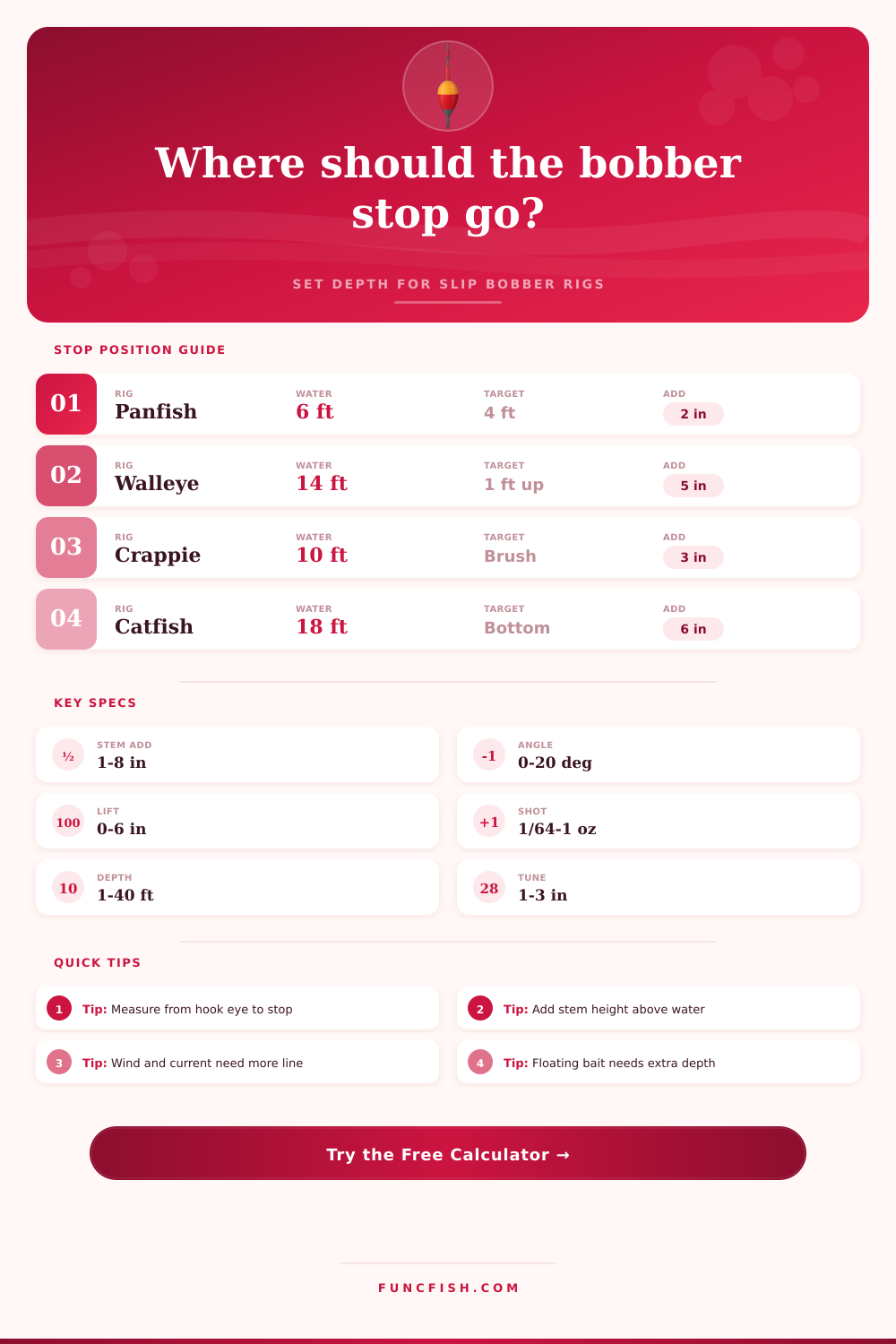
Calculate the bobber stop distance from your hook using target depth, bottom clearance, float stem height, line angle, shot weight, bait lift, current, and wind.
📌Scenario presets
⚙Depth and rig settings
Bobber stop setting
Full breakdown
📋Float and rig reference grid
Pencil Float
Weighted Waggler
Cork / Balsa
Catfish Float
📏Stop position tables
| Target situation | Base hook depth | Typical correction | Stop measurement | Best float style |
|---|---|---|---|---|
| Bluegill under dock | 3-6 ft / 0.9-1.8 m | 1-3 in / 3-8 cm | Hook eye to stop | Pencil slip float |
| Crappie above brush | 6-14 ft / 1.8-4.3 m | 2-5 in / 5-13 cm | Brush top minus clearance | Cork or balsa |
| Walleye over reef | 10-24 ft / 3-7.3 m | 4-9 in / 10-23 cm | Bottom minus 6-18 in | Weighted waggler |
| Trout drift | 3-10 ft / 0.9-3 m | 3-10 in / 8-25 cm | Depth plus drift angle | River drift float |
| Catfish near bottom | 8-30 ft / 2.4-9.1 m | 5-14 in / 13-36 cm | Bottom minus bait gap | Large catfish float |
| Line angle | Extra line at 6 ft | Extra line at 12 ft | Extra line at 20 ft | When it happens |
|---|---|---|---|---|
| 0 degrees | 0 in / 0 cm | 0 in / 0 cm | 0 in / 0 cm | Vertical calm set |
| 5 degrees | 0.3 in / 0.8 cm | 0.6 in / 1.5 cm | 0.9 in / 2.3 cm | Small breeze |
| 10 degrees | 1.1 in / 2.8 cm | 2.2 in / 5.6 cm | 3.7 in / 9.4 cm | Light current |
| 15 degrees | 2.5 in / 6.4 cm | 5.1 in / 13 cm | 8.5 in / 22 cm | Wind push or drift |
| 20 degrees | 4.6 in / 12 cm | 9.2 in / 23 cm | 15.4 in / 39 cm | Strong pull |
| Presentation | Target zone | Dropper length | First adjustment | Calculation note |
|---|---|---|---|---|
| Suspended crappie | 6-18 in above fish | 10-18 in | Shorten 3 in after misses | Use fish mark mode |
| Bottom walleye | 6-12 in off bottom | 8-16 in | Lengthen after clean drifts | Use bottom mode |
| Weed-top bass | 4-10 in over weeds | 12-20 in | Shorten if fouled | Use cover mode |
| River trout | Near seam speed break | 6-14 in | Add 4 in for drag | Use drift angle |
| Catfish cut bait | 6-24 in off bottom | 12-30 in | Add stem and slack | Use heavier shot |
💡Practical calculation checks
Measure the right span: The stop position is measured from the hook eye to the stop knot, not from the bobber to the hook while the rig is still on the rod.
Account for the float stem: If two inches of stem stays above water, the stop knot must sit about two inches farther from the hook to keep the bait at the target depth.
Watch the first cast: If the float lays over, shorten the stop or add shot. If it disappears too easily, reduce shot or add a small visibility allowance.
Use the table as a sanity check: Wind, current, braid, and large foam floats can all increase the actual line length needed for the same vertical hook depth.
The position of the stop knot on a slip bobber rig are critical because the position of the stop knot determine the depth of the bait. If the stop knot is in the wrong position, the bait will either sit too high or too low in the water, which will cause the fish to not biting the bait. Most anglers attempt to guess the position of the stop knot, but guessing often cause errors in the functioning of a slip bobber fishing rig.
There is a few different variable that must be accounted for in determining the position of the stop knot. These variables include the length of the float stem, the buoyancy of the bait, the angle of the fishing line, and the behavior of the bait. The length of the float stem should be accounted for in the total length of the slip bobber fishing rig.
How to Set the Stop Knot on a Slip Bobber
The portion of the float stem that rises above the water contribute to the length of the fishing rig, so the angler must account for the length of the stem in determining the position of the stop knot. If the length of the stem is not accounted for in the position of the stop knot, the bait will sit more higher in the water than the angler has intended. Furthermore, the type of bait that is being used can also contribute to the stopping point of the stop knot.
Bait that floats will sit higher in the water than bait that will sink; therefore, the angler must account for the buoyancy of the bait in the position of the stop knot. The angle of the fishing line can also contribute to the position of the stop knot. If the wind or the current in the water move the water, the wind or current will push against the float.
If the wind or current push against the float, the fishing line will not remain in a vertical line from the stop knot to the hook. Therefore, if the fishing line is at a sharp angle to the water’s surface, the distance between the stop knot and the hook must be longer than the depth that is calculate to account for the angle of the line. The slip bobber line depth calculator account for the angle of the line in relation to the depth required of the line.
The behavior of the bait will also play a role in the position of the stop knot. For instance, if the dropper length is short and includes a heavy jig, the fishing line will remain in a straight position compared to when the length of the dropper is long with a lighter bait. Therefore, the angler should adjust the position of the stop knot to account for these different scenarios.
Additionally, the type of fish that are in the water and the type of cover that they use when swimming will also impact the position of the stop knot. If the fish that are being targeted live in cover that include weeds or brush, the hook must remain a specific distance from these weeds. If the hook gets too close to the weeds, the hook may get stuck in them.
Therefore, the angler must adjust the position of the stop knot to ensure that the hook doesnt get too close to these weeds. The position of the stop knot can also be tuned after the angler casts the rig a few times. If the float of the slip bobber rig dissapears too quickly after the bait is cast into the water, this indicate that the distance between the stop knot and the hook is too long.
Therefore, the angler should move the stop knot closer to the hook. However, if the bait appears to be too high in the water relative to the target depth of the bait, the distance between the stop knot and the hook is too short, so the stop knot should be moved away from the hook. These adjustments should of be made slowly so as to avoid making too many error in the positioning of the stop knot.
Consistency in the positioning of the stop knot can best be achieved by measuring from the hook eye. Measuring from the hook eye to the stop knot will always be more consistent than attempting to estimate the distance from the float. Furthermore, by measuring from the hook eye, the angler will be able to easy reproduce the same distance being used for the stop knot.
By calculating the distance that the stop knot should be from the hook based off the depth that the bait should travel, the length of the float stem, and the angle of the fishing line, that distance can be easily replicated for those same conditions. Thus, by measuring from the hook eye, the angler will be able to maintain the accuracy of the position of the stop knot.