🎣 Slip Sinker Rig Calculator
Find the ideal sinker weight, leader length, and hook size for your fishing conditions
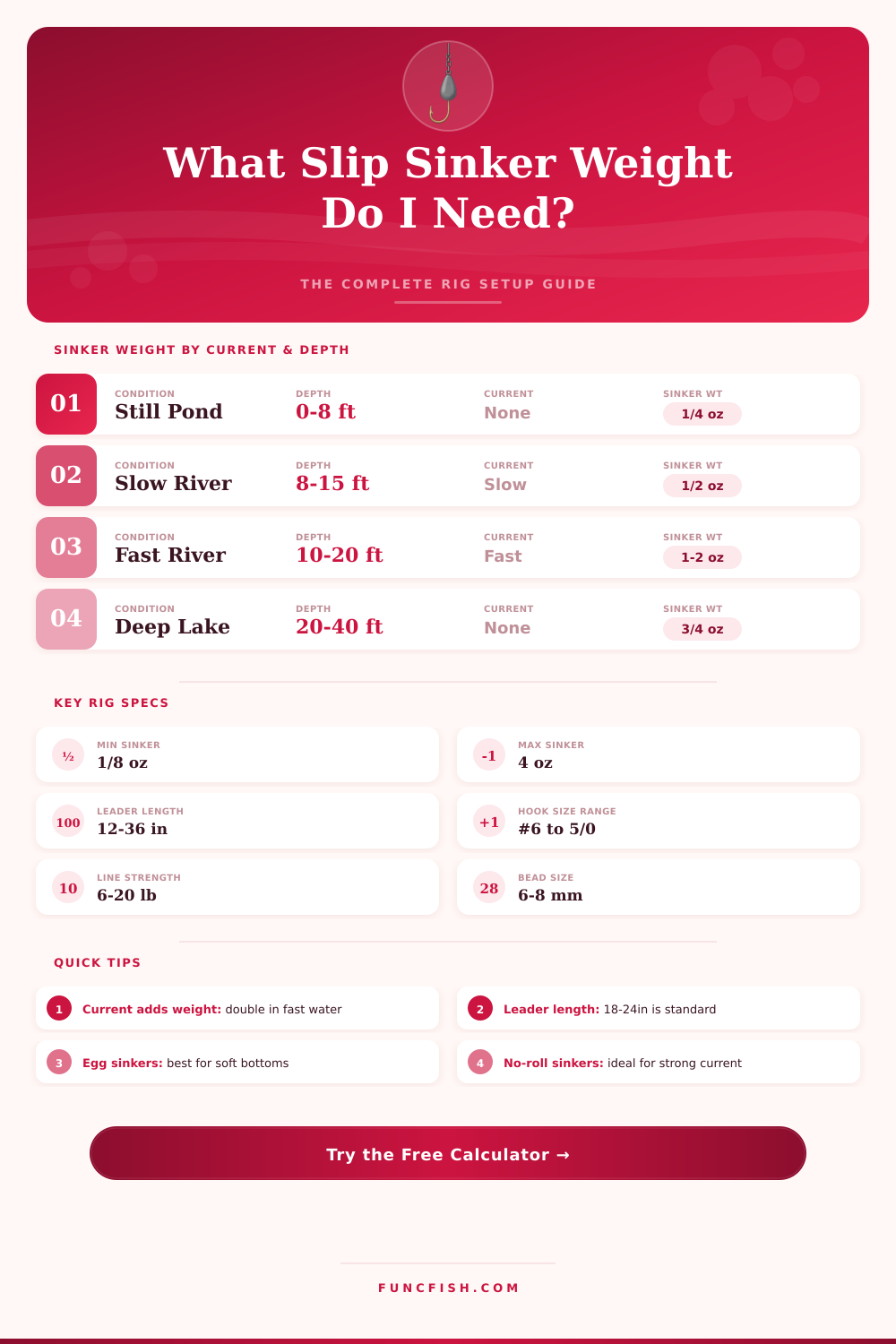
| Current | Depth 0–8 ft | Depth 8–20 ft | Depth 20–40 ft | Depth 40+ ft |
|---|---|---|---|---|
| Still | 1/8 – 1/4 oz | 1/4 – 1/2 oz | 1/2 – 3/4 oz | 3/4 – 1 oz |
| Slow | 1/4 – 1/2 oz | 1/2 – 3/4 oz | 3/4 – 1 oz | 1 – 1.5 oz |
| Moderate | 1/2 – 1 oz | 1 – 1.5 oz | 1.5 – 2 oz | 2 – 3 oz |
| Fast | 1 – 2 oz | 2 – 3 oz | 3 – 4 oz | 4+ oz |
| Species | Typical Weight | Rec. Line Test | Rec. Hook Size | Leader Length |
|---|---|---|---|---|
| Largemouth Bass | 1–8 lb (0.5–3.6 kg) | 10–17 lb | #2 to 2/0 | 12–24 in (30–61 cm) |
| Channel Catfish | 2–20 lb (0.9–9 kg) | 15–30 lb | 2/0 to 5/0 | 18–36 in (46–91 cm) |
| Walleye | 1–10 lb (0.5–4.5 kg) | 6–12 lb | #4 to 1/0 | 18–30 in (46–76 cm) |
| Trout | 0.5–5 lb (0.2–2.3 kg) | 4–10 lb | #6 to #10 | 12–18 in (30–46 cm) |
| Carp | 3–30 lb (1.4–13.6 kg) | 12–20 lb | #4 to 2/0 | 24–48 in (61–122 cm) |
| Striped Bass | 5–40 lb (2.3–18 kg) | 20–40 lb | 3/0 to 6/0 | 24–36 in (61–91 cm) |
| Northern Pike | 3–25 lb (1.4–11.3 kg) | 15–30 lb | 2/0 to 4/0 | 18–30 in (46–76 cm) |
| Panfish | 0.1–1 lb (0.05–0.45 kg) | 4–8 lb | #6 to #12 | 8–14 in (20–36 cm) |
| Line Type | Stretch | Visibility | Abrasion Resist. | Best For |
|---|---|---|---|---|
| Monofilament | High (25–30%) | Low–Moderate | Moderate | General slip rigs |
| Fluorocarbon | Low (5–8%) | Very Low (near invisible) | High | Clear water leaders |
| Braided Line | Near Zero (<1%) | High | Very High | Deep / heavy current |
A slip sinker rig are a fishing technique that uses a weights that can slide along the fishing line. Additionally, a slip sinker rig allow the bait to move naturaly in the water. If a person use a fixed sinker, the sinker will remain in one spot on the fishing line.
However, the fixed sinker can pull on the bait, which make the bait move in an unnatural way. By using a slip sinker rig, the weight will reduce the tension that the weight will place on the bait. Because fish is attracted to the natural movement of the bait, a slip sinker rig will allow the bait to move in a way that increase the chances of the fish biting on the bait.
How to Use a Slip Sinker Rig
The weight of the sinker that is use in a slip sinker rig must be chosen according to the depth of the water and the strength of the current in that area. If the current in the water is strong, then the strength of the current will require a heavier sinker for the bait to remain on the sea floor. However, if the current is weak, you can use a lighter sinker to avoid moving the bait in the weak current.
The type of sea floors in the area can also change the type of sinker that is use. For instance, if the sea floor is mud, then the sinker will need a specific shape to avoid get buried in the mud. For rocky bottoms, the sinker will need to grip the rock so that it does not tumble in the water.
The length of the leader will also change the behavior of the bait in the slip sinker rig. In clear water, the length of the leader should be longer. This is because clear water allow fish to see the bait more better, so giving the bait more room will encourage the fish to chase after it.
In water that is stained or muddy, the leader will be shorter because the mud can hide the bait, and having the bait in the strike zone will encourage the fish to bite on it. The length of the leader will need to be balanced with the size of the hook and the size of the bait. Too short of a leader could make the bait twist when fishing, but if the leader is too long, the fish bites may be soft.
The type of line that is used in a slip sinker rig will also change the function of the fishing rig. If monofilament line is use, it will float slightly in the water. Additionally, using monofilament line will create loop in the water if there is wind in the area.
Fluorocarbon line will sink quick in the water and is best used in clear water because fish find fluorocarbon line difficult to see. Braided line will not stretch when being fished. Additionally, braided line will allow the fisherman to feel the movement of the fish in the water.
However, braided line will require a heavier sinker so that the fishing line will sink. Different species of fish require different type of setups in a slip sinker rig. For instance, you will find catfish on the bottom of the water, so the bait will need to be cutbait with a sinker that will stay in place in the currents.
However, redfish will move with the tide in the water. Therefore, if the tide increase in strength, the weight of the sinker will need to be increased to accommodate the increased current strength. Each species of fish has its habit, so you will have to adjust the slip sinker rig to each type of fish that is to be caught.
To be successful with a slip sinker rig, a person must adjust the weight of the sinker, the length of the leader, and the type of line that is used in the slip sinker rig. If a person feel that the slip sinker rig isnt working correct, only one variable should of been changed at a time. For instance, the weight of the sinker could be changed, the length of the leader could be changed, or the type of line that is used in the slip sinker rig could be changed.
By changing these variable, the goal is to allow the bait to move in a way that mimics the natural movement of the fish that are baiting it.