Smoked Fish Weight Loss Calculator
Estimate final smoked fish weight, process loss, portion count, chamber loading, and starting fish needed from species fat level, brine uptake, surface area, smoke style, and target texture.
📌Smoking presets
⚙Fish, cure, and smoke inputs
Smoked fish weight results
Calculation breakdown
🐟Species and material yield grid
Salmon
Trout
Mackerel
Cod
Dry Cure
Wet Brine
Sweet Glaze
Jerky Strips
📊Smoking yield reference tables
| Species profile | Typical raw moisture | Oil retention | Classic hot smoke final yield |
|---|---|---|---|
| Salmon or steelhead | About 64% | High oil helps retain weight | 60% to 72% after trim |
| Trout or char | About 70% | Moderate oil, tender flesh | 58% to 70% after trim |
| Mackerel or bluefish | About 62% | High oil, strong smoke uptake | 64% to 76% after trim |
| Cod or pollock | About 80% | Lean flesh dries quickly | 52% to 64% after trim |
| Halibut or flatfish | About 78% | Lean, dense flakes | 50% to 62% after trim |
| Cure style | Modeled weight change before smoke | Smoke loss effect | Best calculator use |
|---|---|---|---|
| Dry cure | 2% early weight reduction | Adds firming and slightly more loss | Firm salmon, trout, sablefish |
| Balanced wet brine | 4% brine uptake | Neutral smoke loss baseline | Most hot smoked fillets |
| Light brine | 2% brine uptake | Slightly higher final moisture loss | Delicate fish or short batches |
| Sweet glaze | 7% surface and brine gain | Reduces apparent drying loss | Glossy portions and party trays |
| No cure | No brine gain | Higher purge and less retention | Direct smoke estimates only |
| Smoke target | Temperature band | Time band | Expected finish |
|---|---|---|---|
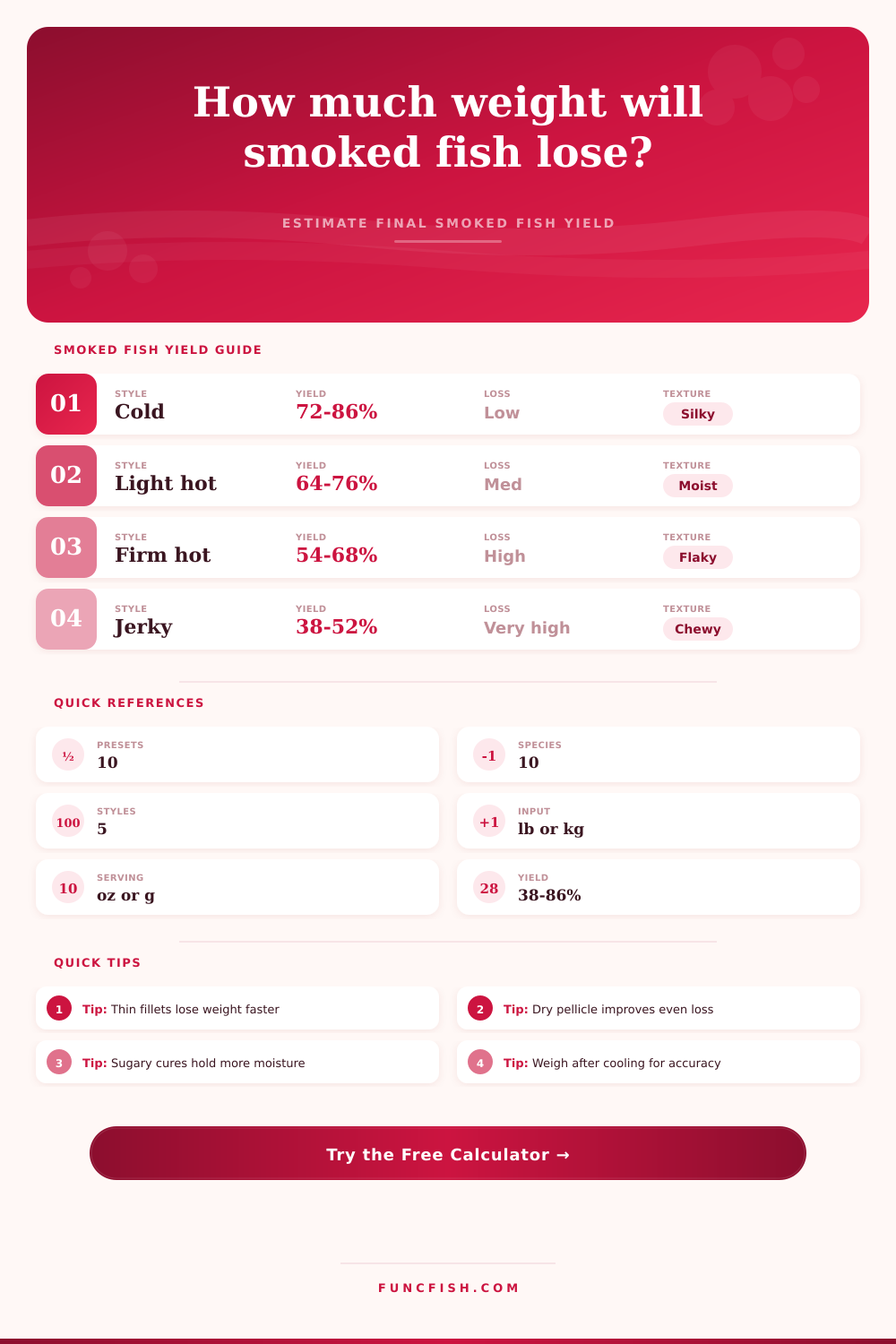
| Cold smoked | 70°F to 90°F | 8 to 24 hours | Highest yield, silky texture |
| Light hot smoked | 120°F to 150°F | 2 to 5 hours | Moist flakes and moderate loss |
| Classic hot smoked | 150°F to 185°F | 3 to 7 hours | Firm flakes and balanced yield |
| Dry hot smoked | 175°F to 210°F | 4 to 10 hours | Dense portions with higher loss |
| Jerky strips | 145°F to 180°F | 5 to 12 hours | Chewy texture and lowest yield |
| Finished serving plan | Imperial serving | Metric serving | Planning note |
|---|---|---|---|
| Appetizer board | 1.5 to 2.5 oz | 45 to 70 g | Use for rich smoked fish with sides |
| Breakfast or snack | 3 to 4 oz | 85 to 115 g | Good default for smoked salmon and trout |
| Main plate | 5 to 7 oz | 140 to 200 g | Use for hot smoked fillets or steaks |
| Jerky pouch | 1 to 2 oz | 28 to 57 g | Small servings because water loss is high |
💡Smoked yield tips
For mixed thickness: enter the thickest average portion, then use a party tray or dry texture margin when thin tail pieces will finish much earlier.
For repeat batches: weigh raw fish, cured fish, and cooled smoked fish once; update the cure uptake and trim values to match your smoker load.
You purchased a ten pound side of salmon for your dinner party, and now it has shrunk down to six pounds of flaky goodness. What happened? The salmon didn’t go into the oven and be eaten! The fish lost some water. Some volume was removed from the salmon as the water left leaving the fat and protein behind. Knowing that will help you plan accordingly.
Confused cooks scramble to figure out what they’ll serve in addition to the salmon. Confident host know how much fish to purchase. Knowing the right amount of shrinkage also allow you to make an informed decision. The salmon shrinkage calculator accounts for moisture, the amount of cure taken up, and the strength of the smoke. It turns that guesswork into a solid plan.
Why Your Salmon Loses Weight When Cooking
Before the fish goes on the smoker is when it gets cured. It is done either with a wet brine or a dry salt rub. During this stage, the fish chemically changes itself. Typically, a wet brine result in weight gain due to absorption by muscle tissue. That early increase is important. It establishes your bigger baseline. Even if you lose the same percent of meat in the smoke as someone who does not cure they’ll end up with less overall weight.
Without a cure, the moisture inside the fish evaporates rapidy. Your finished product’s yield drops and so does the texture. And that’s just setting the table for everything else.
Once the fish has been cured and dried, heat pulls out the water. Because fish is primarily water, they dry out quickly. Species that are leaner, like cod… Are nearly eighty percent water. More to go. Fatty fish, such as salmon, begin around sixty percent water. They hold on to a higher percentage of their initial weight. Your species will decide your ultimate yield. See the chart below. As the table suggest, you’re not going to get what you put in with lean whitefish different than you will with fatty trout. The fish’s biology sets the bar.
You have control over two variables: time and temperature. If you keep it low and smoke slowly, you’ll get higher yields. Because the proteins don’t contract too aggressively the fish remains moist with a silky texture. When you hot smoke it, the water comes out quicker. At higher temperatures, the flake will be firmer (and the final weight will be lower). In the case of jerky, where you want to extract as much water as possible, the yield is much lower. Here’s where the tool does the math for you based off what time/temperature you choose. This provides a realistic expectation of how much you’ll end up with.
Trimming is the last thing that can change your weight at the end of the day. Smoked fish are covered with dark blood lines, pin bones and leathery edges that need to be removed. People commonly forget to include this in their estimate. Planning for a perfect yield might leave you short. Cleanup usually result in three to five percent waste. Have a place for it on the calculator, it makes the math more accurate.
When planning out a dish that serves on a plate, think backwards from it. How many four ounce servings do I want? That’s 24 ounces. What does that mean in finished product? Ninety six ounces. But what if my yield is only sixty percent? You’ll have to begin with more raw fish. The calculator will tell you exactly how much raw fish to buy. It factors in the margin of error. It is a great help when working with uneven fillet.
Smoking, like any other cooking method, is also a form of deliberate reduction. Water is removed from the food, concentrating its flavors while keeping its flesh. When we learn to embrace weight loss as part of the recipe, it alters our approach to the project: we buy enough raw fish to account for the loss in weight. Curing becomes intentional; smoking follows suit. What results is something flavorful and dense. Knowing the numbers ahead of time allows us to savor the process without concern for scale.
You should of known that!