Snap Weight Depth Calculator
Estimate how deep a trolling setup will run from snap weight size, line out, clip position, line drag, lure dive, speed, and current.
📌Scenario presets
⚙Trolling setup
Snap weight depth estimate
Full breakdown
📋Line and weight reference grid
10 lb Braid
15 lb Mono
17 lb Fluoro
3 oz Snap
📏Snap weight depth tables
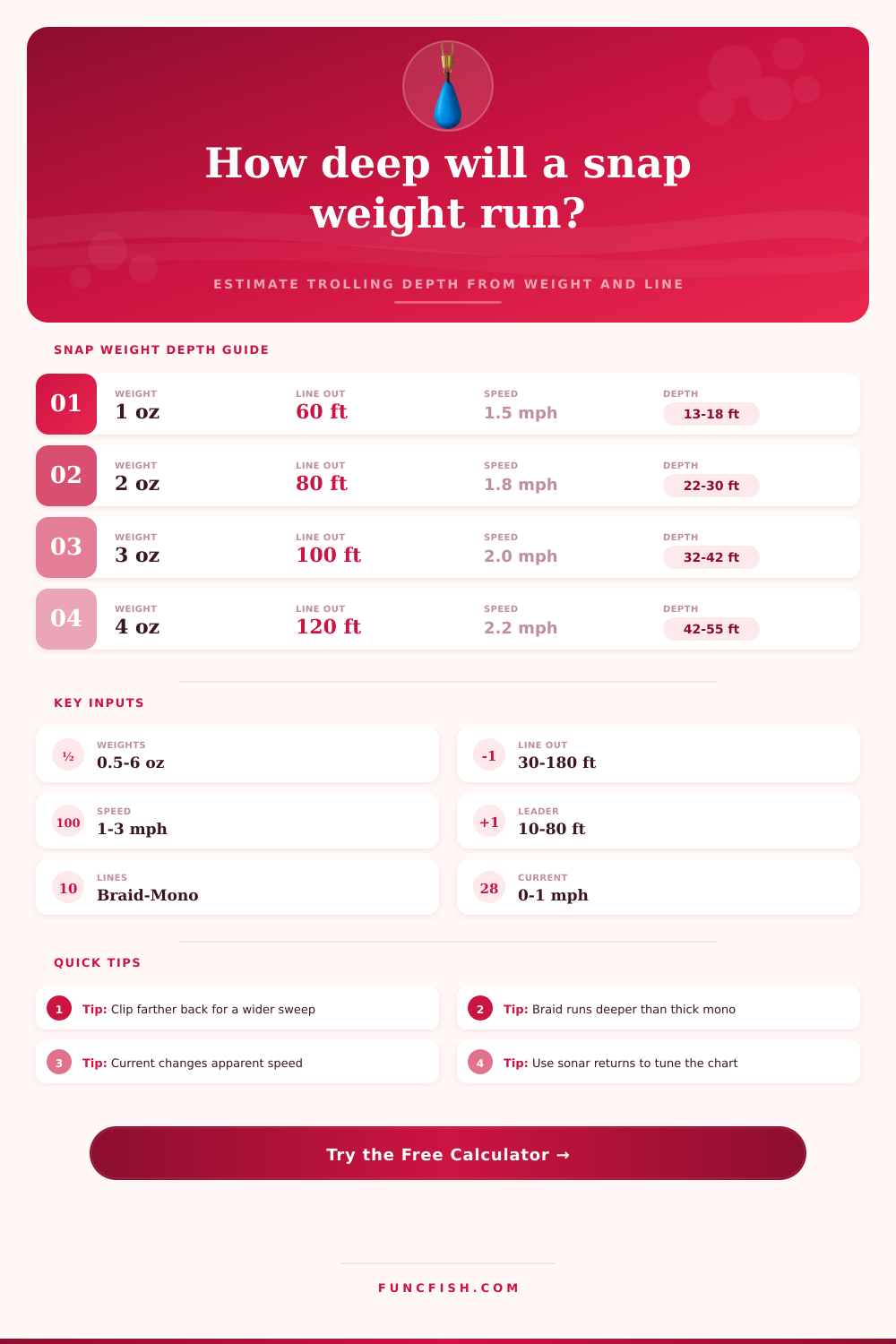
| Snap weight | Typical line out | Useful speed range | Approximate added depth |
|---|---|---|---|
| 0.5 oz / 14 g | 30-70 ft / 9-21 m | 1.0-1.8 mph | 4-10 ft / 1.2-3 m |
| 1 oz / 28 g | 40-90 ft / 12-27 m | 1.2-2.2 mph | 8-18 ft / 2.4-5.5 m |
| 2 oz / 57 g | 60-120 ft / 18-37 m | 1.3-2.4 mph | 15-30 ft / 4.6-9.1 m |
| 3 oz / 85 g | 80-150 ft / 24-46 m | 1.4-2.6 mph | 22-42 ft / 6.7-12.8 m |
| 4 oz / 113 g | 90-180 ft / 27-55 m | 1.5-2.8 mph | 30-55 ft / 9.1-16.8 m |
| 6 oz / 170 g | 120-220 ft / 37-67 m | 1.6-3.0 mph | 42-75 ft / 12.8-22.9 m |
| Lure or rig | Base dive at 100 ft | Drag behavior | Best snap role |
|---|---|---|---|
| Shallow crankbait | 6-9 ft / 1.8-2.7 m | Low pull | Reach suspended fish |
| Medium crankbait | 10-14 ft / 3-4.3 m | Moderate pull | Stretch the dive curve |
| Deep crankbait | 17-25 ft / 5.2-7.6 m | High pull | Fine tune above bottom |
| Trolling spoon | 1-3 ft / 0.3-0.9 m | Very low pull | Primary depth control |
| Crawler harness | 2-5 ft / 0.6-1.5 m | Blade drag | Slow contour work |
| Live bait rig | 1-2 ft / 0.3-0.6 m | Natural drag | Hold depth at slow speed |
| Species pass | Common target depth | Typical speed | Common snap setup |
|---|---|---|---|
| Walleye flats | 15-35 ft / 4.6-10.7 m | 1.2-2.2 mph | 1-3 oz, 50/50 method |
| Open-water salmon | 25-70 ft / 7.6-21.3 m | 2.0-3.0 mph | 3-6 oz on braid |
| Lake trout edges | 35-80 ft / 10.7-24.4 m | 1.4-2.4 mph | 3-6 oz with spoons |
| Brown trout shoreline | 8-25 ft / 2.4-7.6 m | 1.5-2.3 mph | 0.5-2 oz on stickbaits |
| Striped bass tide | 15-45 ft / 4.6-13.7 m | 1.8-3.0 mph | 2-4 oz against push |
| Crappie basin | 8-20 ft / 2.4-6.1 m | 0.9-1.5 mph | 0.5-1 oz light line |
| Adjustment | Depth effect | When it matters | Calculator treatment |
|---|---|---|---|
| Thinner braid | Runs deeper | Long leads and small weights | Lower drag factor |
| Speed increase | Runs shallower | Spoons and harnesses | Higher apparent drag |
| Leader before clip | Changes lure dive | Crankbaits ahead of weight | Separate lure dive segment |
| Following current | Runs deeper | River channels and tides | Reduces apparent speed |
| Cross wind bow | Runs shallower | Planer boards and side pull | Adds line-bow penalty |
| Sonar calibration | Corrects estimate | Known bottom ticks | Applies a multiplier |
💡Depth calculation checks
Tip: Treat snap-weight charts as starting points. Line diameter, boat surges, lure pull, and current can move the running depth several feet.
Tip: If the calculator is close but not exact, enter a known sonar or bottom-contact depth once and reuse that calibrated spread for the same setup.
Snap weights is tools that solve a problem for peoples who troll for fish. People who troll for fish use a lure that run at a specific depth. A person doesnt want to switch rods or purchase new fishing gear to fish at a different depth for the bait.
A snap weight clip onto the fishing line behind the boat. The snap weight create mass for the fishing line. This mass allow the fishing line and its attached lure to go downward into the water.
How to Use Snap Weights to Control Lure Depth
There are several variable that affect the depth of the bait, and these variable interact with each other. To find the best depth for the bait, a person should use a calculation instead of guessing at the depth that the bait will reach or using a single depth chart to determine depth. The diameter of the fishing line is one of the variable that will affect the depth of the lure.
Using a thick fishing line will create more drag for the line in the water. More drag for the fishing line will cause the line to lift the lure upward. Using braided fishing line will allow the line to move through the water with less resistance than the monofilament fishing line of the same strength.
The use of a braided fishing line of the same strength as the monofilament line will allow the bait to travel to a deeper point in the water. As the length of the fishing line increase, the difference in depth increase between braided and monofilament line. The speed of the boat is another variable in determine the depth of the lure.
High speed for the boat will increase the pressure of the water on the fishing line and the lure. Higher water pressure on the line and lure will push the line and lure upward in the water. Even small change in boat speed will move the lure several feet in the water.
Current is another variable in setting the depth of the lure. If a person troll with the current in the water, the apparent speed of the lure decrease. With trolling with the current, the fishing line will remain straighter in the water.
With the fishing line remaining straighter in the water, the snap weight will sink to a deeper part of the water. If a person troll against the current, the effect will be opposite of trolling with the current. Crosswind and wave can affect the depth of the line and the lure in the water.
A crosswind or wave will create a side pull on the fishing line. This side pull will cause the fishing line to bow downward. When the fishing line bow downward, the effective depth of the lure will be less than with a straight fishing line.
Using a calculator will help a person with these variable. Using a calculator will save the person the effort of guessing at how these variable will affect the depth. The type of bait that is being use will affect the starting depth of the lure.
For example, crankbaits will have their own dive action. For this reason, a snap weight will only extend the depth of the lure. Other type of bait, such as spoons and live bait, will start near the surface of the water.
For these type of bait, the snap weight will perform the majority of the work to lower the bait to the desired depth. The distance between the bait and the snap weight will affect the depth of the lure. For example, using a long leader will allow the bait to maintain its natural action.
Using a leader of this length will allow the snap weight to move farther from the bait, which will allow the weight to pull the fishing line and the bait downward. Anglers often use depth table to determine the depth of the lure. Depth table, however, are often inaccurate in their indicated depth for the lure.
Depth table often assume that the water is still, the boat is traveling at an average speed, and that the line has a specific diameter. Water condition will rarely be the same as those assumed by depth table. As a result, the lure can travel out of the strike zone for the fish.
A depth table will not account for a current that follow the boat, change in the boat speed, or a different diameter of fishing line. To find the best depth for the bait, a person should use a calculation instead of a depth table. Another tool that can be used is the reference grids.
These grid will show a person the different depth of the snap weights with different length of fishing line and boat speed. These grid are a starting point for people who troll for fish. However, the grid will not provide the final answer.
A person should find a weight that get the bait as close to the desired depth as possible. Using the knowledge of the grid, a person can then adjust the length of the fishing line or the boat speed. Using a sonar device, the person can monitor the depth of the lure while adjusting the length or speed of the boat.
The height of the tip of the fishing rod can also impact the depth of the lure. For example, if a person set the rod tip higher above the water, the effective distance of the fishing line will be shorter. A shorter distance will create a different angle of the fishing line in the water.
This is most important for using light snap weight and length of fishing line. A calculation will account for the height of the rod tip above the water. However, many people do not account for this variable when determining the depth of the lure by eye.
A common mistake by people who troll for fish is assuming that adding more weight to the fishing line will increase the depth of the lure. However, using too much weight can create more drag for the line in the water. This drag will lift the bait.
The same effect will happen if a person let out too much fishing line. If a person use too much line, the fishing line will lift the snap weight and the lure. Using a calculator will help people understand where these effect begin to take place for a given length of fishing line.
Beyond the variable that directly relate to the fishing line and the boat, other variable relate to the area where the fish live. The temperature layer in the water will determine where the bait is located. For example, if the lure set to twenty-eight feet will not be able to find the fish if the bait is located at forty feet.
A snap weight will help to set the depth of the lure, but a person using snap weights will have to monitor the sonar graph to adjust the depth of the lure to where the fish are moving. One benefit to using a calculation for snap weights is that it allow for repeatability in the process. Once a person has determined the depth of the lure with a certain type of snap weight, line length, and boat speed, that same setup can be used in the future.
While the condition in the water may change, the effect of each of these variable will be the same. Using the calculation allow a person to create a routine in trolling for fish that ensures that the line and the bait will reach the depth that the angler desire.