🎯 Speargun Band Calculator
Calculate optimal band length, stretch ratio, and pull force for your speargun setup
| Barrel Length | Rec. Band Length (3:1) | Stretched Length | Power Level |
|---|---|---|---|
| 40 cm (16 in) | 16 cm (6.3 in) | 48 cm (18.9 in) | Low |
| 60 cm (23.6 in) | 20 cm (7.9 in) | 60 cm (23.6 in) | Medium |
| 80 cm (31.5 in) | 27 cm (10.6 in) | 81 cm (31.9 in) | Medium-High |
| 100 cm (39.4 in) | 33 cm (13 in) | 99 cm (39 in) | High |
| 110 cm (43.3 in) | 37 cm (14.6 in) | 111 cm (43.7 in) | High |
| 120 cm (47.2 in) | 40 cm (15.7 in) | 120 cm (47.2 in) | Very High |
| 130 cm (51.2 in) | 43 cm (16.9 in) | 129 cm (50.8 in) | Max |
| Species | Typical Weight | Barrel Length | Band Rec. |
|---|---|---|---|
| Reef Snapper | 1–5 kg (2–11 lb) | 60–75 cm | 14–16mm, 1 band |
| Grouper | 5–30 kg (11–66 lb) | 90–110 cm | 16–18mm, 2 bands |
| Tuna (Bluefin) | 30–200 kg (66–440 lb) | 120–150 cm | 20mm, 2–3 bands |
| Wahoo | 10–40 kg (22–88 lb) | 100–120 cm | 16–18mm, 2 bands |
| Mahi-Mahi | 5–20 kg (11–44 lb) | 90–110 cm | 16mm, 2 bands |
| Flounder | 0.5–3 kg (1–7 lb) | 50–65 cm | 14mm, 1 band |
| Amberjack | 10–50 kg (22–110 lb) | 110–130 cm | 18–20mm, 2 bands |
| Snook | 2–10 kg (4–22 lb) | 70–90 cm | 16mm, 1–2 bands |
| Cobia | 5–25 kg (11–55 lb) | 90–110 cm | 16–18mm, 2 bands |
| Sea Bass | 1–8 kg (2–18 lb) | 65–85 cm | 14–16mm, 1–2 bands |
| Shaft Dia. | Min Band Width | Rec. Band Width | Max Band Width |
|---|---|---|---|
| 5 mm | 12 mm | 14 mm | 16 mm |
| 6 mm | 14 mm | 16 mm | 18 mm |
| 6.5 mm | 14 mm | 16 mm | 18 mm |
| 7 mm | 16 mm | 16–18 mm | 20 mm |
| 8 mm | 16 mm | 18 mm | 20 mm |
| 9 mm | 18 mm | 20 mm | 22 mm |
| 10 mm | 20 mm | 20–22 mm | 24 mm |
Speargun bands are essential speargun component as the speargun’s performance rely on the quality of the speargun bands. If you install speargun bands incorrectly, the speargun can have too much recoil or too little power. To avoid these issue, you should of understood the proper way to select and install speargun bands.
The first step in installing speargun bands is determining the band route. The band route is the distance that the speargun band take from the band slot to the shaft notch. The length of the speargun barrel does not necessarily indicate the band route.
How to Choose and Fit Speargun Bands
The muzzle’s design can change the band route. For instance, spearguns with an open muzzle has a shorter band route than spearguns with a roller muzzle. The length of the band route dictates the length of the speargun bands to cut.
If you dont measure the band route, speargun bands may be cut to the wrong length. Another vital measurement is the stretch ratio of the speargun bands. The stretch ratio is the relationship between the length of the speargun bands when resting and when they is stretched.
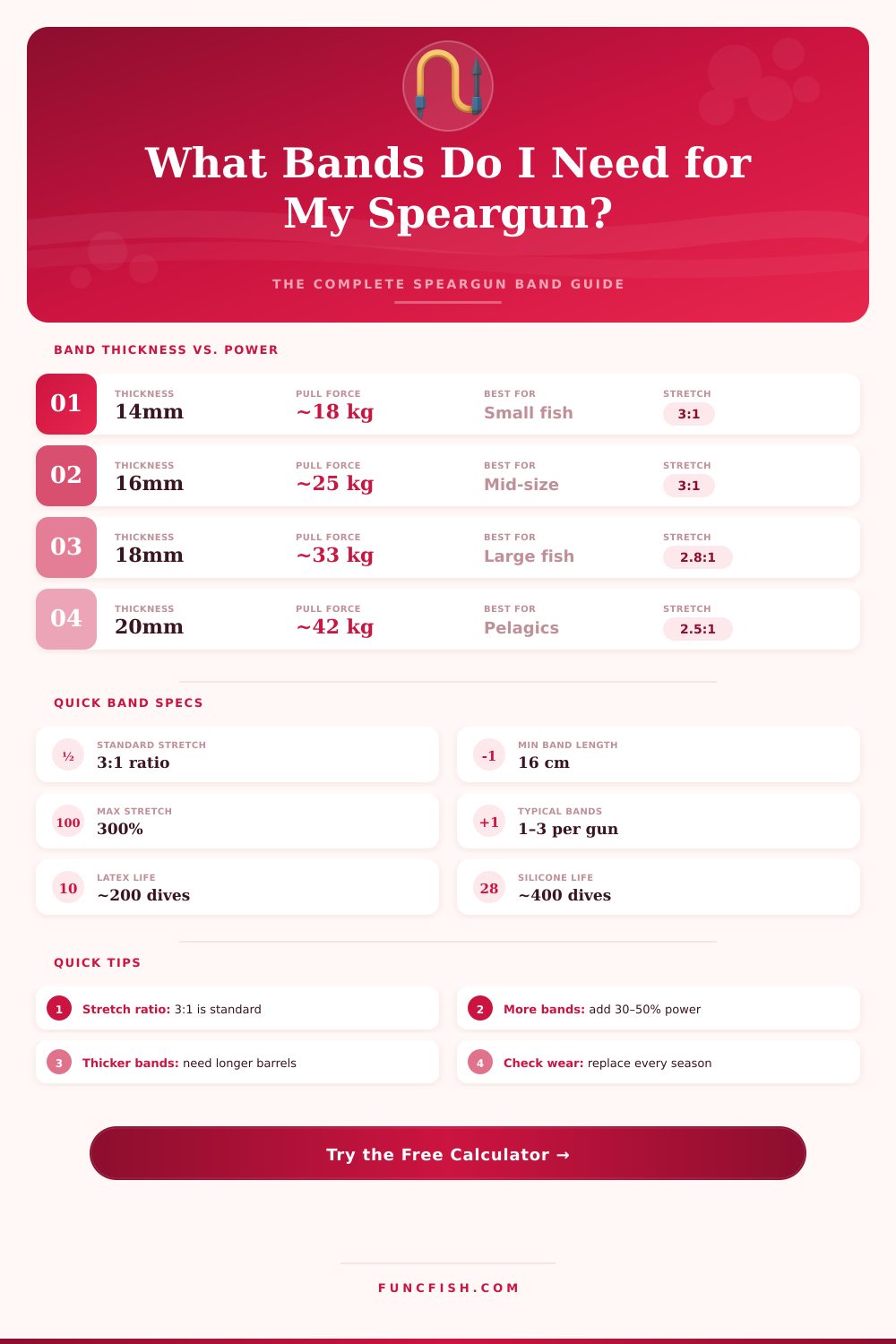
You must maintain the stretch ratio to ensure that the bands do not break and to ensure that they provide enough power to the speargun shaft. If the stretch ratio is higher than 3.6, the speargun bands may break or blow out of the speargun during use. If the stretch ratio is lower than 3.0, the speargun bands will not provide enough energy to propel the speargun shaft forward.
For instance, 14 mm speargun bands has a stretch ratio of 3.0 to 3.2 while 18 mm speargun bands for catching larger fish requires a stretch ratio of 3.3 or higher. The latex grade of the speargun bands and the speargun shaft diameter determine how well the speargun bands will function. Depending on the latex grade selected for the speargun bands, the speargun can have more power or more control.
Soft latex provide better control while power oriented latex provides more energy. The shaft diameter must be able to manage the recoil created by the speargun bands. If using multiple heavy speargun bands, the shaft has to be thick enough to manage the recoil.
Thicker shafts are required for spearguns with heavy bands while thinner shafts may be required for smaller spearguns. The number of speargun bands will increases the power that the speargun bands create. However, using too many speargun bands will create too much recoil for the speargun.
Adding too many speargun bands to a short speargun will make it difficult for the speargun user to aim the speargun due to the recoil that the speargun will create. Instead of adding too many speargun bands, the user should consider the geometry of the speargun and the stretch ratio of the bands. Another factor to consider is the wishbone allowance.
This is the length of the speargun bands that is required for knots and dyneema to attach to the speargun shaft. The wishbone allowance should be between 6 cm and 10 cm. Environmental factors can change how well the speargun bands will function.
For example, speargun bands made of fresh latex will stretch more better than latex that has sat for a while. Old latex may become gummy and not function as effectively as fresh latex. The temperature of the water that is being speared can also change how the bands work; colder water can make the latex for the speargun bands stiffen.
Finally, before cutting the speargun bands, you should measure the band route with a string. Using a string to measure the band route will ensure that the bands are cut to a correct length. Cutting the bands to the correct length will ensure that no material is wasted when equipping the speargun.
Its important to recieve the right equipment, and using alot of different bands can be confusing.