Stinger Hook Length Calculator
Calculate the finished stinger link from the anchor point to the hook eye, then convert it to cut length with hook geometry, knot allowance, material stretch, tail clearance, and short-strike placement.
📌Stinger rig presets
⚙Rig geometry inputs
Measure the anchor point from the lure nose to the jig hook bend, split ring, wire loop, or keeper where the stinger link starts. Measure hook eye-to-point along the pull direction, not around the bend.
Stinger hook length result
Calculation breakdown
🎣Gear and species comparison grid
Walleye jig
Salmon troll
Spinnerbait
Pike trace
Musky lure
Trout spoon
Lake trout tube
Fluke bait
📏Hook geometry reference
| Hook style | Typical eye-to-point projection | Typical gap or width | Best stinger use |
|---|---|---|---|
| Size 8 compact treble | 0.45 in / 1.1 cm | 0.30 in / 0.8 cm | Small spoons, walleye minnows, finesse paddletails |
| Size 6 round-bend treble | 0.55 in / 1.4 cm | 0.36 in / 0.9 cm | 3 to 4 inch soft plastics and lake trout tubes |
| Size 4 round-bend treble | 0.68 in / 1.7 cm | 0.46 in / 1.2 cm | 4 to 6 inch swimbaits and larger spoons |
| Size 2 heavy treble | 0.82 in / 2.1 cm | 0.58 in / 1.5 cm | Pike, musky, heavy-current bait rigs |
| 1/0 short-shank single | 0.78 in / 2.0 cm | 0.55 in / 1.4 cm | Spinnerbait trailer hooks and weedier presentations |
| 3/0 octopus hook | 1.20 in / 3.0 cm | 0.82 in / 2.1 cm | Salmon, fluke strips, baitfish trolling rigs |
🔗Link material and attachment allowances
| Material | Working stretch used | Stiffness effect | Typical extra cut length |
|---|---|---|---|
| 20 to 40 lb fluorocarbon | 1.2% to 1.6% | Holds a straighter line but can spring away from soft baits | 0.8 to 1.2 in / 2.0 to 3.0 cm |
| 25 lb monofilament | 2.5% | Soft and forgiving, but grows slightly under pull | 0.7 to 1.0 in / 1.8 to 2.5 cm |
| 30 lb braid | 0.4% | Very limp, good for natural trailing action | 0.7 to 1.1 in / 1.8 to 2.8 cm |
| 80 lb assist cord | 0.6% | Limp with high abrasion resistance around split rings | 1.0 to 1.4 in / 2.5 to 3.6 cm |
| 7-strand wire | 0.2% | Tooth-proof, but needs a larger loop radius | 1.3 to 2.0 in / 3.3 to 5.1 cm |
| Single-strand titanium | 0.3% | Springy and kink resistant, useful for pike and musky | 1.5 to 2.2 in / 3.8 to 5.6 cm |
🐟Rig placement reference
| Presentation | Anchor point | Hook point target | What to watch |
|---|---|---|---|
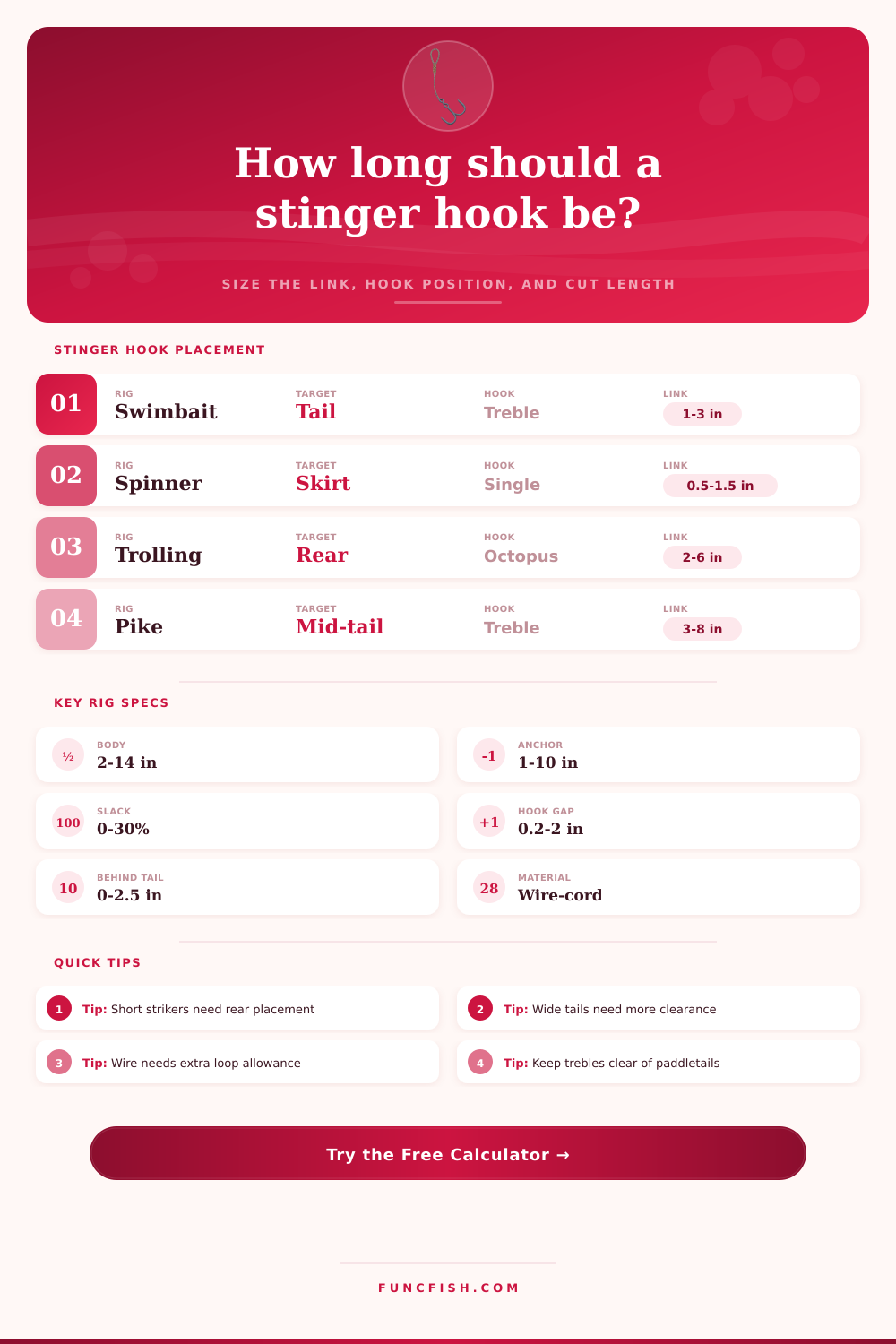
| Soft swimbait jig | Jig hook bend or small line loop | Just behind the paddletail hinge | A treble that reaches the tail paddle will foul on every kick |
| Spinnerbait trailer hook | Main hook bend with tubing keeper | Skirt end or slightly beyond skirt | Too long turns the trailer sideways on helicopter falls |
| Hoochie or trolling fly | Rear of skirt head or bead chain | Near skirt tips when wet | Fast trolling stretches soft leaders and moves hooks back |
| Deadbait quick-strike | Front hook or wire eye | Second hook at rear third of bait | Spacing should follow bait length, not just wire length |
| Bucktail or musky bait | Rear split ring or tail wire | Behind hair but ahead of blade strike path | Large trebles need room to swing without touching blades |
| Spoon assist | Split ring or solid ring | Hook point trailing spoon cup | Short links keep the hook from wrapping over the spoon |
🎯Species strike-zone reference
| Target species | Common short-strike pattern | Useful hook placement | Length adjustment |
|---|---|---|---|
| Walleye and zander | Nipping from the rear or clamping the tail | Point 0.2 to 0.6 in behind tail on 3 to 5 inch baits | Add a small setback, but keep the hook above the paddletail path |
| Bass | Engulfing from behind or below | Point at tail hinge or skirt end | Shorten in grass and lengthen slightly in open water |
| Salmon trolling | Slashing and turning on a skirt | Hook bend near skirt tips once the skirt is wet | Allow for leader stretch during speed changes |
| Pike and musky | Side hit followed by rolling pressure | Second hook near rear third or tail root | Favor wire and enough loop radius for hook rotation |
| Trout and kokanee | Quick pecks on small moving lures | Short assist behind spoon or fly | Keep the link short enough to avoid spoon wrap |
| Fluke and flounder | Grabbing the end of a strip or gulp bait | Hook point near the strip end | Match the setback to bait length and current sweep |
💡Rigging notes
Measure under light tension: A limp braid stinger and a fluorocarbon stinger can measure the same on the bench but fish at different effective lengths. Pull the finished rig straight before comparing hook point position.
Check the swing path: After tying, wet the lure and shake it at fishing speed. If the hook point clips the paddletail, skirt, spoon cup, or blade path, shorten the link or choose a smaller hook before fishing it.
It is a stinger hook. The purpose of the stinger hook is to pick up short strikes that happen just before main hook sets. When you’re fishing a swimbait jig and feel a hard slam into something, it’s typically a short strike that you’ve missed. This happens if you don’t have the rig setup proper.
That’s where many anglers go wrong with getting the link length dialed in. If the link is too short, you’ll miss the strike, too long and you’ll be wrapping your own lure. The calculator does all of the math for you so you won’t have to guess out there on a windy bank but knowing why those numbers are important will change the way you fish with them.
How to Set Up Your Stinger Hook
Keep in mind that link length doesn’t always change at the same rate between hook eye and the jig head; this is the biggest mistake most people make. The current pulls the links tight, but tails cause the hooks to sway far away. Consider the swing path before tying a single knot. A curl tail does not produce the same wake as a paddletail which determines hook positioning relative to bait body. On each kick if the hook point clips the paddle, you’re simply adding drag and weight. The key is to place it near the tail enough to catch bites but still away from main action.
Your materials also greatly affect true length of your rig. While fluoro is stiff and has very little stretch, it will hold its form. The problem with braid is that it’s going to be pretty limp and has minimal stretch unless trimmed right, in which case it’ll ball up on you. Then wire won’t stretch whatsoever, but it need a bigger loop size to work well. So those factors come into play on how much you need to account for in your cut length, particularly if you’re using some sort of large knot or crimp. Half an inch different than your raw cord could go away completely when the knot cinches down and the fishing line is tight while fighting a fish. For this reason, measuring out the final product with slight tension are better than simply counting on a ruler on the bench.
The hook geometry also affects proximity of the point to the bait. The smaller size 8 treble has the smaller eye-to-point projection and it sit closer to the jig head without fouling. Heavy assist hook or a bigger octopus hook will project further out so they needs more clearance behind the bait. So again with the hook size you selected, adjust your link length accordingly. Swapping hooks without adjusting the link mean that your point will not be in the right place relative to the tail hinge and your balance score goes down.
The last tweak is informed by species behavior. For walleyes, which nip from behind, you want the hook positioned just behind tail root. Musky and pike are inclined to roll over baitfish so sometimes you want to space your hook further back to cover some more length of body. When trolling salmon, the combination of speed and stretch on leaders tend to pull hooks back on their own. That’s another dynamic force requiring extra slack added to the equation.
The calculator creates a balance score. It rewards setups with good strike coverage but avoids ones prone to fouling, making those tradeoffs easy to see. A stinger should of been thought of as an extension of your presentation. It must complement the lure’s motion. After tie-in, shake the rig around and get it wet. Observe how hook swings. Ideally, it stays in the sweet spot, never touching the skirt or plastic while doing so. This subtle detail can convert tentative bites into caught fish.