Sturgeon Lifespan Calculator
Estimate sturgeon age, likely lifespan, maturity stage, growth window, and confidence from species, fork length, girth, weight, river or lake habitat, growth zone, and age-band reference.
📌Sturgeon lifespan presets
⚙Species, size, habitat, and age inputs
Sturgeon lifespan estimate
Calculator output appears here after choosing a sturgeon profile.
Calculation breakdown
📊Sturgeon species and lifespan comparison grid
Lake Sturgeon
White Sturgeon
Green Sturgeon
Atlantic Sturgeon
Shovelnose
🧬Species baseline reference
| Species | Typical lifespan | Fork length model | Maturity cue | Calculator effect |
|---|---|---|---|---|
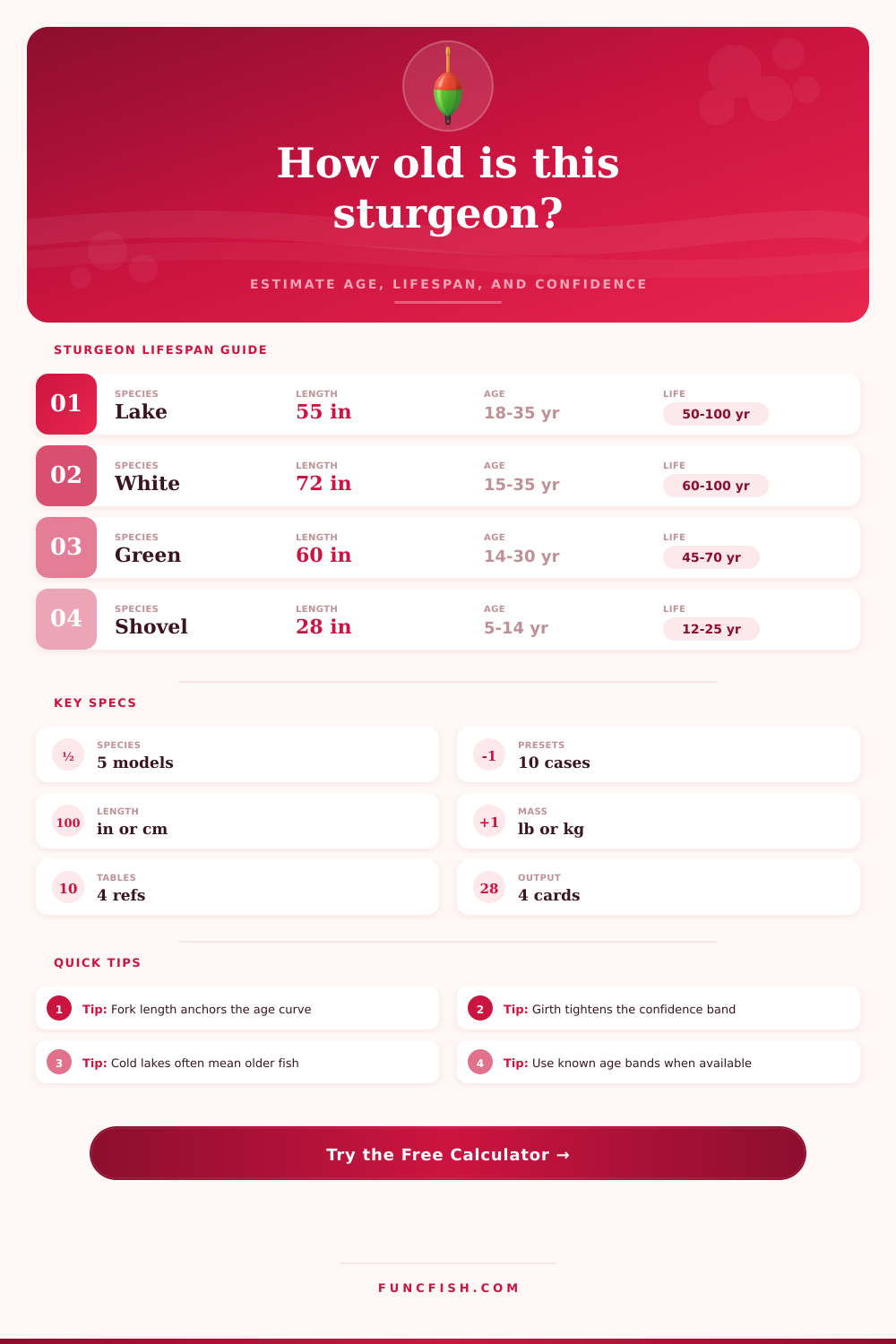
| Lake sturgeon | 50-100 years | Long, slow curve | Often late maturity | Raises age for the same length |
| White sturgeon | 60-100 years | Largest body ceiling | Large adult size threshold | Allows very long remaining lifespan |
| Green sturgeon | 45-70 years | Coastal big-river profile | Mid-to-late maturity | Moderate age and high adult range |
| Atlantic sturgeon | 40-60 years | River-ocean growth profile | Adult size varies by river | Balances growth and longevity |
| Shovelnose sturgeon | 12-25 years | Compact river profile | Earlier adult class | Caps maximum lifespan lower |
📏Fork length and age-band reference
| Age band | Small species length | Large species length | Typical age signal | Use in calculator |
|---|---|---|---|---|
| Juvenile | 10-20 in / 25-51 cm | 18-36 in / 46-91 cm | Young and fast-changing | Wide confidence band |
| Subadult | 20-27 in / 51-69 cm | 36-55 in / 91-140 cm | Pre-mature or maturing | Growth zone matters most |
| Mature adult | 27-34 in / 69-86 cm | 55-80 in / 140-203 cm | Adult size reference | Maturity class tightens age |
| Large adult | 34+ in / 86+ cm | 80+ in / 203+ cm | Older adult likely | Condition and habitat refine result |
🌊Habitat, maturity, and growth modifiers
| Input | Lower setting | Middle setting | Higher setting | Calculator effect |
|---|---|---|---|---|
| Habitat | Warm reservoir | Large river | Cold lake | Changes age pace and lifespan ceiling |
| Growth zone | Productive fast | Average regional | Slow cold-water | Same length reads younger or older |
| Maturity | Immature | Mature adult | Late-life adult | Guards against impossible age classes |
| Body condition | Lean for length | Expected | Heavy for length | Adjusts confidence and growth reading |
| Age-band reference | Visual estimate | Regional table | Known-age band | Controls width of the final range |
🔎Measurement and confidence reference
| Measurement set | Best input | Secondary input | Confidence effect | Why it matters |
|---|---|---|---|---|
| High confidence | Fork length | Weight and girth | Narrowest band | Confirms condition instead of size alone |
| Medium confidence | Fork length | Weight or girth | Moderate band | One body metric checks the curve |
| Low confidence | Estimated length | No body metric | Wide band | Visual size can miss old slow growers |
| Reference only | Species class | Habitat class | Broadest band | Useful for comparison, not exact age |
| Known-age band | Independent age range | Measured size | Strong band | Supports the biological estimate |
💡Sturgeon age estimate notes
Age-band tip: Sturgeon can add length slowly after maturity, so a large fish from a cold lake may be much older than the same length from a productive river reach.
Measurement tip: Fork length drives the curve, while weight and girth mostly refine condition. Use measured body metrics to narrow the confidence band.
Sturgeon lives for long periods of time. Because sturgeon live for long periods of time, individuals may often wonder about the age of a sturgeon. Sturgeon grows at a slow pace after the sturgeon reaches it’s maturity.
Thus, length is an imperfect measurement of the age of a sturgeon. For instance, a 60-inch sturgeon that lives in a cold lake may be elder then a 60-inch sturgeon that lives in a warm river. A calculator can provide an estimate of the age of a sturgeon based off the species of the sturgeon, the fork length of the sturgeon, the girth of the sturgeon, the weight of the sturgeon, the habitat type in which the sturgeon lives, and the age reference type.
How to Estimate a Sturgeon’s Age
Fork length is the central measurement within the calculation of the age of a sturgeon. Most sturgeon species has a growth curve that indicates that they grows rapidly in their early years and that their rate of growth slows over time. The calculator computes an age of the sturgeon based upon the fork length of the sturgeon based upon this growth curve.
In addition to the length of the sturgeon, the calculator may also adjust the age of the sturgeon based upon the habitat type in which it lives and based upon the growth zone within which it lives. For instance, because sturgeon tend to live longer in cold lakes in the northern regions of their habitat ranges as compared to warm rivers in their southern regions, adjusting for habitat type will adjust the estimated age range of the sturgeon. Similarly, the growth zone settings for the calculation will impact the calculated age of the sturgeon; the growth zone settings will indicate if the individual sturgeon experienced either a fast or slow growth rate for that species of sturgeon.
Finally, the calculation of age may also use the maturity class of the sturgeon to ensure that the estimated age appears to be realistic for that sturgeon. Weight and girth of the sturgeon may be used in the calculation to determine the physical condition of the sturgeon. For instance, if the sturgeon is heavy for its length, it may be in good physical condition, and a sturgeon in good physical condition may have grown at a faster rate than most sturgeon of that species.
Conversely, a sturgeon that is lean may be growing slow and, therefore, may be of an older length than the length of the sturgeon suggests. Thus, weight and girth will be used to adjust the age of the sturgeon and the confidence in that calculated age. For instance, if length is the only value entered, the age band will be wider than if the other values are entered; the calculator is assuming the sturgeon is of average physical condition in only providing length as an input; thus, the band is wider to account for the assumption.
The maximum size for most sturgeon species range from 100 years for species like lake sturgeon and white sturgeon to 25 years for shovelnose sturgeons. Each species has these ranges as a means of calculating the age range of the sturgeon. Thus, age range calculations will use these references to adjust for the length of the sturgeon.
For instance, a lake sturgeon in its elder refuge habitat will have a range in its lifespan that is within the 100-year maximum lifespan range, but a lake sturgeon living in a warm reservoir may have a lifespan that is less than that range. Age-band reference type can be one of three different categories. For instance, using visual estimates of length will lead to the widest age band for the sturgeon; length measurements alone can be inaccurate due to the slow growth of sturgeon after maturity.
Using scute readings or fin-ray readings will indicate the age of the sturgeon and narrow the age band. Finally, tagging data will also lead to more narrow age band due to the age of the sturgeon being pre-determined by its tags. Thus, the calculator will widen or narrow the age band based upon the age-band reference type that is selected for the calculation.
One of the most common mistakes in interpreting the calculator’s output is to treat the estimated age as an exact age. Instead, the age band of the sturgeon is the calculated output. For instance, if length, weight, and girth are all determine for a sturgeon, it will have a much narrower age band than if those measurements are made only by eye.
Thus, the band of the calculated age indicates the uncertainty of the calculation of the age of the sturgeon. Sturgeon species grow to reach lengths slowly after they reach maturity as sturgeon. Thus, age does not necessarily correlate to length for sturgeon.
A 70-inch sturgeon living in a cold lake may be older than a 90-inch sturgeon that lives in a fast-growing river. Thus, adjusting for habitat type and growth zone will adjust the calculated age accordingly. The confidence in the age of the sturgeon will increase with the number of age determinations that are made.
For instance, if length, weight, and girth are entered, the calculator will have more confidence in the age of the sturgeon than if length is the only age measurement provide. In the latter case, the calculator makes an assumption about the physical condition of the sturgeon; if length, weight, and girth are entered, the calculation can make an accurate determination of physical condition. Thus, the confidence score indicates whether the age determination was based upon measured data for the sturgeon or upon assumptions about the physical condition of the sturgeon.
The age of sturgeon may be determined for various purposes. For instance, fish managers may use the determined age to establish size limits for sturgeon populations to ensure that the spawning age of the sturgeon is protected, and anglers may use the information to determine if the sturgeon has contributed to the sturgeon population’s next generation. Thus, the calculator allows anglers to determine the age of sturgeon without having to use a laboratory to perform analyses on the specimen.
While not as accurate as a laboratory analysis, the calculator can convert length measurements to age to determine whether a sturgeon is young, middle-aged, or old.