Swivel Size Calculator
Size a fishing swivel from target species, line test, lure or bait weight, scenario load, leader material, drag setting, safety factor, and swivel style.
📌Rig Presets
⚙Swivel Inputs
Swivel match estimate
Calculation breakdown
📋Equipment Data Cards
Light Swivels
All-Purpose Swivels
Heavy Swivels
Offshore Swivels
📊Reference Tables
| Swivel size | Nominal rating | Metric rating | Common line window |
|---|---|---|---|
| 14 | 20 lb | 9 kg | 2-6 lb finesse lines |
| 12 | 30 lb | 14 kg | 4-10 lb trout and light bass |
| 10 | 45 lb | 20 kg | 6-14 lb spinning and jigging |
| 8 | 60 lb | 27 kg | 10-20 lb all-purpose casting |
| 7 | 75 lb | 34 kg | 12-25 lb inshore and walleye |
| 6 | 90 lb | 41 kg | 15-30 lb bait and current rigs |
| 5 | 110 lb | 50 kg | 20-40 lb surf and pike leaders |
| 4 | 150 lb | 68 kg | 30-50 lb surf and salmon rigs |
| 3 | 200 lb | 91 kg | 40-65 lb trolling leaders |
| 2 | 250 lb | 113 kg | 50-80 lb heavy trolling |
| 1 | 300 lb | 136 kg | 65-100 lb offshore leader |
| 1/0 | 400 lb | 181 kg | 80-130 lb pelagic rigs |
| 2/0 | 500 lb | 227 kg | 100-160 lb tuna and shark leaders |
| 3/0 | 650 lb | 295 kg | 130-200 lb heavy offshore rigs |
| Swivel style | Strength behavior | Twist relief | Best calculator use |
|---|---|---|---|
| Barrel swivel | Baseline strength | Moderate | Simple bait rigs and low-speed current |
| Crane swivel | Efficient for size | Good | General casting, jigs, and drifting |
| Rolling swivel | Smooth compact build | Good | Leader connections and inshore rigs |
| Ball bearing swivel | Strong but slightly bulkier | Excellent | Trolling, spoons, flashers, spinning lures |
| Snap swivel | Snap is the limiting point | Moderate | Small lure swaps when drag is modest |
| Coastlock snap swivel | Better snap retention | Good | Surf plugs, spoons, and heavy casting |
| Three-way swivel | More junction load | Moderate | Bottom rigs, droppers, and current rigs |
| Power swivel | High rating for size | Good | Compact heavy leaders and offshore rigs |
| Species class | Typical line test | Drag window | Starting swivel band |
|---|---|---|---|
| Panfish | 2-6 lb / 1-3 kg | 0.5-2 lb / 0.2-0.9 kg | 14-12 |
| Trout | 4-8 lb / 2-4 kg | 1-3 lb / 0.5-1.4 kg | 12-10 |
| Bass | 10-20 lb / 5-9 kg | 3-7 lb / 1.4-3.2 kg | 10-7 |
| Walleye | 8-15 lb / 4-7 kg | 2-5 lb / 0.9-2.3 kg | 10-7 |
| Redfish / snook | 15-30 lb / 7-14 kg | 5-10 lb / 2.3-4.5 kg | 7-5 |
| Catfish | 20-50 lb / 9-23 kg | 6-16 lb / 2.7-7.3 kg | 6-4 |
| Pike / musky | 30-80 lb / 14-36 kg | 8-20 lb / 3.6-9.1 kg | 5-2 |
| Salmon | 20-50 lb / 9-23 kg | 6-18 lb / 2.7-8.2 kg | 4-2 |
| Tuna / pelagic | 50-200 lb / 23-91 kg | 15-80 lb / 6.8-36 kg | 1-3/0 |
| Scenario | Load multiplier | Twist base | Sizing note |
|---|---|---|---|
| Finesse casting | 0.95x | 24 | Small hardware matters more than reserve strength |
| General casting | 1.00x | 34 | Balanced starting point for most lure rigs |
| Heavy casting | 1.16x | 42 | Hard casts and heavier lures need more reserve |
| Jigging | 1.08x | 30 | Vertical load but less line twist than spoons |
| Drift or current rig | 1.22x | 38 | Current keeps steady pressure on the connection |
| Surf casting | 1.32x | 46 | Shock from sinkers and waves raises rating demand |
| Slow trolling | 1.40x | 52 | Use extra margin for steady pull and lure spin |
| Fast trolling | 1.72x | 66 | High drag and speed favor ball bearing hardware |
| Bottom rig | 1.18x | 36 | Sinker load and snag contact drive hardware size |
Ratings are calculator reference values for rig matching. Always compare them to the actual swivel package rating and the weakest connection in the rig.
🔗Swivel / Line / Species Comparison Grid
Trout Spoon
Small spinner or spoon rig with light mono or fluoro.
Bass Casting
Spinnerbait, spoon, or leader connection on medium tackle.
Walleye Drift
Jig, spinner rig, or bottom bouncer in moving water.
Inshore Leader
Redfish, snook, and schoolie striper leader connections.
Catfish Bottom
Sinker rig with steady pull and occasional snag shock.
Pike Wire
Wire leader, spoon, or glide bait with tooth protection.
Salmon Troll
Flasher, spoon, or rotating bait behind steady trolling load.
Tuna Trolling
Large pelagic leader with high drag and high pull reserve.
💡Calculator Tips
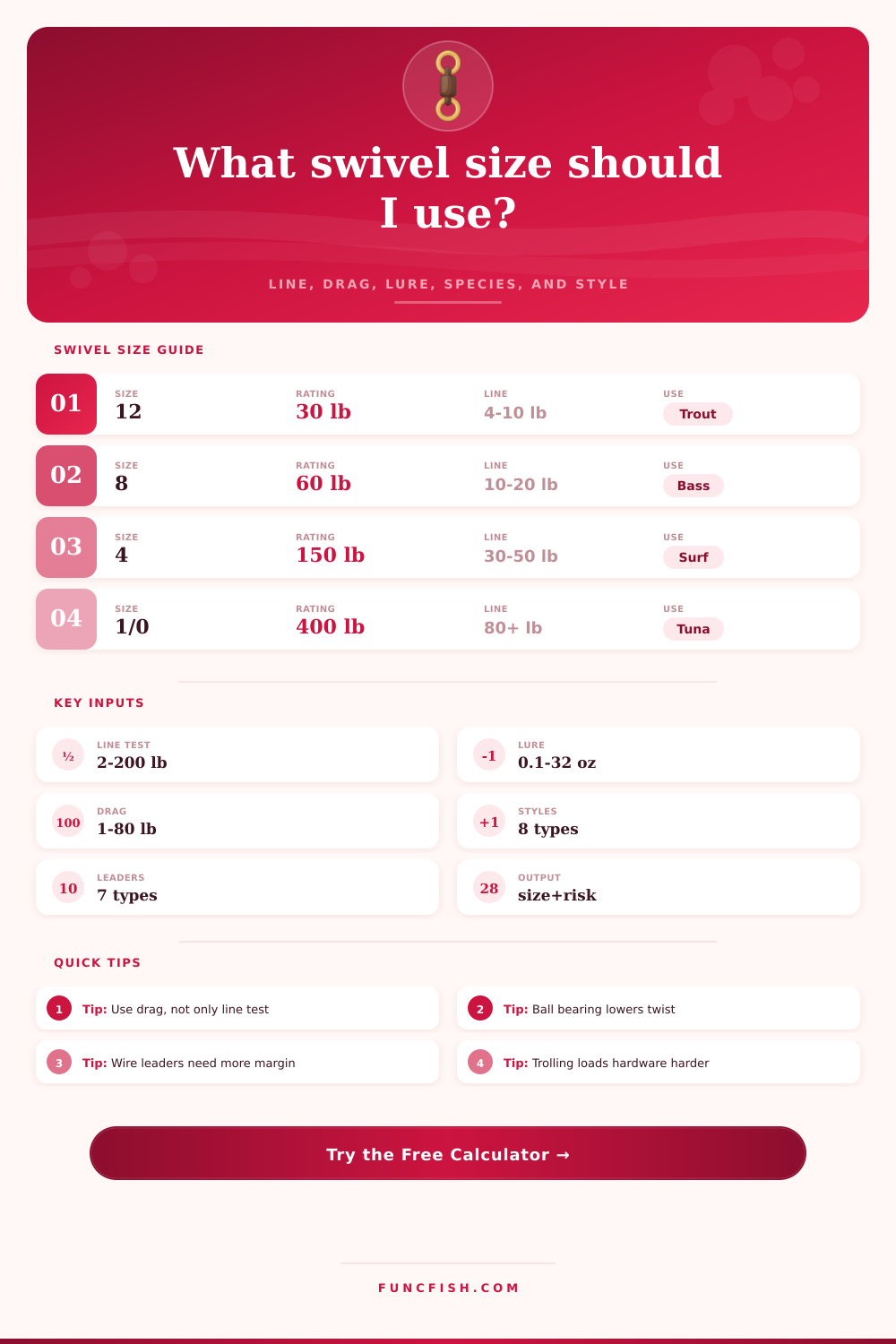
Drag tip: Size the swivel from the drag load and shock factor, not just the printed line test. High drag on braid can push a small snap swivel past its practical range.
Twist tip: Spinning spoons, flashers, and fast trolling usually justify a ball bearing swivel even when the strength rating looks similar to a barrel swivel.
A fishing swivel is used to prevent line twist and allow the lure to rotate correctly. Choosing the correct fishing swivels is essential because the wrong fishing swivel could cost you your fishes. If the fishing swivel is too small for the job, it can snap or gets stuck on the fish.
However, if it is too large for the fishing scenario, it can dampen the fishing lure action or spook the fish. You must determine the drag pulls of your reel, the rotation of the lure, and the water scenario to pick a perfect fishing swivel. The strength of the fishing swivel should be based off the drag of your fishing reel.
How to Choose the Right Fishing Swivel
While the line test is the number on the fishing line, the drag is the force your fishing reel must endure when there is a fight with a caught fish. The drag is the baseline for your fishing swivel, but you must add some extra force for the shock of the cast or fight with a fish. Small fishing swivels can take a load of fish until it buckle.
Depending on the species of fish you are after, some fish require different fishing swivels then other. A trout fight is different than a pike that headshakes the fisherman. The fishing scenario you are in will change the requirements for the fishing swivel.
If you are using a light spoon in calm waters, you require a smaller fishing swivel that does not overpower the fish lure wiggle. However, if you are on the water trolling a fish flasher behind the boat, you require a fishing swivel that can take the extra force and high rotation of the fish. Different fishing rigs place different types of pressure on the fishing swivel.
For example, a three-way fishing swivel can take the sideways pressure, but a surf casting rig can take the shock of a sinker on each wave. The scenario determines the size of the fishing swivel you requires. The type of leader you use will determine the fishing swivel that is appropriate for your fishing gear.
Monofilament fishing leaders will allow for lighter fishing gear. However, pike fishing uses wire fishing leaders as they do not flex under the fishs bite. However, they will transmit the movement of the fish, thus, requiring a more robust fishing swivel.
Braided fishing main lines have zero stretch; therefore, they will require more force on the fishing swivel than monofilament main lines. There are different styles of fishing swivels for specific fishing scenarios. Crane swivels are used for compact fishing rigs.
Coastlock fishing swivels allow for quick changes of lures in the surf zone. Power fishing swivels is used for offshore fishing. Additionally, barrel swivels work well with bait fishing but require ball-bearing swivels for spinning lures as they will rotate more easy.
Fishing line twist can occur if the fishing swivel, fishing line, and lure are not the correct size for the fishing scenario. If the fishing line is twisted too much, it will form a helix in the fishing line, forcing the fisherman to rebuild their fishing rig. Therefore, you should factor in a safety factor when determining the size of the fishing swivel.
For finesse fishing, you need a light fishing swivel. However, for the trophy fish you seek, you need a heavy fishing swivel so that failure to withstand the fish will not cost you a fishing season this year. A common mistake when fishing is to not use the proper fishing swivel for your fishing scenario.
A size 10 fishing swivel will break under the force generated by a fifteen-pound braided line when using a two-ounce spoon when trolling. Additionally, the wire leader for pike fishing will increase the force needed on the fishing swivel as it will not flex when the fish bites. Fishing rigs will fail at the weakest link, which is the knot above the fishing swivel.
There are fishing swivel presets for specific fishing scenarios. For example, using a bass spinnerbait on braided line will require a balanced fishing swivel. For trolling for tuna offshore, a fishing swivel with a heavy reserve of strength is necessary.
The surges of different types of fish will require different fishing swivels. Using these presets will allow the fisherman to quickly flag whether or not a fishing swivel is a good match with their fishing gear. If it is a tight match, the fisherman may want to upgrade their fishing swivel as the knots may take the stress of the fish.
Additionally, if it is a bulky match, the fishing swivel will dampen the action of their finesse fishing gear. Reference tables will assist the fisherman in determining the perfect fishing swivel for their fishing scenario. Size charts show the weight of the fishing line that a fishing swivel can take so that a size 12 fishing swivel is appropriate for trout fishing lines and a 1/0 fishing swivel for pelagic fish.
The scenario table will show why a fishing swivel must be upraised for surf fishing conditions versus casting. The species bands shows the minimum strength of fishing swivel needed as tuna require more strength than panfish. Using these reference tables will allow the fisherman to cross-check the calculations made for the fishing swivel.
Another way to determine the correct fishing swivel for your fishing scenario is to test them in the water. Even with a perfect fishing swivel according to the reference tables, a poor quality crimp or corroded fishing swivel will fail when under stress from the water. Inspect your fishing swivels after each fishing trip.
However, be sure to inspect any fishing swivels used when fishing in saltwater. A smaller fishing swivel may seem more stealthy when fishing but will fail under heavy load. Fishing swivels found in cheaper fishing gear may work for light fishing scenarios but will bind under the heat of the sun.
If you determine your fishing swivel drag, pick the correct style for the spin of your fishing lures and add in a safety factor for the fish you are after, then your fishing swivel will spin correctly when the fishing line is under tension. You should of checked the swivel more carefully. Its better to be safe.
If you dont use the right one, you might lose alot of fish. Youll find that the moddern swivels are better. Even if you think you know, you should of tested the gear.
To many people forget this. Their gear will fail if they dont check. You’re going to need a reliabel setup.