Tackle Box Weight Calculator
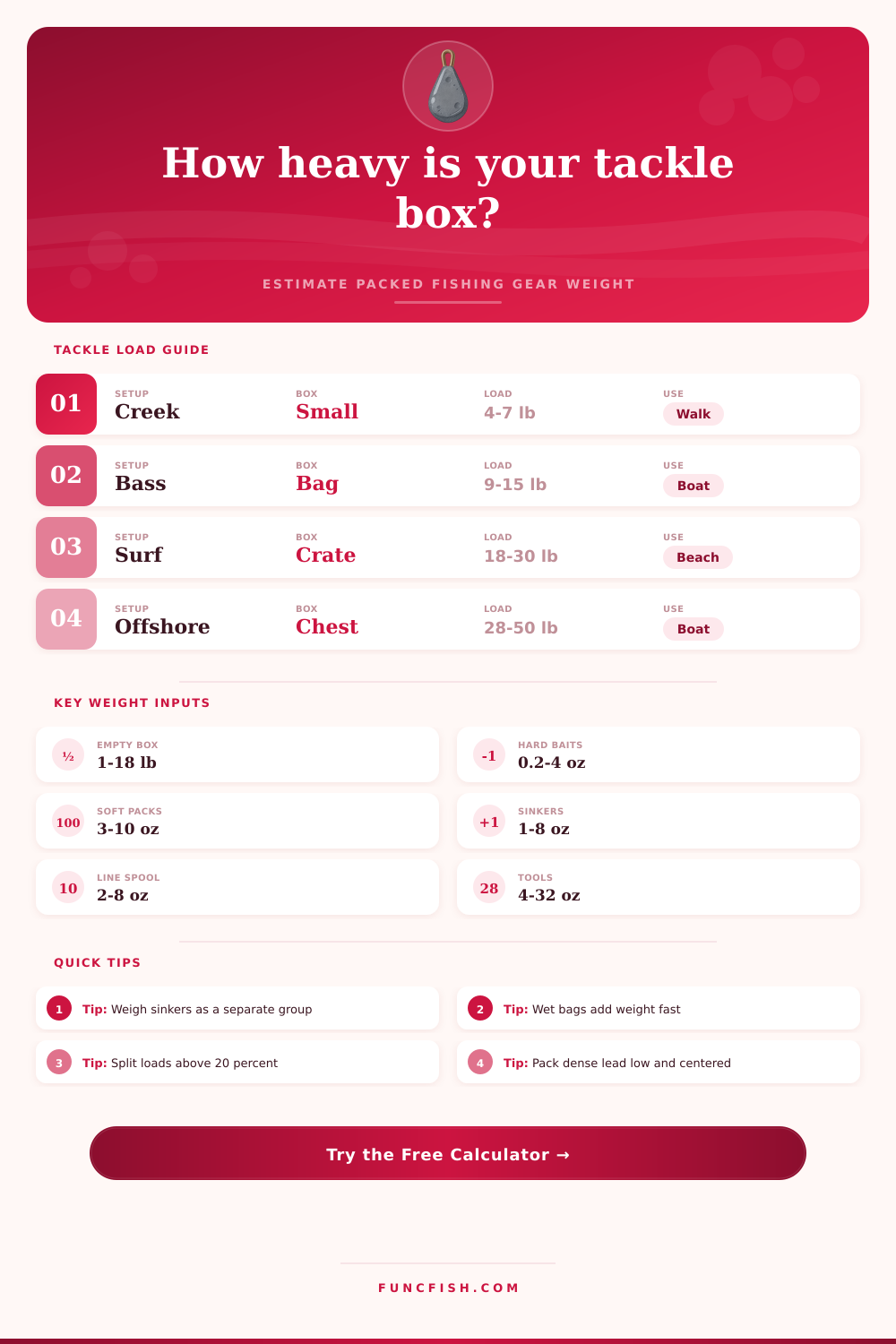
Estimate your loaded tackle box weight from the box shell, trays, hard baits, soft plastics, sinkers, line, tools, and wet gear so the pack is easier to balance.
📌Scenario presets
⚙Tackle load settings
Tackle box weight forecast
Full breakdown
📋Equipment weight reference grid
3500 Tray
3700 Tray
Deep Tray
Plug Tube
Soft Bag
Kayak Crate
Surf Bag
Offshore Chest
📐Tackle weight reference tables
| Tackle item | Typical unit weight | Metric equivalent | Weight note |
|---|---|---|---|
| Finesse jig | 1/16-1/4 oz | 1.8-7 g | Small but numerous |
| Bass crankbait | 3/8-3/4 oz | 11-21 g | Treble hooks add bulk |
| Swimbait | 1-4 oz | 28-113 g | Raises tray weight quickly |
| Surf plug | 1.5-4 oz | 43-113 g | Often carried in tubes |
| Egg sinker | 1/2-6 oz | 14-170 g | Dense load, pack low |
| Line spool | 2-8 oz | 57-227 g | Leader spools vary widely |
| Fishing setup | Common loaded range | Metric range | Carry guidance |
|---|---|---|---|
| Panfish ultralight | 3-6 lb | 1.4-2.7 kg | Easy walking load |
| Trout creek sling | 4-8 lb | 1.8-3.6 kg | Keep one tray lean |
| Bass bank bag | 9-16 lb | 4.1-7.3 kg | Shoulder load is noticeable |
| Kayak inshore crate | 12-25 lb | 5.4-11.3 kg | Secure dense tackle low |
| Surf plug bag | 10-24 lb | 4.5-10.9 kg | Wet plugs add water weight |
| Offshore chest | 28-55 lb | 12.7-24.9 kg | Boat-only load |
| Carry mode | Comfort target | High load marker | Best balance move |
|---|---|---|---|
| Hand carry | Under 8 lb | 12 lb | Use fewer sinkers |
| Shoulder strap | Under 12 lb | 18 lb | Shift tools inward |
| Backpack | Under 18 lb | 28 lb | Heavy trays near spine |
| Boat deck | Under 35 lb | 50 lb | Keep lid secure |
| Kayak crate | Under 22 lb | 32 lb | Keep center of gravity low |
💡Practical checks
Tip: Calculate sinkers and tools separately from lures. They usually create the dense load that makes a box feel awkward.
Tip: For shore walking, compare loaded tackle weight to body weight and carry distance before adding another full tray.
Tackle box weight are a significant factor for an angler due to the impact that the weight of a tackle box have upon you movement and physical comfort. Many angler tend to pack too much gear into they tackle boxes; the resulting tackle box becomes difficultly to carry on a trail. While anglers may feel the weight of their tackle box while near a vehicle, anglers who walk along a trail will feel the weight of the tackle box more ready.
Anglers who has a tackle box that is too heavy experience pain in their shoulder. Additionally, those who carry tackle boxes that is too heavy may even begin to lose their balance while on the trail. The way that anglers carry their tackle boxes can impact how an angler feels the weight of the tackle box.
How Tackle Box Weight Affects You
For instance, if the tackle box is stored within a shoulder bag, the weight of the tackle box will feel different to an angler when move on flat ground compared to when the angler is traveling on a steep trail. A tackle box stored on a kayak will feel lighter then a tackle box that an angler carries in an angler’s hand, although the tackle box on a kayak may become too difficult to manage if the water are choppy. These differences are test with the tackle box weight calculator.
The various components that is contained within tackle box can impact the weight of the tackle box. Each tray that is added to a tackle box increase the weight of the tackle box. Additionally, each tray that is added to the tackle box also increases the volume of the tackle box.
Each hard bait that is added to the tackle box will increase the weight of the tackle box. Additionally, each soft plastic bait will increase the weight of the tackle box. Each sinker and terminal tackle is very dense; these item are often overlooked when calculating the weight of the tackle box.
Finally, if the sinkers and terminal tackle are all located in one corner of the tackle box, the tackle box will feel unbalanced, which can lead to difficulty in transporting the tackle box. The wet gear that is within the tackle box will increase the weight of that tackle box. Tackle boxes and gear bag can absorb water from rain or spray; this water will increase the weight of the tackle box.
The wet level selector in the tackle box weight calculator account for the weight of the water that is on the tackle box trays and the weight of the water that is within the fabric of the bag. While the weight of water for one item may be considered to be small, the weight of water can become a larger problem for anglers who have a tackle box that is already heavy. Your own body weight and the distance that you walk will impact the weight of the tackle box that you feel.
For instance, ten pounds will feel different to an angler whose body weigh 150 pounds as compared to an angler whose body weight is 220 pounds. Similarly, the weight will feel more heavier after walking 600 feet as compared to after walking only 60 feet. The carry rating and the effective carry feel number in the calculator adjust according to your body weight and the distance that you walk.
The reference tables provides information about the typical weights of tackle boxes that other anglers use. For example, a panfish trap may weigh four pound, but a surf bag may weigh twenty pounds. These tables will not provide information about the weight that you must carry, but they can provide information that help to you determine if the weight of your tackle box is within the normal range.
The results of the tackle box calculator will help you to make better decisions regarding the item that you place within the tackle box. If you know that certain items will lead to a high dense gear share, you can leave those items at home. Additionally, if you know the wet level that you will encounter, you can prepare for the weight of water that may collect on your tackle box.
By calculating the weight of the tackle box ahead of time, you will find that planning your gear more effective will make it easier to decide what gear to leave at home.