Tautog Weight Calculator
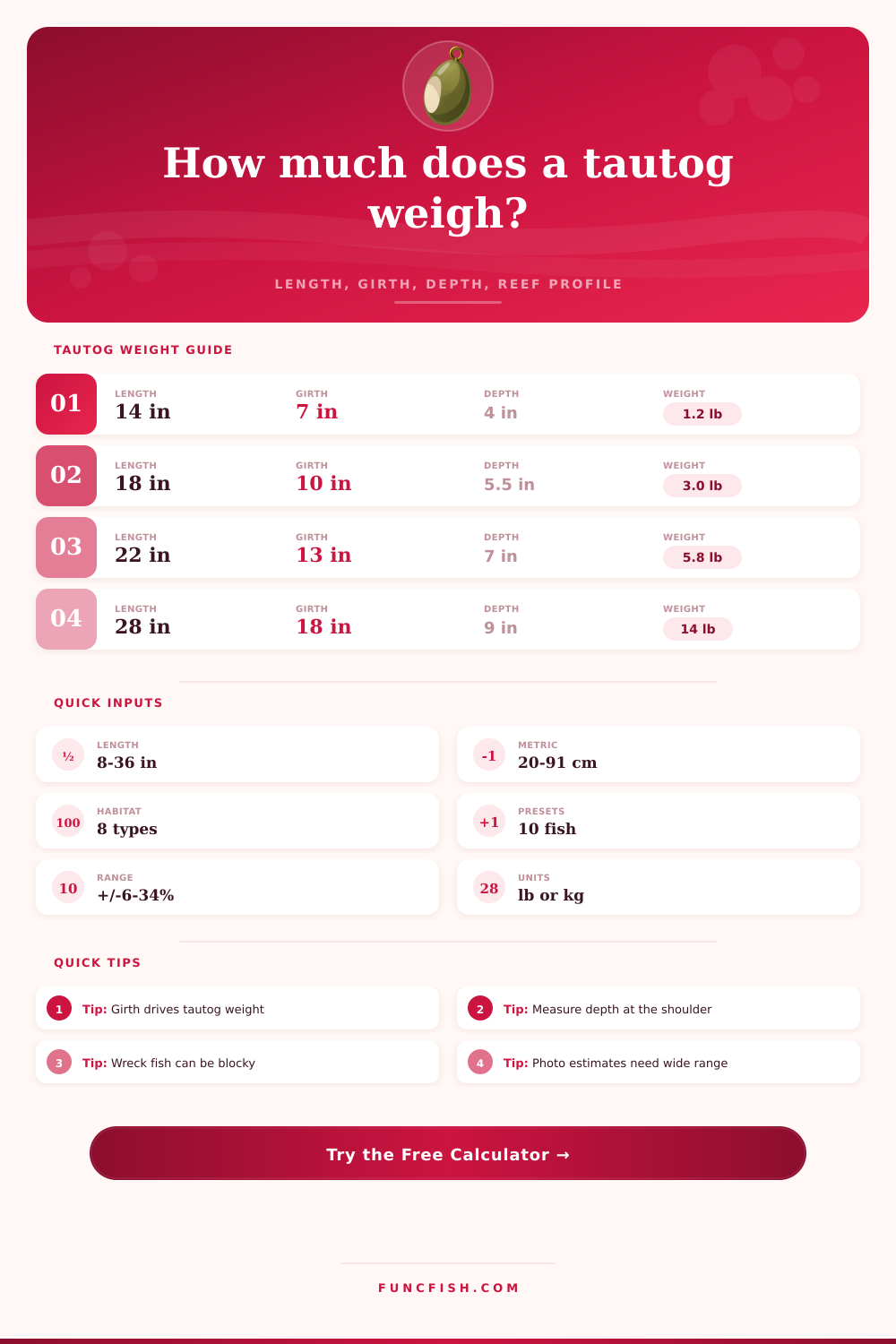
Estimate tautog weight from total length, widest girth, body depth, reef or wreck habitat, body class, condition, season and forage signal, confidence, and unit system.
📌Tautog presets
⚙Measurements and reef profile
Model: tautog are compact reef fish, so the calculator blends a length-girth estimate, a body-depth cross-check, and a condition index. Habitat, body class, forage signal, and confidence adjust the final range.
Tautog weight estimate
Calculation breakdown
📊Tautog shape data
Jetty keeper
Wreck adult
Boulder bull
Trophy whitechin
🐟Tautog and reef fish comparison
Tautog
Compact, blocky blackfish built for rock and wreck cover.
Sheepshead
Deep shoulder, chunky body, and strong shellfish profile.
Black Sea Bass
Short reef fish with a tall but lighter body shape.
Triggerfish
Compressed and tall, lighter than a same-girth tautog.
Scup
Deep pan-shaped profile with smaller adult weights.
Lingcod
Longer predator profile with less blocky shoulder mass.
📘Reference tables
| Total length | Typical girth | Typical depth | Common estimate | Field read |
|---|---|---|---|---|
| 12 in / 30 cm | 6-7 in / 15-18 cm | 3.5-4 in / 9-10 cm | 0.7-1.1 lb / 0.3-0.5 kg | Small compact fish |
| 16 in / 41 cm | 8-9.5 in / 20-24 cm | 4.5-5.2 in / 11-13 cm | 1.8-2.8 lb / 0.8-1.3 kg | Keeper-class body |
| 20 in / 51 cm | 11-13 in / 28-33 cm | 5.8-6.8 in / 15-17 cm | 4.0-6.2 lb / 1.8-2.8 kg | Solid reef adult |
| 24 in / 61 cm | 14-16 in / 36-41 cm | 7-8.5 in / 18-22 cm | 7.5-11.0 lb / 3.4-5.0 kg | Large wreck fish |
| 30 in / 76 cm | 19-22 in / 48-56 cm | 9-11 in / 23-28 cm | 16-25 lb / 7.3-11.3 kg | Trophy blocky class |
| Habitat profile | Expected girth ratio | Expected depth ratio | Weight effect | Range effect |
|---|---|---|---|---|
| Rock jetty pocket | 0.54-0.60 of length | 0.28-0.32 of length | Baseline tautog frame | Moderate range |
| Nearshore wreck ribs | 0.56-0.63 of length | 0.30-0.34 of length | Slightly heavier body | Moderate range |
| Deep wreck hull | 0.60-0.68 of length | 0.31-0.35 of length | Blocky adult potential | Wider range |
| Boulder field edge | 0.58-0.66 of length | 0.31-0.35 of length | Heavy shoulder signal | Moderate range |
| Mussel bed ledge | 0.55-0.62 of length | 0.29-0.33 of length | Full belly signal | Moderate range |
| Body class | Typical length | Shape cue | Condition cue | Calculator effect |
|---|---|---|---|---|
| Juvenile compact fish | 8-13 in / 20-33 cm | Short, narrow body | Low reserve | Lower multiplier |
| Keeper-class tautog | 14-19 in / 36-48 cm | Deepening shoulder | Balanced reserve | Baseline multiplier |
| Chunky reef adult | 18-24 in / 46-61 cm | Round girth | Full body | Higher multiplier |
| Bull blackfish frame | 22-29 in / 56-74 cm | Blocky head and shoulder | Heavy reserve | Strong multiplier |
| Trophy whitechin | 26-36 in / 66-91 cm | Very high girth | Peak mass | Highest multiplier |
| Confidence setting | Best input source | Expected range | Shape blend | Use when |
|---|---|---|---|---|
| Excellent | Board and measured girth | About 6-8% | None | Fish stayed straight and calm |
| Good | Straight fish and field tape | About 9-12% | Very light | Normal deck measurement |
| Standard | Quick tape estimate | About 13-17% | Light profile help | Girth or depth was quick |
| Rough | Curved fish estimate | About 18-24% | Moderate blend | Fish moved or flexed |
| Photo or memory | Photo or remembered size | About 25-34% | Strong profile help | Measurements are approximate |
💡Measurement tips
Tautog weight changes quickly with shoulder girth. If the fish is curled, measure length first and use the profile backup setting for shape.
Rock, wreck, boulder, and mussel fish can carry weight differently. Match the habitat to the fish shape, then choose confidence honestly.
This calculator estimates fish weight from measurements and body profile inputs only.
Tautogs is a species of fish that live near rocks, wrecks, and rubble. Furthermore, they exhibit a relatively fast movement while they are move because their bodies are compact. Because of the compact nature of a tautog, it is impossible to accurately estimate the weight of a tautog based only upon its length.
Instead, because a tautogs weight will vary based upon the amount of food that it has eaten, a tautog that is of an average length when measured on a ruler may end up being either heavier or lighter than other tautog of the same length. Once you enter the length, the girth, and the depth of the tautog into the calculator, the calculator provide you with an estimate of its weight. These three variables is the foundation of the calculator, but the other settings within the calculator are just as important.
How to Estimate a Tautog’s Weight
For instance, the habitat of the tautog is used to indicate if the tautog lived in a jetty pocket or a deep wreck. Tautogs that live in a jetty pocket have relatively little mass compared to tautogs that live in deep wreck. Additionally, the body class help to indicate the frame of the tautog, the condition and forage indicates if the tautog has been traveling or eating on a ledge, and the measurement confidence allows the fisherman to indicate whether the measurements of the tautog were taken on a board or guessed upon while on a boat deck.
The girth of the tautog is one of the variables that will have the most impact upon the weight calculations of the calculator. A small change in the girth of the tautog can lead to a large change in the weight of the fish. The depth of the tautog is another of the measurements that is used within the calculator to weight the fish appropriately, as tautogs tend to be deeper than other reef fish species of the same length.
The calculator calculates the weight of the tautog based upon the girth and depth measurement of the fish in combination with the habitat data entered into the calculator. Furthermore, if the fisherman gathered the girth and depth measurements for the tautog from a photograph, that data can be weighted more heavily towards the expected tautog profile than the specific measurement entered by the fisherman. The weight of the tautog can also be affected by other real-world condition outside of those reflected in the data entered into the calculator.
For instance, a tautog that has eaten a significant amount of green crabs will have more reserve mass within its body than a tautog that did not eat any crabs. Similarly, a tautog that spent its life in warm water will have less reserve mass than a tautog that lived in cooler water. Additionally, an adult tautog that just spawn may be long in length but light in weight relative to a tautog that has not just recently spawned.
These condition help to ensure that the calculator appropriately calculates the weight of the tautog, and the calculator reveals the weight of the tautog, the weight range of the tautog, and the condition index of the tautog. The condition index help to indicate whether the tautog is heavier or lighter than other tautogs of the same length. The reference tables help to reveal the typical girth and depth ratio of tautogs of different sizes and habitat types.
These tables are helpful in that they allow a fisherman to verify the measurements that are entered into the calculator, and allow the fisherman to adjust the weight estimate of the tautog if the measurements appear to be too low. For instance, if a tautog is measured to have a girth ratio that is too low relative to the reference tables for tautogs of its size and habitat type, the weight estimate can be adjusted using the profile-backup calculations within the calculator to avoid providing an incorrect weight estimate. Additionally, if the depth and girth of a jetty pocket tautog are larger than the reference tables suggest for that habitat type, the fish may be an adult tautog that has been eating mussels.
Many people believe that the weight of the tautog is a matter of simple arithmetic based off the length of the tautog. However, the body shape of the tautog is another of the factors that should be considered. For instance, tautogs are deeper and have rounder bodies than species like sheepshead or black sea bass.
Thus, an equation that may work for calculating the weight of a sheepshead fish would not work for a tautog. The calculator helps to indicate why a 20-inch tautog would weigh more than a 20-inch scup or a 20-inch triggerfish. Furthermore, understanding the weight of the tautog is another of the factor that will help a fisherman to determine whether or not the tautog should be kept.
The weight estimate provided by the calculator can be used both to decide whether or not to keep a fish, or to compare the weight of two different tautogs. Length is not the only measurement of a tautog that should be considered when deciding whether to keep the tautog; other measurements, such as the girth, the depth of the tautog, and its habitat should also be considered. Furthermore, the weight range provided by the calculator is helpful in acknowledging that a tautog that is moving or whose measurements are curved will have less precision in its weight than if the tautogs measurements are taken on a board.
Such a calculator enables a fisherman to notice certain pattern within tautogs over time. For instance, the fisherman may note that tautogs from certain wrecks have higher girth ratios than tautogs from other wrecks of the same size. Additionally, the fisherman may note that most tautogs that are caught in mussel beds in the late season fall within the upper half of the expected weight range of tautogs of the same length.
These observations of certain pattern in the tautogs are formed over time through gathering the measurements of numerous tautogs. Thus, the calculator makes these pattern visible to the fisherman. The accuracy of the weights and measurements provided in the calculator are only as useful as the accuracy of the information that is provided by the fisherman.
The fisherman should measure the tautog when it is straight, it should be honest with its description of the habitat, and it should use an accuracy level for the confidence in the measurements based upon how the tautog was measured. When these variable are provided to the calculator, the calculator will provide the weight of the tautog, the range of possible weight of the tautog, and the condition index of the tautog. Each of these three variable will provide the fisherman a more complete understanding of the tautog than the length measurement of the tautog alone.