Tenkara Line Length By Rod Calculator
Estimate the main tenkara line, tippet, total rig length, landing reach, and control score from rod length, stream size, canopy, wind, fly weight, line material, and target fish.
📌Tenkara setup presets
⚙Rod, water, and line inputs
Use the fished length of a zoom rod, not the collapsed length.
Extra reach helps line avoidance, but makes landing harder.
Use 1.00 for rod-length line, 1.20 for extra reach, or below 1.00 for canopy.
Tenkara line recommendation
Calculation breakdown
📊Line-to-rod comparison grid
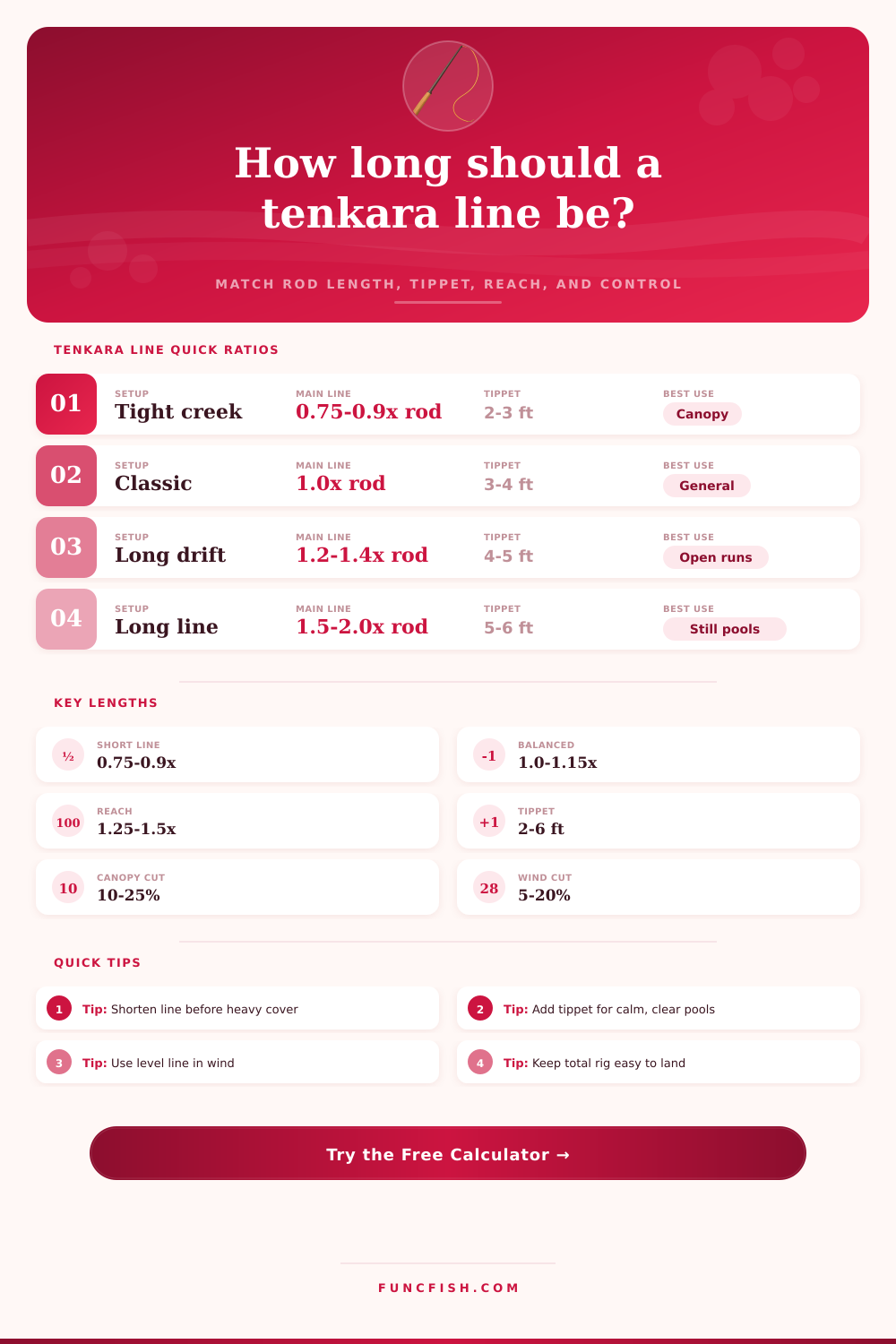
Short Line
0.75-0.90x rod. Best for brush, steep banks, small plunge pools, and newer anglers who need easy landing.
Rod-Length Line
0.95-1.10x rod. The classic starting point: enough reach, clean casting, and simple fish handling.
Reach Line
1.15-1.45x rod. Better line hold-off and drift length in open water, but wind and landing demand rise.
Long Line
1.50-2.00x rod. Useful for calm pools and advanced anglers; expect handlining and slower fish landing.
🎣Quick reference cards
Beginner Start
Brushy Creek
Open Run
Wind Check
📘Tenkara line ratio table
| Water type | Main-line ratio | Tippet | Landing feel | Notes |
|---|---|---|---|---|
| Tight canopy creek | 0.75-0.90x rod | 2-3 ft | Easy | Short line keeps casts under branches. |
| Small pocket water | 0.90-1.05x rod | 3-4 ft | Easy to balanced | Good for quick casts and close drifts. |
| Classic freestone run | 1.00-1.20x rod | 3.5-4.5 ft | Balanced | Useful default for most rods. |
| Open meadow or tailwater | 1.20-1.50x rod | 4-5.5 ft | Moderate | Add reach when wind is low. |
| Clear slow pool | 1.35-1.80x rod | 4.5-6 ft | Demanding | Longer tippet helps stealth. |
⚖Material and wind adjustment table
| Line material | Wind handling | Sag | Best ratio range | Use when |
|---|---|---|---|---|
| Level fluoro #2.5 | Light | Low | 0.9-1.3x | Delicate dry or unweighted kebari. |
| Level fluoro #3.0-#3.5 | Good | Low | 0.9-1.45x | Most all-round tenkara fishing. |
| Level fluoro #4.0 | Strong | Medium | 0.85-1.25x | Wind, heavier flies, or stiff rods. |
| Light furled line | Fair | Medium | 0.85-1.1x | Smooth turnover and close casts. |
| Standard furled line | Fair | Higher | 0.75-1.0x | Beginners, larger flies, and short water. |
| Hybrid tapered line | Good | Medium | 0.9-1.25x | Mixed dry/dropper or variable streams. |
📏Rod length setup examples
| Rod length | Short setup | Classic setup | Reach setup | Typical tippet |
|---|---|---|---|---|
| 9 ft / 2.7 m | 7-8 ft | 9-10 ft | 11-12 ft | 2-3.5 ft |
| 10.5 ft / 3.2 m | 8-9.5 ft | 10.5-11.5 ft | 12.5-15 ft | 3-4 ft |
| 12 ft / 3.6 m | 9-10.5 ft | 12-13 ft | 14.5-17 ft | 3-5 ft |
| 13 ft / 3.9 m | 10-12 ft | 13-14 ft | 15.5-19 ft | 3.5-5.5 ft |
| 14.5 ft / 4.4 m | 11.5-13 ft | 14.5-16 ft | 17.5-22 ft | 4-6 ft |
🛠Troubleshooting table
| Symptom | Likely cause | Adjustment | Calculator input to change |
|---|---|---|---|
| Line piles up in wind | Too long or too light | Shorten 5-15% or use heavier level line | Wind, material, target ratio |
| Fish hard to net | Total rig too long | Shorten main line or tippet | Landing buffer, tippet |
| Fly drags immediately | Not enough reach or tippet | Add line in open water, add 6-12 in tippet | Reach need, tippet |
| Snagging branches | Canopy limit too tight | Use 0.75-0.9x line and compact cast | Canopy, water type |
| Heavy fly collapses cast | Line lacks turnover | Shorten line or use heavier main line | Fly weight, material |
💡Rigging tips
Tip: For a new rod, start with a main line about the rod length and a 3-4 ft tippet. Fish it first, then add reach only where you can still land fish cleanly.
Tip: In wind, shorter level line often beats a long pretty setup. A small reduction in line length can improve turnover, accuracy, and fly-first presentation.
The initial lesson with tenkara fishing is that easy thing is getting your cast out there. Trying to land a trout on the end of your fly line with a bunch of line in your hand and no slack are altogether something else. The fish throws itself around like crazy in rushing water and that’s where the panic sets in for most of us.
There is too much line for control and not enough for reach. It’s a balancing act, and figuring out what length is right is more important then purchasing the latest and greatest stick. Plugging in your environment into the calculator (above) does all this math for you; there’s no need to guess between punching short vs. You might be drifting long on any given day.
How to Choose the Right Line Length for Tenkara Fishing
But what do those numbers tell us about the water? If you’re fishing a tight canopy creek, it tells you to make it brief. Low-hanging branches and limited space mean a long line will be a liability because it will snag on tree leaves well before reaching the water. Shortening the main line to nine tenths or three quarters of your rod length transform chaos into precision here. Reach gives way to accuracy and that’s a fair exchange when the fish are right next to you.
On the other hand, wide riffles and open tailwater stretches begs for longer rigs. Presentation replaces precision as name of the game. Your feet remain planted on the bank but the fly needs to float high and loose in the water column during a long drift. To do so means extending your main line past the reach of your rod; sometimes even one point five times longer or longer. Leaving the current to deliver the fly. That puts the leader outside the “drag” zone where it might otherwise spook wary fish.
But increased distance also makes control harder. The further the fly is from your hand, the more difficult it is to immediately apply tension. It is also harder to turn it toward the net or up onto the bank if no landing tool are used.
But then there’s the wind. Wind is the sailor’s friend, but it also becomes a factor that screws everything up. Wind is a sail on a heavy line and a brake on a light one. But because most anglers don’t pay attention to wind until their cast collapses halfway across the water they chalk it up to themselves instead of equipment. A heavier line cuts through the wind. Its mass pushes through with momentum, letting you keep length while getting good turnover on the line. When the wind blows faster than the fly can come back out, lighter mono, thin lines or furls flutter about and pile up. The calculator factors wind speed into a control score that basically tells you how ambitious you should of be for distance given the physics of the day.
But there is another more subtle element here: tippet length. Longer tippets help add stealth because they keep your main line further off from the trout’s visual field. So if the water is clear and the trout are spooky in certain pools, a longer tippet can help add stealth. They do, however, make your casting loop more complex and heavier. And when you’re fishing tiny dries or around heavy cover, shorter two-foot tippets makes the rig tight and responsive.
There is no single best length, only the right length to match how the fish are behaving that afternoon. A lot of folks see their rig as something fixed: they buy some line from the shop and use it however they can for each season without changing anything. But tenkara is all about being flexible, and that rigidity work against it. By bringing along multiple lengths and diameters of spools, you can adjust the length and diameter of your rig beforehand, even before getting into the waders. Add a foot when the water clears and fish press deep. Clip back five when the wind kicks up. These small adjustments make an ordinary day of fishing into a strategic battle against the elements.
So how do I put all this together? In the end, we aren’t out there trying to throw the most distance with the greatest brute force and land largest trophy. We’re trying to create a balanced relationship between you, the water and the line. The rod bends naturaly when the length is right. Your fly lands softly on the water. You can fight a fish without breaking tension. You’re no longer fighting the gear; you are now fishing the stream.
Tenkara is addictive for me because that seamless rhythm allows us to take what was once a cord tied to a hook and make it an extension of our own instinct. Simple lines becomes so much more.