Three-Way Swivel Dropper Length Calculator
Estimate finished sinker dropper length, cut length before tying, hook leader clearance, tangle margin, and sinker hold for three-way swivel rigs in current, surf, rivers, and reef water.
📌Three-way rig presets
⚙Dropper rig settings
Use the full swinging length of a minnow, strip bait, live bait, chunk, or lure behind the hook.
This is the intended bait zone above the sinker when the sinker is touching bottom.
Three-way swivel dropper forecast
Calculation breakdown
📊Dropper material data grid
20 lb Mono
50 lb Fluoro
80 lb Hard Mono
Coated Wire
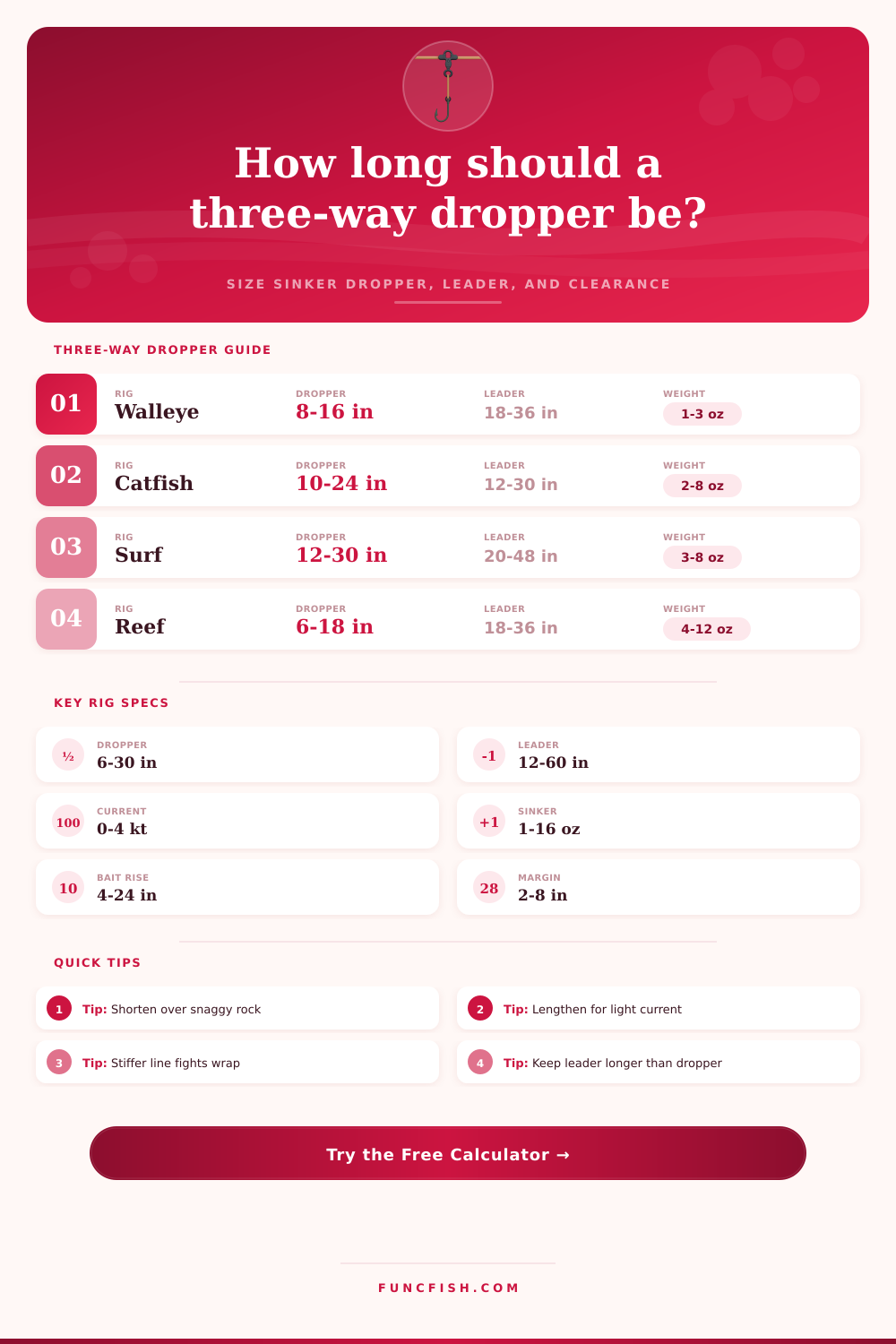
📏Three-way swivel dropper sizing table
| Fishing setup | Finished dropper | Hook leader range | Typical sinker | Clearance note |
|---|---|---|---|---|
| River walleye drifting | 8-16 in / 20-41 cm | 18-36 in / 46-91 cm | 1-3 oz / 28-85 g | Short enough to tick bottom without lifting the bait too high. |
| Catfish bottom bait | 10-24 in / 25-61 cm | 12-30 in / 30-76 cm | 2-8 oz / 57-227 g | Extra dropper height helps bait stay above silt and small debris. |
| Surf chunk or live bait | 12-30 in / 30-76 cm | 20-48 in / 51-122 cm | 3-8 oz / 85-227 g | Long enough for wave lift, short enough to limit tumble. |
| Reef and wreck bait | 6-18 in / 15-46 cm | 18-36 in / 46-91 cm | 4-12 oz / 113-340 g | Short droppers reduce sinker wedging near rock and wreck edges. |
| Fluke drift three-way | 10-22 in / 25-56 cm | 24-60 in / 61-152 cm | 2-8 oz / 57-227 g | Leader does the swimming; dropper only controls bottom tracking. |
🐟Species and rig comparison grid
| Species group | Bait ride zone | Dropper bias | Leader bias | Material match |
|---|---|---|---|---|
| Walleye and sauger | 4-12 in / 10-30 cm | Moderate, bottom-ticking | Longer for natural minnow sweep | 20-40 lb mono or fluorocarbon |
| Catfish and sturgeon | 6-18 in / 15-46 cm | Longer over silt, shorter in heavy flow | Short to medium for bait control | 40-80 lb mono or hard mono |
| Surf stripers and red drum | 8-24 in / 20-61 cm | Longer for wave lift | Medium to long for chunk swing | 50-80 lb mono or hard mono |
| Reef snapper and grouper | 4-14 in / 10-36 cm | Shorter to avoid rock snags | Medium with abrasion control | 50 lb fluorocarbon or hard mono |
| Pike and toothy fish | 8-20 in / 20-51 cm | Moderate with bite clearance | Wire or heavy leader near bait | Coated wire or single strand |
⚓Sinker style reference table
| Sinker style | Hold behavior | Snag tendency | Dropper effect | Best water |
|---|---|---|---|---|
| Pencil sinker | Light hold, slides through rock | Low | Can run slightly longer in cobble | Rivers, riprap, drift rigs |
| Walking sinker | Moderate rolling contact | Low to medium | Good with medium dropper lengths | Walleye, trout, slow trolling |
| Bank or no-roll | Stable bottom hold | Medium | Shorten near ledges and timber | Catfish, sturgeon, channels |
| Pyramid or sputnik | Strong sand grip | Medium in shell | Longer dropper can ride surf lift | Beach, inlet, sand bar |
| Sash or deep-drop weight | Vertical depth control | Medium to high | Use short controlled droppers | Reef, wreck, deep structure |
🧵Swivel size and leader matching table
| Swivel class | Main line range | Dropper range | Leader range | Use case |
|---|---|---|---|---|
| Small #10-#7 | 6-15 lb / 3-7 kg | 8-20 lb / 4-9 kg | 6-12 lb / 3-5 kg | Panfish, trout, light river walleye |
| Medium #6-#3 | 10-30 lb / 5-14 kg | 15-50 lb / 7-23 kg | 10-40 lb / 5-18 kg | Bass, walleye, catfish, fluke |
| Large #2-1/0 | 20-60 lb / 9-27 kg | 30-80 lb / 14-36 kg | 30-80 lb / 14-36 kg | Surf, reef, snapper, heavy catfish |
| Heavy 2/0-4/0 | 50-100 lb / 23-45 kg | 60-130 lb / 27-59 kg | 50-150 lb / 23-68 kg | Sturgeon, big drum, deep reef drops |
💡Dropper calculation tips
Angle tip: A three-way dropper is rarely vertical in moving water. The calculator lengthens the finished dropper as current angle increases so the swivel still rides at the intended bait height.
Tangle tip: If the hook leader is much longer than the dropper and bait swing combined, use stiffer dropper material, a shorter bait, or a slightly longer sinker link to keep the leader from reaching the weight.
That’s what I mean when I talk about the bottom dread. After all this time you finally get the bite and set the hook as the weight plows through sand and the line tightens. Three seconds later your bait floats there just where you need it. But then the sweep of the current carries it away, your leader spirals around the link of your sinker and you’ve got a lost cause on your hands. Reel up and you’re faced with mess of lines. Grab the knife, curse for at least 15 minutes and then hope you can untangle things.
Oh no, it wasn’t the fish’s fault. It was the math between those swivel eyes. If you can’t get spacing correct you might have a strike zone, but more likely a snare box. This is where geometry comes into play and where the three-way dropper length calculator take care of it for us. It converts your bait size and water speed to precise link lengths. And that’s what keeps things apart.
How to Stop Fishing Line Tangles
Anglers tie most of their rig by eye. They use one set length that might work on one lake, but not in another river. What they do is ignore the way water movement plays itself out underwater. Introduce current and the sinker doesn’t just sit there. It make a wake. It pulls and drags. The whole rig move. At an angle. So the dropper length that seems fine sitting on your boat deck now becomes dangerously short when water begins to move.
The tool handles that pull, it adjusts the final length according to your chosen scenario. You can use it whether you’re standing fast against surging current or drifting with walleye.
In reality it all comes down to the material used for the dropper link. Mono and heavy fluoro hold a rigid form. It resist tension from the weight and maintains a broad angle. Your leader is clear of the sinker’s wash. Braid and other softer stuff will bend too far, collapse the geometry and let your hook line swim back in the sinker’s wash.
Long rigs are okay if you’re fishing over clean sand where there is no snag to worry about. But slide that same rig across riprap or broken rock, and now you’ve got issues with the added length. These tradeoffs is nicely shown by table on the page. Shorter droppers on reef make sense since the sinker can’t get wedged. And it keeps bait away from the abrasive bottom.
For example, how much do you want the bait to live in the water column? Where is the target species? If the fish are eating bottom feeders like a flatfish (flounder, fluke), you want the leader swimming on top of the sand. Sometimes this mean a longer hook link. In contrast, if the fish are in deep channel silt and they’re a catfish, you’d want the bait up high enough to get out of the muck but not so far up that it’s floating through hidden debris. That’s your sweet spot. The calculator can help find it for you. It can balance what you want your bait to do relative to how the sinker will actualy hold it.
Dropping anchor: If you choose a pencil sinker on a rocky river, for instance, the tool would of recommend a bit of extra dropper length since the weight slides instead of gripping. In heavy current, opt for a bank or pyramid sinker. Recommendations also tightens to keep tension and not overload the knot.
The other silent killer is knot allowance. Maybe you figure out a ten-inch finished link. Then you forget to count the terminal tackle knots on each end, such as a Palomar or Improved Clinch. Your final rig will then be less than you wanted. You have to factor in actual size of the snap. A single inch makes the difference between keeping your bait up in the strike zone or down in the mud. The output gives you a cut length taking all this terminal tackle allowance into account. No more measuring once and tying and hoping. Just measure and tie it right.
And there’s also a tangle score. It is a kind of warning light if your leader is longer than it should be relative to the dropper, the current is too big for your chosen weight size. Tension and separation are keys to building a better rig. The sinker need to do the work of holding its position. The bait needs to do the work of looking alive. They shouldn’t be fighting each other. That’s when the knots stop happening.
And that’s why it’s important to understand how length, stiffness and current all plays together. When you get that, the strikes starts happening instead than the knots. That little change of perspective makes a difference from a fun afternoon on the water to a productive one. It keeps your strike zone clear and your line clean.