Tilapia Weight Calculator
Estimate tilapia weight from Nile, blue, Mozambique, or hybrid type, total length, standard length, girth, body depth, water condition, body condition, measurement confidence, and gear match.
📌Tilapia presets
⚙Tilapia measurements
Snout to the end of a pinched tail.
Snout to tail base; useful for checking TL accuracy.
Wrap the deepest shoulder and belly point.
Back to belly, excluding dorsal and pelvic fins.
Tilapia weight estimate
Full breakdown
📋Tilapia quick data
Nile Baseline
Blue Tilapia
Mozambique
Hybrid
📊Tilapia reference tables
| Total length | Nile baseline | Metric equivalent | Common class |
|---|---|---|---|
| 6 in | 0.16 lb | 73 g | Fingerling / juvenile |
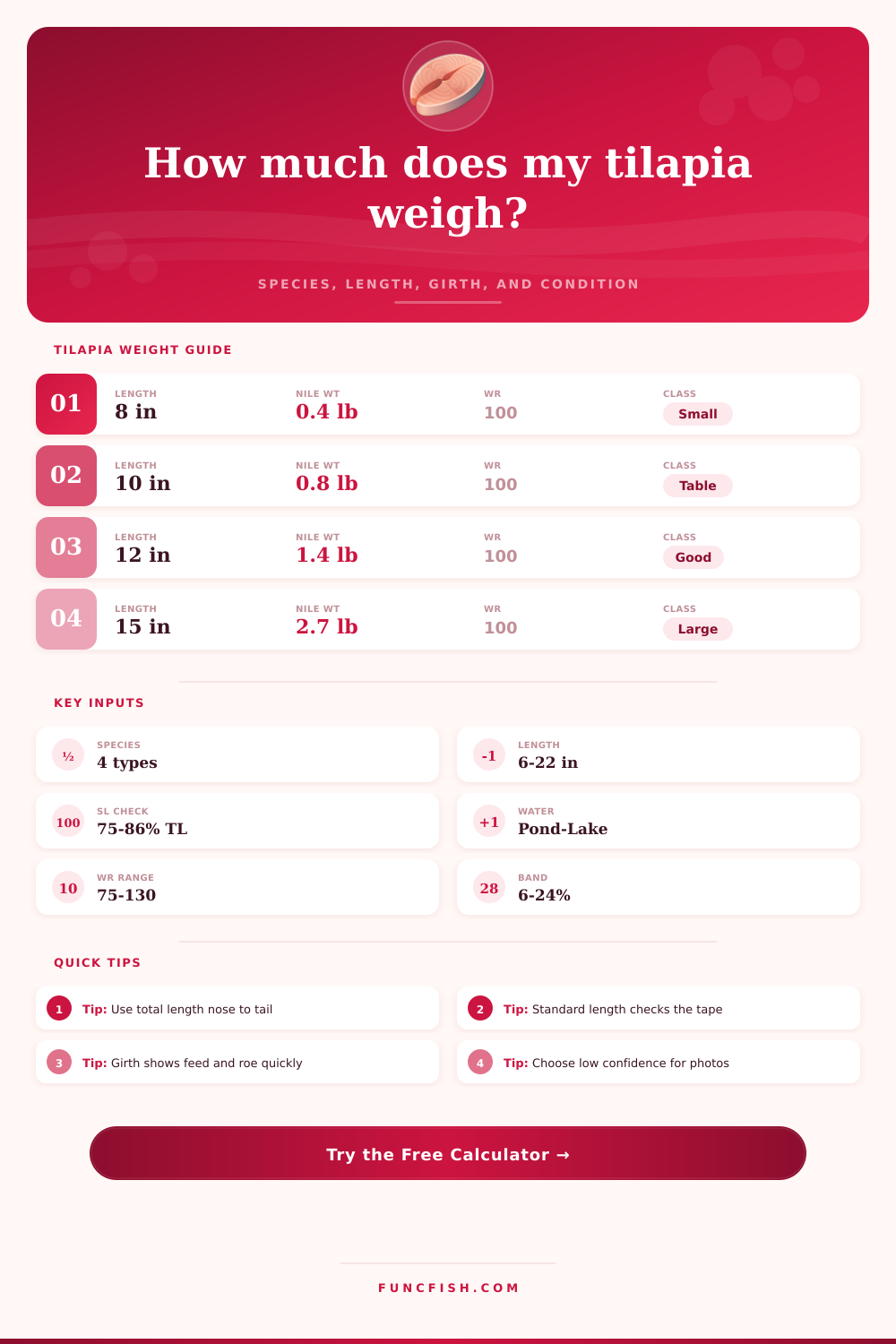
| 8 in | 0.42 lb | 190 g | Small grow-out fish |
| 10 in | 0.82 lb | 372 g | Light table fish |
| 12 in | 1.39 lb | 630 g | Good harvest fish |
| 15 in | 2.68 lb | 1.22 kg | Large adult tilapia |
| 18 in | 4.52 lb | 2.05 kg | Very large breeder |
| Species or strain | Weight shift | Typical shape cue | Calculator use |
|---|---|---|---|
| Nile tilapia | Baseline | Fast growth, deep body | Default pond and farm estimate |
| Blue tilapia | -4% | Often slightly slimmer | Useful for cooler lakes and canals |
| Mozambique tilapia | -8% | More variable wild shape | Use for warm wild lakes and brackish canals |
| Red or Nile-blue hybrid | +4% | Selected growth strain | Use for commercial pond or cage fish |
| Water condition | Weight shift | Best matched with | Tilapia-specific reason |
|---|---|---|---|
| Fed grow-out pond | +8% | Hybrid or Nile | Regular feed creates fuller shoulders and belly |
| Fertile greenwater pond | +5% | Nile or blue | Natural plankton plus warm water support condition |
| Lake or reservoir cage | +6% | Hybrid harvest fish | Cage feeding usually produces consistent body form |
| Clear lake or quarry | -7% | Blue tilapia | Lower forage can create longer, leaner fish |
| Wild warm lake | -2% | Mozambique or mixed fish | Natural forage gives mixed size and condition |
| Warm river or canal | -6% | Wild fish | Current and variable food often reduce body mass |
| Harvest holding tank | -4% | Any strain | Purging and crowding can reduce stomach weight |
| Condition or confidence | Adjustment | Use when | Range effect |
|---|---|---|---|
| Thin narrow body | -14% | Flat belly, narrow shoulders | Often low feed or high density |
| Average market shape | 0% | Normal harvest body | Best default condition choice |
| Full belly after feeding | +8% | Rounded stomach after ration | Scale weight may fall after purging |
| Roe or brood female | +11% | Deep mature female | Use tighter range if girth is measured |
| Board plus soft tape | 6% band | Length, girth, depth measured | Tightest estimate |
| Photo or tub estimate | 18% band | Length visible, shape inferred | Perspective widens range |
🧮Gear and species comparison grid
Nile Pond Fish
1.00 Baseline factor for fed ponds, tanks, and farm harvest checks.Blue Lake Fish
0.96 Good for cooler lakes where fish often run a little leaner.Hybrid Cage Fish
1.04 Selected strains can carry extra mass at the same length.Light Spin Gear
0.5-3 lb Best match for most table-size tilapia in ponds and canals.💡Measurement tips
Length tip: Enter both total length and standard length when possible. Tilapia standard length commonly sits near four-fifths of total length, so a strange ratio warns you to recheck the tape.
Shape tip: Girth and depth are the fastest way to separate a fed pond tilapia from a lean river or clear-lake fish at the same length.
To estimate the weight of an tilapia, you must consider more than the length of the tilapia. Consider the shape of the tilapia, and more importently, the girth of the tilapia; the girth of the tilapia indicate the mass of the tilapia. Tilapia with a rounded belly will typically weigh more then tilapia with a thin belly.
Tilapia that lives in ponds that receive regular fish food will typically have a rounded belly compared to tilapia that live in clear lakes where the tilapia must chase they’re food. To determine the mass of the tilapia, take the girth of the tilapia (by wrap a tape measure around the tilapia) and the distance from the back of the tilapia to its belly. These two measurements is more important to understand the weight of the tilapia, since the length of the tilapia does not reflect its weight.
How to Estimate Tilapia Weight
The species of tilapia will change the weight of the tilapia, and will also change the way that the angler can best estimate the weight. Nile tilapia are deep-bodied fish, and often gain weight quick. Blue tilapia is adapted to live in cooler water, and typically contain less mass than Nile tilapia of the same size.
Mozambique tilapia live in rivers, and are adapted to the currents in these rivers, and to the much leaner food source that are available in these habitats. Therefore, Mozambique tilapia typically contain less mass than tilapia from other habitats. Finally, the hybrid tilapia is a cross breed between the different tilapia species, and typically gains weight quick when raised.
The type of water that the tilapia lives in will also affect the weight of the tilapia. Tilapia that live in ponds that receive fish pellets will be more massive with full belly, while tilapia that live in rivers will be thinner due to the erratic food availability in those habitats. Math can help anglers to calculate the weight of the tilapia, but the angler must factor in the confidence with which he can take the measurements.
An angler can gain confidence in the measurement of the tilapia by measuring the length of the tilapia on a board with a soft tape measure, or by estimate the length of the tilapia from a photograph. Additionally, the angler must also consider the feeding state of the tilapia. Tilapia with a full stomach will contain more temporary bulk than tilapia that have been purged of their food.
Using these measurements, tilapia can be log, and a tilapia will have a condition index. A tilapia that is balance will have a condition index of 100, while a heavy tilapia will have a condition index that is more higher than 100, while a thin tilapia will have a condition index lower than 90. Farmers can use the information regarding the weight of a tilapia to make decision regarding the harvest of the tilapia from there ponds.
Anglers can use the information to log their catch without having to weigh the tilapia. Should tilapia be sorted from a tank, length will provide information regarding the size of the tilapia, but the girth will reveal which of the tilapia contain more mass and, therefore, is worth more money. Wild tilapia may appear to be large from their length, but the girth will reveal whether the tilapia is skinny or fat.
One of the common mistake when determining the length of tilapia is to forget to pinch the tail of the tilapia. Tilapia that are measured without pinching the tail will appear to be of more length than they are. Another mistake is to ignore the type of water in which the tilapia live; ignoring the water type will lead to inaccurate estimate of the weight of the tilapia.
The weight of the tilapia contain information regarding the health of the tilapia and it’s environment. Tilapia with a low condition index may indicate parasite in the water, or that the feed that is provided to the tilapia is producing poor result in terms of the conversion of feed to tilapia. A tilapia with a high condition index may reveal that the tilapia is being overfed.
Additionally, the weight of tilapia can help determine brood female; tilapia that are 11 percent above the norm tend to contain viable eggs. By measuring the tilapia and understanding the heft of their bellies, farmers can make better decision regarding the tilapia and the management of their pond.