Treble Hook Size Converter
Convert treble hook size to a single hook equivalent, lure-length match, split ring size, hook gap, wire class, species fit, and buoyancy effect.
📌Treble conversion presets
⚙Hook, lure, and species inputs
Treble conversion results
Recommended single hook, split ring, lure fit, and buoyancy effect will appear here.
Full breakdown
📋Treble, single, and lure comparison grid
Finesse Lures
Bass Plugs
Big Freshwater
Saltwater Plugs
📏Treble to single size reference
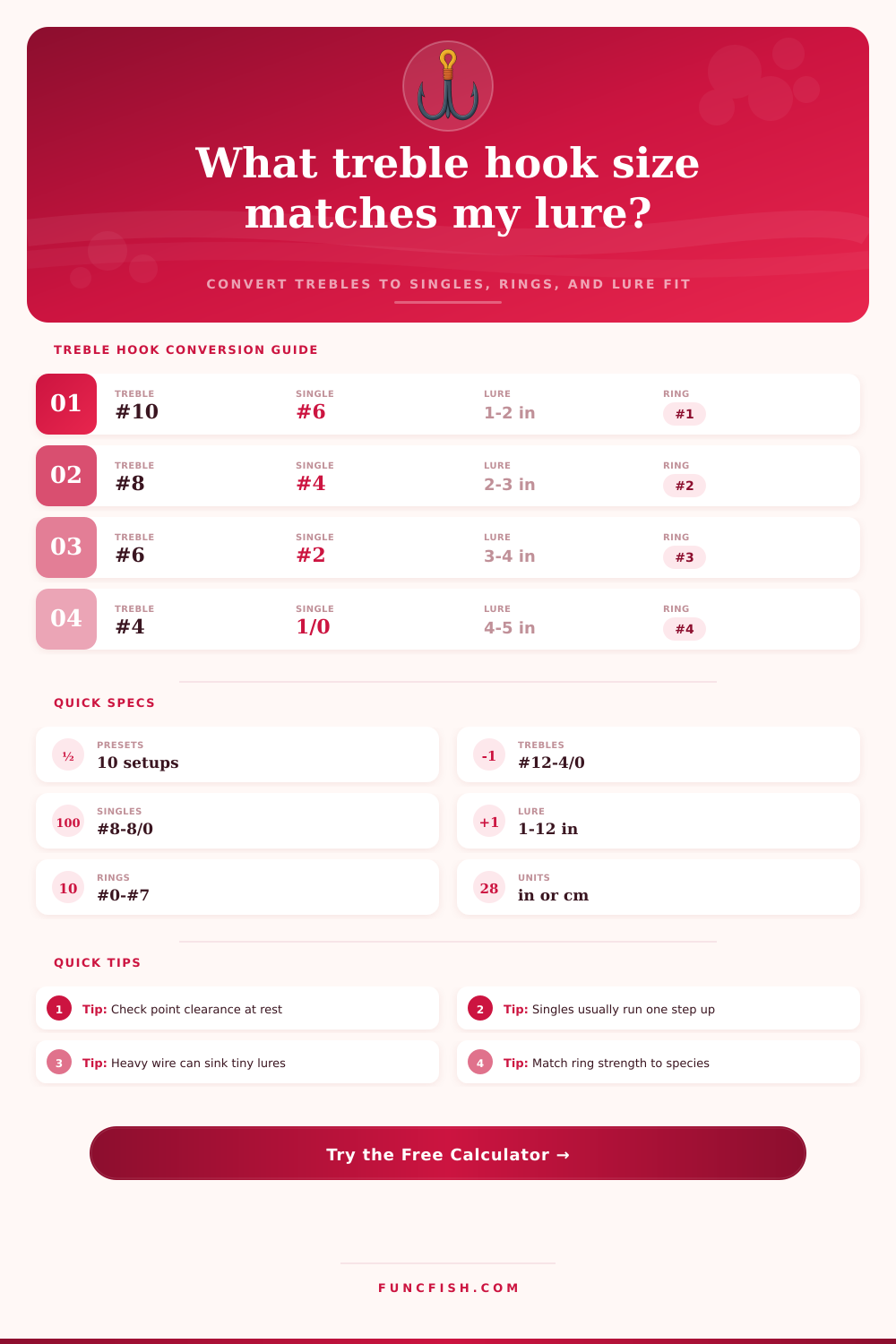
| Treble size | Average gap | Inline single | Typical lure length | Starting split ring |
|---|---|---|---|---|
| #12 | 3.6 mm / 0.14 in | #8 single | 1.0-1.6 in / 2.5-4.1 cm | #0-#1 |
| #10 | 4.6 mm / 0.18 in | #6 single | 1.3-2.0 in / 3.3-5.1 cm | #1 |
| #8 | 5.6 mm / 0.22 in | #4 single | 1.8-2.7 in / 4.6-6.9 cm | #1-#2 |
| #6 | 7.1 mm / 0.28 in | #2 single | 2.4-3.5 in / 6.1-8.9 cm | #2-#3 |
| #4 | 8.9 mm / 0.35 in | #1 or 1/0 single | 3.0-4.5 in / 7.6-11.4 cm | #3-#4 |
| #2 | 11.2 mm / 0.44 in | 1/0 or 2/0 single | 4.0-5.5 in / 10.2-14.0 cm | #4 |
| #1 | 12.7 mm / 0.50 in | 2/0 single | 4.5-6.5 in / 11.4-16.5 cm | #4-#5 |
| 1/0 | 15.2 mm / 0.60 in | 3/0 single | 5.0-7.5 in / 12.7-19.1 cm | #5 |
| 2/0 | 17.8 mm / 0.70 in | 4/0 or 5/0 single | 6.0-9.0 in / 15.2-22.9 cm | #5-#6 |
| 3/0 | 20.3 mm / 0.80 in | 6/0 single | 7.0-10.5 in / 17.8-26.7 cm | #6 |
| 4/0 | 22.9 mm / 0.90 in | 7/0 or 8/0 single | 8.0-12.0 in / 20.3-30.5 cm | #6-#7 |
🔗Split ring and wire class reference
| Ring size | Approx strength | Hook range | Species fit | Wire note |
|---|---|---|---|---|
| #0 | 8 lb / 3.6 kg | #12-#10 | Panfish, trout | Fine wire only |
| #1 | 12 lb / 5.4 kg | #10-#8 | Trout, panfish | Fine to standard |
| #2 | 20 lb / 9.1 kg | #8-#6 | Bass, walleye | Standard wire |
| #3 | 30 lb / 13.6 kg | #6-#4 | Bass, redfish | Standard to strong |
| #4 | 45 lb / 20.4 kg | #4-#1 | Walleye, salmon | Strong wire |
| #5 | 70 lb / 31.8 kg | #1-1/0 | Striper, pike | Strong to heavy |
| #6 | 100 lb / 45.4 kg | 1/0-3/0 | Musky, tuna | Heavy wire |
| #7 | 150 lb / 68.0 kg | 3/0-4/0 | Pelagic plugs | Extra-heavy wire |
🐟Species and lure fit table
| Target species | Common lure length | Treble band | Single band | Ring band |
|---|---|---|---|---|
| Panfish | 1.0-2.0 in / 2.5-5.1 cm | #12-#8 | #8-#4 | #0-#2 |
| Trout | 1.2-3.0 in / 3.0-7.6 cm | #12-#6 | #8-#2 | #0-#3 |
| Bass | 2.0-5.0 in / 5.1-12.7 cm | #8-#2 | #4-1/0 | #2-#4 |
| Walleye | 3.0-5.5 in / 7.6-14.0 cm | #6-#2 | #2-2/0 | #3-#4 |
| Redfish / trout | 3.0-5.0 in / 7.6-12.7 cm | #6-#2 | #2-2/0 | #3-#5 |
| Salmon | 3.5-6.0 in / 8.9-15.2 cm | #4-#1 | #1-3/0 | #4-#5 |
| Pike / musky | 5.0-10.0 in / 12.7-25.4 cm | #1-3/0 | 2/0-7/0 | #5-#6 |
| Tuna / pelagic | 6.0-12.0 in / 15.2-30.5 cm | 1/0-4/0 | 4/0-8/0 | #6-#7 |
⚖Buoyancy and lure behavior table
| Buoyancy type | Weight sensitivity | Treble-to-single cue | Action risk | Check after swap |
|---|---|---|---|---|
| Floating | High | Stay equal or lighter | Rise slows quickly | Float height |
| Slow floating | Very high | Use fine or standard wire | Can become suspending | Pause rise |
| Suspending | Critical | Weigh both hooks | Balance changes fast | Sink rate |
| Slow sinking | Medium | Small increase is usable | Fall rate increases | Glide angle |
| Sinking | Low | Strength can lead | Action usually stable | Hook swing |
| Metal lure | Low | Match gap and strength | Least sensitive | Flutter speed |
💡Practical conversion checks
Tip: After swapping trebles for singles, hang the lure level and make sure the hook points cannot reach the line tie, bill, or each other during a hard turn.
Tip: If a floating or suspending lure loses action, keep the same gap target but step down one wire class or one split ring size before changing lure cadence.
If you replace treble hooks with single hook, the action of the lure may change because the weight of the lure may change. For example, an floating crankbait will not float as quickly, and a jerkbait will sit in a nose down position due to the added weight of the single hook. The size of the trebles, the length of the lure, the species of fish being targeted, the class of wire used on the hooks, and the buoyancy of the lure affects the action of the lure.
Many angler choose to change only one of these variables when replacing treble hooks with single hooks, but each of these variables affects the other variables of the lure. The calculator help to manage each of these variables by performing mathematical calculations on the variables after the angler enters them. The data to be entered includes the size of the treble hook that is to be replaced, the length of the lure and its weight, the species of the fish that will be targeted with the lure, and the buoyancy of the lure.
What Happens When You Replace Treble Hooks with Single Hooks
The calculator will suggest the size of the single hook, the size of the split ring that will contain the single hook, and how the action of the lure may change as a result of replacing the treble hooks with the single hook. The length of the lure is one of the most important variables to consider for determining the size of the treble hook that should be used with the lure. For instance, a three-inch squarebill crankbait may have best working with a size six treble hook, but the same size six treble hook may be too small for a five-inch glidebait as the hook may not be able to reach the mouth of the bass.
The species of the fish that will be targeted with the lure will change the type of hardware that should be used with the lure. For instance, redfish will place more pressure on the split ring than will species like pike. The calculator will determine the size of the split ring based off the species of the fish that the lure will target, but only in the case that the same number of hooks are used on the lure as were originally present.
If, for instance, a bass that originally had two treble hooks is to have those replaced with a single hook, the balance of the weight of the lure will change significant. This change in weight will have an impact upon lures like suspending jerkbaits, as even a small change in the weight of the lure will change the lure from a suspending jerkbait to a sinking jerkbait. The class of wire that is to be used on the hooks will impact both the weight and strength of the hooks.
For instance, fine wire hooks are typically used on small trout spoons due to their lightweight nature. However, the fine wire isnt strong enough for use on lures like muskies glidebaits as they will straighten when the musky is caught. Heavy wire hooks are strong but add more weight to the lure.
The calculator will measure the buoyancy effect as a percentage change in the weight of the lure to help the angler decide if the weight of the hook is an acceptable weight for the type of fishing in which they will be using the lure. Buoyancy type will impact the action of the lure when weight is added to the lure. For instance, floating lures will lose their ability to quickly rise to the surface of the water when weight is added to the lure.
Similarly, suspending lures will lose their ability to remain suspended in the water column when weight is added. In contrast, sinking lures and metal spoons will not change their action with the addition of weight. This impacts the type of hooks that can be used on these different types of lures.
Consequently, the calculator measures the risk to the action of the lure. By using this calculator, the angler can identify any problems with the replacement of the treble hooks with single hooks before actualy fishing with the lure. For instance, using a size four treble hook on a four-inch crankbait may work well if it is to be replaced with a one-ohh single hook.
However, using the same single hook on a suspending jerkbait may cause the jerky bait to sink in the water. Thus, the calculator allows for the angler to understand the effect that each of these variables will have on the lure in anticipation of the angler’s decision to use that type of lure. Many people who attempt to replace treble hooks with single hooks do so without understanding each of the variables that may impact the performance of the lure.
For instance, many angler do not understand that using the same split ring on a lure will cause that split ring to potentially open when it is exposed to the fish that it is catching. Another mistake that many anglers make is that they do not understand the effect that changing the number of hooks will have on the weight of the lure. For instance, if an angler removes the three treble hooks of a jerkbait and replaces them with one single hook, the lure will lose a few grams of weight per hook that was removed.
Therefore, the jerkbait will lose several grams of weight in total. A suspending jerkbait that loses several grams of weight may cause the jerkbait to begin to rise with the water column rather than remain suspended in the water. Thus, the calculator accounts for the number of hooks on the lure in its calculation of the total weight of the lure and its hardware.
The calculator also cannot account for several other variables that may impact the performance of the lure in the wild. For instance, the species of fish may only strike at the lures with less force in colder water. In this case, the angler may use a larger gap between the hooks despite the extra weight of the hooks.
In clear water, the lures may flash too much for the fish to want to chase the lure, thus clear water may require the use of smaller hooks. Additionally, the presence of heavy cover in the area in which the angler intends to fish will require the split rings to be stronger than those recommended based upon the species of the fish that live in that area. The goal of the use of these types of calculations and suggested changes is not to score the best possible lure for the angler, but to understand the way that each of the lure variables work in relationship to each other.
If the angler understand how each of these variables interact with each other, the angler will have a better understanding of the type of hardware decisions that the angler will have to make when modifying lures.