🔋 Trolling Motor Battery Calculator
Calculate runtime, amp hours needed, and ideal battery size for your trolling motor setup
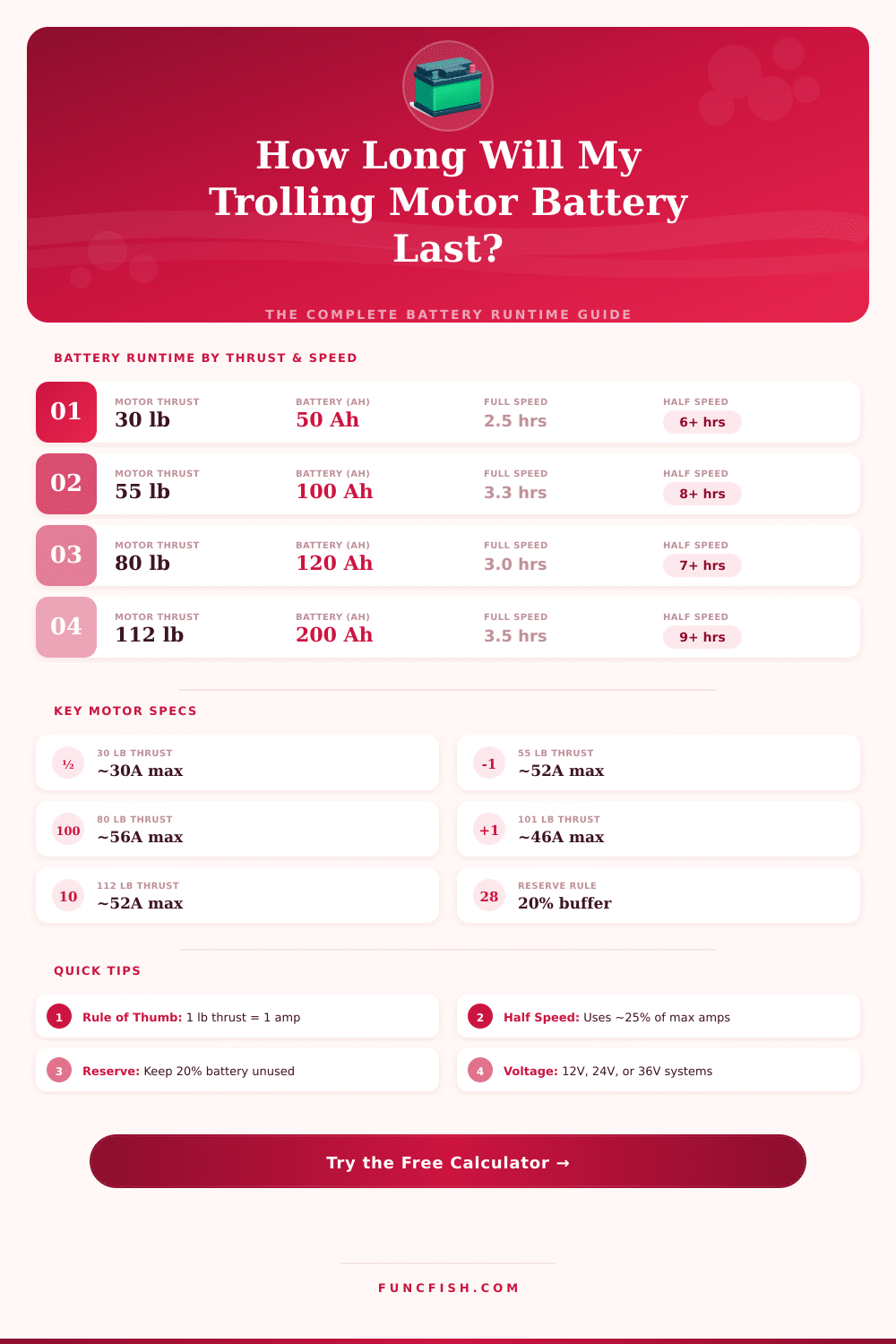
| Motor Thrust (lbs) | Voltage | Max Amps | 50Ah Runtime | 100Ah Runtime | Recommended Ah |
|---|---|---|---|---|---|
| 30 lb | 12V | 30A | ~1.7 hrs | ~3.3 hrs | 50–60 Ah |
| 40 lb | 12V | 42A | ~1.2 hrs | ~2.4 hrs | 75–100 Ah |
| 45 lb | 12V | 42A | ~1.2 hrs | ~2.4 hrs | 75–100 Ah |
| 55 lb | 12V | 52A | ~1.0 hr | ~1.9 hrs | 100–120 Ah |
| 70 lb | 24V | 42A | ~1.2 hrs | ~2.4 hrs | 100–120 Ah |
| 80 lb | 24V | 56A | ~0.9 hrs | ~1.8 hrs | 120–150 Ah |
| 101 lb | 24V | 46A | ~1.1 hrs | ~2.2 hrs | 150–180 Ah |
| 112 lb | 36V | 52A | ~1.0 hr | ~1.9 hrs | 180–200 Ah |
| Scenario | Typical Motor | Avg Speed Used | Rec. Trip Duration | Min. Battery Needed |
|---|---|---|---|---|
| Bass Tournament | 80–112 lb | 70–80% | 8–10 hrs | 150–200 Ah |
| Walleye / Crappie | 45–55 lb | 50–65% | 6–8 hrs | 100–120 Ah |
| Trout Lake | 30–55 lb | 40–60% | 4–6 hrs | 60–100 Ah |
| Kayak / Small Boat | 30–36 lb | 35–50% | 4–5 hrs | 50–75 Ah |
| Salmon Trolling | 55–80 lb | 60–75% | 6–8 hrs | 100–150 Ah |
| Muskie / Pike | 80–112 lb | 75–85% | 6–8 hrs | 150–200 Ah |
| Catfish Drifting | 45–55 lb | 30–50% | 5–7 hrs | 80–100 Ah |
| Striped Bass | 80–112 lb | 70–80% | 6–8 hrs | 150–200 Ah |
| Battery Type | Usable Capacity | Cycle Life | Weight (100Ah) | Best Use |
|---|---|---|---|---|
| Flooded Lead Acid | 50% (DoD) | 300–500 | ~62 lbs / 28 kg | Budget setups |
| AGM Sealed | 50–60% (DoD) | 500–700 | ~60 lbs / 27 kg | Most anglers |
| Gel Battery | 50% (DoD) | 500–800 | ~58 lbs / 26 kg | Vibration-prone boats |
| Lithium (LiFePO4) | 80–90% (DoD) | 2000–5000 | ~26 lbs / 12 kg | Tournament fishing |
| Lithium-Ion | 80% (DoD) | 500–1500 | ~22 lbs / 10 kg | Lightweight setups |
| NiMH | 70% (DoD) | 500–1000 | ~55 lbs / 25 kg | Specialty use |
Choosing the right Battery for a Trolling Motor is key for anyone that spends hours on the water. These devices run on 12V, 24V or 36V setups, depending on the kind of Trolling Motor installed. For a Trolling Motor you need a deep cycle or marine Battery.
Normal batteries simply do not work because Trolling Motors need repeated drains and recharges.
Choose the Right Battery for Your Trolling Motor
Some common kinds deserve thought. Lead-acid flooded batteries form a frequent and cheap option for deep cycle uses. They handle steady draining and recharging well.
Lead-acid batteries usually have a 12 volt rating so for 24V or 36V setups you will have to link two or three of them. That adds extra weight.
Lithium batteries, especially LiFePO4-type, weigh less and take fewer space for the same power. One single 24V or 36V lithium unit can replace several lead-acid matches. Even so lithium stays the most exepnsive option.
As more makers enter the market with lithium options, the prices will likely drop. For someone that plans to use their boat long term, lithium could prove a wise expense. One must however note, that lithium marine batteries did not serve for starting the boat motor.
They work only for deep cycle uses.
When you choose a Battery, consider its type, the amp-hour rating and your budget. The amp-hour value shows how much time the Battery will last. To guess the length of use, divide the amp-hours of the Battery by the amp draw of the motor.
A Trolling Motor at full speed can use around 36 amps, so a 40 amp-hour Battery would last four around one hour at full power. Battery with bigger amp-hour capacity gives longer run time.
Groups 27 and 31 for deep cycle batteries are popular sizes. Group 31, with its higher reserve power, forms a solid choice for Trolling Motors. When the Trolling Motor session lasts less than one and a half hours, group 24 size can work well.
Simply avoid draining them under 50 percent, because deeper draining shortens the life of the Battery.
Lithium batteries commonly include a built-in manager for batteries, or BMS, that carries guards to keep the health and life of the unit. The current limit of the BMS must beat the need of the Trolling Motor, otherwise the Battery will shut during heavy usage.
Cheap batteries can last years with proper care. Store them in a shed during cold and use a smart charger after every trip helps a lot. Mounted on the boat simplifies everything, because you only must connect it to an extension cord.
Waterproof chargers for marine settings exist for 36V setups also. Thecharging matters almost as much as the quality of the Battery itself.