Tube Jig Fall Rate Calculator
Estimate how fast a tube jig sinks after line drag, plastic style, head weight, water temperature, current, and casting angle are all pulling on the same fall.
📌Scenario presets
⚙Tube fall settings
Tube jig fall forecast
Full breakdown
📋Tube fall data grid
Hollow Finesse
Salted Soft
Goby Tube
Flipping Tube
📊Reference tables
| Tube setup | Common head | Typical depth | Expected fall |
|---|---|---|---|
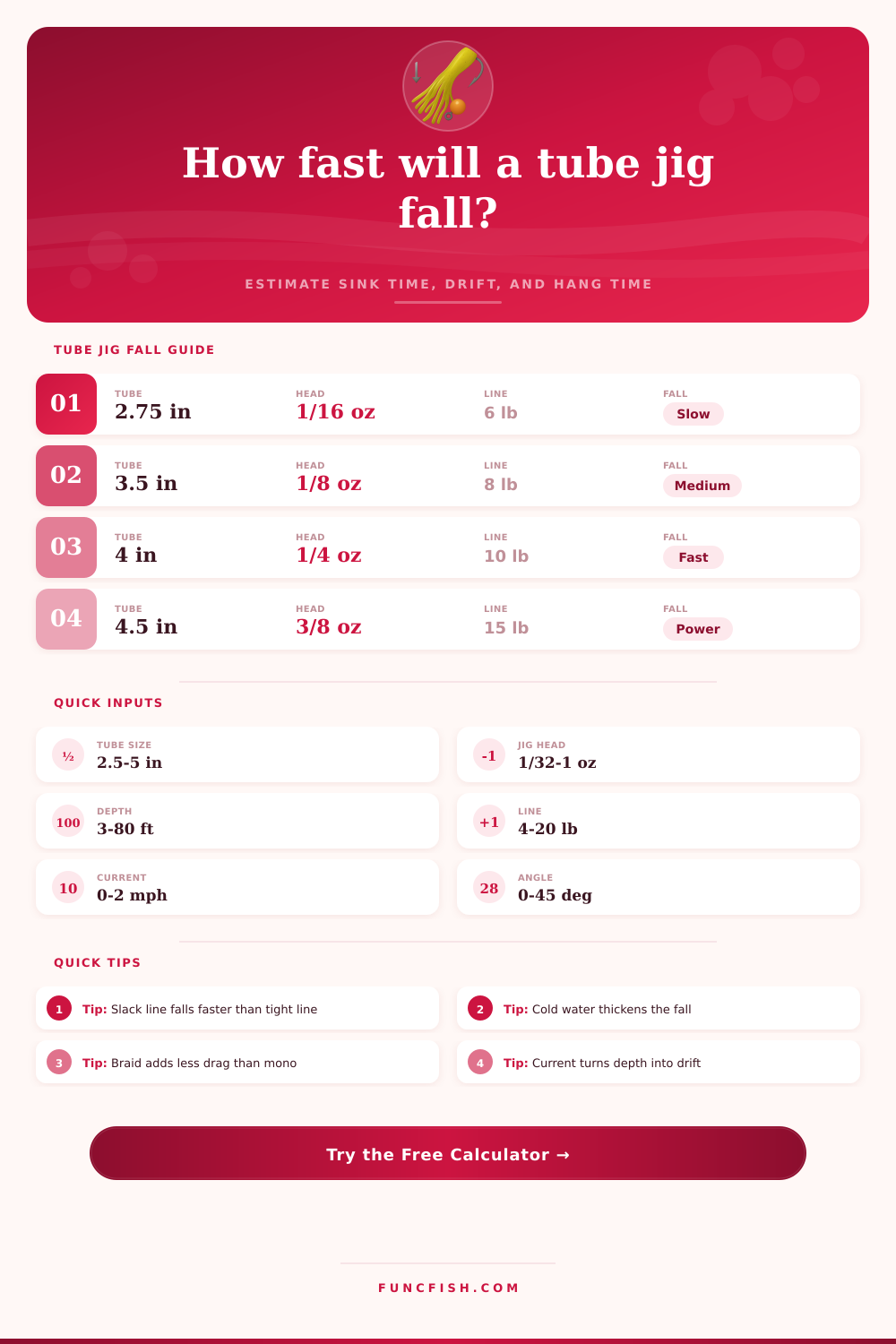
| 2.5 inch micro tube | 1/32 to 1/16 oz | 3 to 10 ft / 1 to 3 m | Slow hover |
| 3 inch finesse tube | 1/16 to 3/32 oz | 6 to 18 ft / 2 to 5 m | Soft spiral |
| 3.5 inch smallmouth tube | 1/8 to 3/16 oz | 8 to 30 ft / 2 to 9 m | Balanced fall |
| 4 inch ledge tube | 3/16 to 1/4 oz | 15 to 45 ft / 5 to 14 m | Fast contact |
| 4.5 inch flipping tube | 5/16 to 1/2 oz | 3 to 15 ft / 1 to 5 m | Power drop |
| 5 inch heavy cover tube | 1/2 to 1 oz | 4 to 20 ft / 1 to 6 m | Penetrating fall |
| Line material | Typical diameter | Sink behavior | Fall effect |
|---|---|---|---|
| 6 lb braid | 0.005 in / 0.13 mm | Floats slightly | Least drag, crisp fall |
| 10 lb braid | 0.007 in / 0.18 mm | Floats slightly | Low drag, good feel |
| 6 lb fluorocarbon | 0.009 in / 0.23 mm | Sinks | Balanced tube glide |
| 8 lb fluorocarbon | 0.010 in / 0.25 mm | Sinks | Strong all-around fall |
| 12 lb fluorocarbon | 0.012 in / 0.30 mm | Sinks | More drag, more control |
| 8 lb monofilament | 0.011 in / 0.28 mm | Floats | Slows semi-slack fall |
| 12 lb monofilament | 0.014 in / 0.36 mm | Floats | Strong pendulum effect |
| 10 lb copolymer | 0.012 in / 0.30 mm | Near neutral | Moderate drag |
| Condition | Adjustment | Calculator factor | Fishing read |
|---|---|---|---|
| Cold water below 45°F / 7°C | Thicker water | 0.91 to 0.96 | Fall slows and glides |
| Warm water above 70°F / 21°C | Lower viscosity | 1.03 to 1.08 | Tube reaches bottom sooner |
| Slack line | Minimal line drag | 0.94 line factor | Fastest vertical drop |
| Tight line | Pendulum drag | 0.62 line factor | Longest hang time |
| Current over 1 mph / 1.6 km/h | Lateral push | Drift multiplier | Cast up-current |
| Line angle over 30° | Longer path | Cosine correction | Fall is less vertical |
💡Fall-rate checks
Tip: If the calculator shows too much drift, increase head weight before shortening the tube. Tube profile is often the action you want to keep.
Tip: A tight line can make a 1/8 oz tube fish like a lighter jig because the tube swings instead of dropping straight.
The tube hits the water and hangs there, You see it happen. The line goes slack as the tube doesn’t drop. Instead, it floats sideways like trash stuck in weeds, or it falls so slowly the surrounding fish won’t even look at it.
A tube jigs fall rate isn’t just about gravity and weight pulling it downward. It’s a combination of water viscosity, line tension, drag and buoyancy. Most guys believe they cast to reach their target depth, when in fact they is fighting the rate of delivery. Control the fall and you control the strike.
Why Fall Rate Matters
You enter all your set-up information into the calculator above and it does the math for you. You don’t have to guess at all those conversions and coefficients which are often wrong on the bank. They’ll consider water temp, line material, head weight, tube style, etc. It will provide you with an estimated sink rate that is pretty close to realityy.
And why should you care about that? Because different rates of fall will trigger fish differently. A suspended smallmouth over rock wants that slow steady glide. A walleye sitting up on a ledge may want a faster descent to react to the bait before it hits the muck. Knowing what these inputs mean in the real world makes you rig different than others.
The air-filled space in a hollow finesse tube give more drag than say a salted soft plastic. It’s a flutter action and it also slows the fall because of that air that makes it float. But in cold, viscous water, you can gets a tube to stall entirely. So what does the tool do? It adjusts based off the temperature; it knows that the colder the water is, the more resistance there will be against that plastic.
The one thing that many people don’t consider in this equation are line choice. Braid has almost zero drag and extremely low diameter. Your jig will go down straighter and quicker. You have more friction with monofilament or fluorocarbon because it create more surface area on the water. This is not always a negative. Sometimes that added drag helps give your bait a wider pendulum swing throughout the fall. This is ideal when targeting bass looking for a horizontal fall rather than a vertical fall.
The calculator also gives you an option to adjust for line tension. A tight line is like a brake whereas a slack line allow the bait to fall freely at its top speed. I know many guys who leave their reel drag far too tight or too loose and they don’t realize how much it impacts the presentation. If your line is tight, you are fighting the line instead of letting the jig head do its work.
But there’s another element that goes beyond just weight, current and wind. A tube with the same sink rate as one above might look like a poor choice on a river, but maybe not. The current causes it to travel sideways as it falls downward. This give it an almost spiraling path through the water column, exposing it to much more of the column than even a straight fall would. Being able to see how far your lure drifts gives you an idea of its location when it reaches the bottom. If you’re targeting something in the river like a piece of structure, it can help you realize that casting upstream lets the current bring your tube down onto them for you. This is better than struggling to get a vertical presentation in the current which is often more productive.
The page includes reference tables that lay out the typical setup for various scenarios and detail how tube size and head weight work together. For example, as you increase your tube size, you need to add more weight to the head so it can sinks deeper and have enough momentum to push through cover without getting caught. But if you add too much weight, the entire action dies. You’re looking for that sweet spot of sinking the lure down quick enough to appear naturaly, but slow enough to stay down in the strike zone.
Tube jig fishing require both precision and patience. It’s not just chucking plastic around. It’s building a move profile that forces predators to respond. Half of the battle is the fall rate whether you’re casting out over deep, clear water or flipping the stuff. Note what happens upon contact with the surface. A rapid fall means missing fish who don’t have time to react. A slow fall means giving them all day to think twice about it. You should of known that. The sweet spot exists somewhere between those two points where curiosity becomes aggressive. Get dialed-in on the sweet spot, and your lure will stay in the strike zone at precisely the right moment.