Two Hook Flapper Spacing Calculator
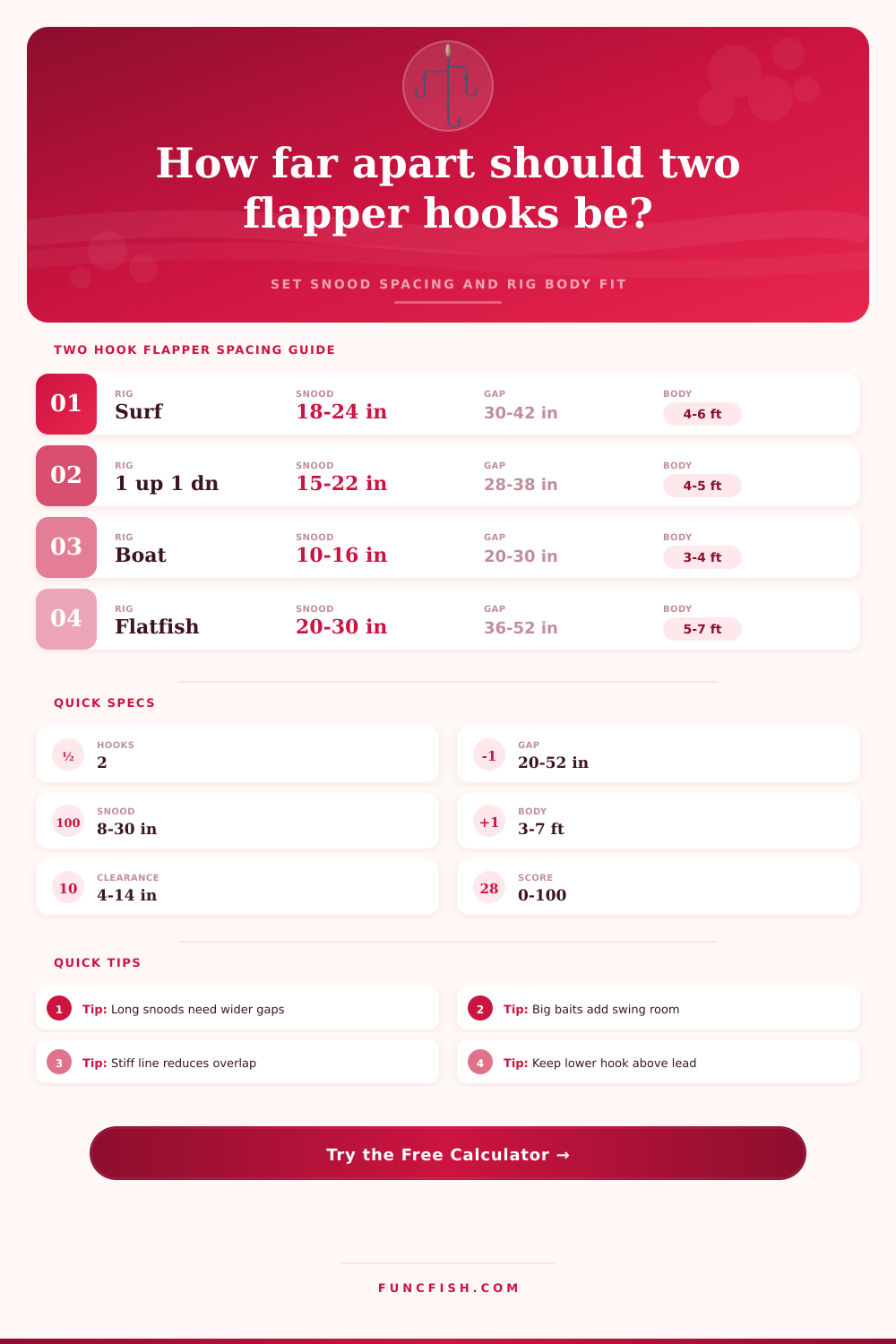
Calculate the spacing between two flapper snood attachment points, plus top tag, lower lead drop, total rig body length, hook swing overlap, and a practical anti-tangle score.
📌Two Hook Flapper Presets
⚙Spacing Inputs
Results appear after calculation.
Spacing breakdown
🛠Rig Material Reference
📊Two Hook Flapper Spacing Tables
| Rig situation | Typical snood | Branch spacing | Lower lead drop | Best use |
|---|---|---|---|---|
| Light surf scratching | 10-16 in / 25-41 cm | 22-32 in / 56-81 cm | 7-10 in / 18-25 cm | Whiting, dabs, croaker, pompano |
| Standard two-hook flapper | 15-22 in / 38-56 cm | 28-42 in / 71-107 cm | 9-14 in / 23-36 cm | General beach and pier fishing |
| Long flatfish snood | 22-30 in / 56-76 cm | 40-56 in / 102-142 cm | 10-16 in / 25-41 cm | Flounder, fluke, sole, plaice |
| Compact boat flapper | 8-14 in / 20-36 cm | 18-28 in / 46-71 cm | 6-10 in / 15-25 cm | Boat bream, porgy, snapper |
| Clipped distance rig | 18-26 in / 46-66 cm | 34-50 in / 86-127 cm | 12-18 in / 30-46 cm | Power casting with bait clips |
| Bait profile | Swing addition | Spacing effect | Clearance note |
|---|---|---|---|
| Small worm or clam strip | Low | Base spacing usually works | Fine for short snoods and light casts. |
| Worm and fish cocktail | Medium | Add 1-3 in / 3-8 cm | Allow for bait fold and hook point cover. |
| Sandeel or slim fish bait | Medium | Add 2-4 in / 5-10 cm | Long slim baits swing past the hook bend. |
| Whole squid or bulky crab | High | Add 4-8 in / 10-20 cm | Use more lower drop so bait clears the lead. |
| Fish strip or flapper bait | High | Add 4-10 in / 10-25 cm | Tail flutter increases hook-to-hook overlap risk. |
The calculator treats the two snoods as moving arcs around their attachment points. The recommended gap is wider when baits are long, snoods are soft, casts are hard, or tide pressure makes both snoods sweep the same way.
💡Spacing Notes
Branch-to-branch spacing: Measure between the two swivels, dropper knots, rotors, or trapped beads. Do not measure hook to hook while the rig is hanging.
Body length check: If the calculated body is longer than your rod or rig wallet, shorten snoods first, then move to stiffer material before reducing bait clearance.
Here you are standing on the bank holding a rig you just tied up. You fear if you throw it too hard, those snoods won’t reach water without tangling. That’s one of the issues facing all casts: Physics. Why does hook distance matter? For two reasons. One, to ensure the baits is close together so the fish can locate them. Two, to ensure baits aren’t too far apart to avoid colliding on the cast and retrieve. Mess up the spacing here and it take longer to get it right and wrecks your knots.
Swing radius is the key. Current force the snoods backward, while gravity pulls sinker downward. Snaps of short snoods cause drag as they tighten up against main line. This scares sensitive species such as flatfish and whiting. Long snoods lacking proper separation wrap back on themselves. What’s required? You need a certain relationship between branch spacing and snood length to allow the bait to move naturaly. Most do not know because many are guessing from outdated drawings.
Why Hook Spacing Matters
Hook Spacing: Hook spacing is altered by the material stiffness. Soft lines like monofilament bend, follow the mainline, and droop down. A wider gap is required when using these softer materials so they don’t overlap each other. Fluorocarbon holds its form away from the rig body. So you can pack them tighter together and still have a good presentation. The hook spacing recommendations in the calculator take into account the material type you choose.
Stiffer snoods push out more, while soft materials collapses on themselves more when they take on a load. Many anglers fail to realize that bait profile also plays an important role. When you use a little worm, it sticks out only slightly past the eye of the hook. So there’s very little room for clearance. With big baits like a bulky crab bait or even a whole squid, they swing out in a wide arc that can easily intersect with adjacent snood’s path.
If you’re using a large bait, you have to space the points of attachment further apart then usual. Otherwise, as you retrieve it, the trailing end of one bait will collide with the shank of next hook. It’s really important when fishing around heavy surf because all of this motion is made larger by the water turbulence.
Another factor where lead drop has been problematic are how much it loosens the system by altering distance between the sinker and lower hook. A short drop pulls bottom bait sideways. Sometimes it buries the bait into the sand before the fish realize it’s there. But with a longer drop, the sinker stays anchored so the snood can sit vertically above it, creating a clean presentation on seabed. But the bigger the drop the longer overall the rig becomes. This makes it harder to cast heavy weight because of air resistance.
So how far out do you go on a flapper rig? Well, you have practical constraints. Long rigs work well for flatfish that roam widely, but they are bad for fast-striking fish that needs food immediately. You’ll see some general snood length and placement for different target species in the table of references below. These extend from short compact boat rigs through to longer surf rigs. That will give you an idea of where your visual “need” is compared with your actualy “need”.
You must manage how the parts work together to build a decent two-hook flapper rig, keeping three moving parts separate yet presenting them attractively on the bottom. Hours of frustration along the water’s edge could of been saved with a little more planning before you tie this knot. You’re looking for a rig that sits straight and lands clean. When the bite comes, it offers no resistance. That balance between order and chaos makes the difference between a tangled mess and a working rig.
You certainly do not want them to see your knots before they see the food. They need to see the bait.