
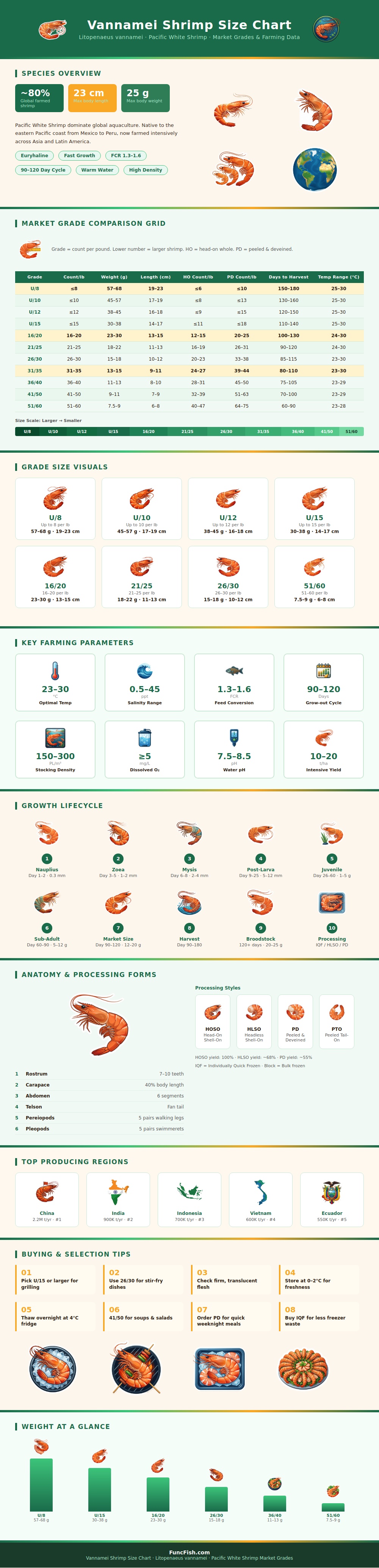
If you’ve ever shopped for shrimp at a fish counter, I’m guessing that you was bewildered: What do all those different kind of shrimp mean? How can one be more expensive then another when they all seem pretty much alike in the bin? What’s going on? Mostly it’s nothing; it’s just that they’re being sold by size grade. That sort of thing matter, shopping becomes exact instead of arbitrary, and once you understand how sizes work, you stop buying whatever seems large and start buying what will cook properley.
And that’s the reason that the Pacific White Shrimp dominate this market. It feed effectively, adapts easy to various levels of water salinity, and reaches size quickly. That means farmers finds it predictable, and cooks find its textural uniformity desirible. From tiny larval form all the way up to adult form, the life cycle last only a matter of a few months. So when demand goes up, so does supply, because there isn’t much time between these two stages.
How to Choose the Right Shrimp Size for Your Meal
If you aren’t familiar with it, you may find the grading system unintuitive. What does the number on the package mean? Well, it’s the number of shrimp per pound. A lower number mean there are fewer shrimp per pound, which makes each individual shrimp larger. So for instance, a bag marked U/8 contain only eight or fewer shrimp and they’re going to be really big. In fact, a 51/60 count has dozens of tiny little shrimp in the same pound. So it’s sort of a reverse psychology thing.
People think bigger must taste better, but that is not how physics work. Size also matters when it comes to cooking success: Heat penetrates by mass, so a large piece of meat will reach desired doneness different than a small one. Same goes for shrimp: While outer muscle fibers will constricts, tightening into rubber bands as they near doneness, large ones takes longer to fully cook from the inside out.
Because they are grilled, they need to be the largest size: U/15 or larger. The thicker flesh can withstands high-heat treatment without turning rubbery while staying moist enough not to dry out entirely. In contrast, with stir-fries, you want quicker cooking time, which means smaller grades. That’s where the 26/30 count hit the sweet spot. It sears nearly instantaneously and picks up flavor of any sauces quickly. If using giants (above) in a fast stir-fry, you’ll end up either with a too-tough exterior or still-rare interior.
Why? Match grade to method.
There’s one other aspect of shrimping that most consumers don’t consider: style of processing. Shrimp with shells intact (whole shell-on) look dramatic on the plate but require more work from you. Peeled and deveined varieties will be easier to prepare, but will also have an added price tag due to human work. Because there is less mass after being cleaned, expect to see roughly half the initial starting weight. If you are in a hurry, go ahead and pay the extra cost. Otherwise, you’re just paying someone else to do work that won’t greatly improve the dish, unless the shrimp are especially small and going into something simple like a salad or soup. In this case, you do not need to peel them, simply purchase as needed.
No matter what grade you select, storage is key to keep it fresh. Frozen shrimp should be kept cold (but not freezer burnt!) and thawed carefuly in the refrigerator, not under warm water. Thawing too quickly will shock the shrimp’s cells and ruin its texture. For best eating, once thawed, prepare immediately.
That visual reference clears up those differences with the length and weight breakdowns. It helps you get a good idea of how much bigger or smaller a piece of shrimp realy is before you open the bag. So at the end of the day, picking the proper shrimp isn’t as much about learning a number system as it is learning the relationship between size and heat. Once you understand why that little guy performs so well in soup and that big boy really pops on the grill, the aisle doesn’t seem quite as overwhelming anymore. And instead of being intimidated by the product, you realize it’s simply a protein that’s flexible, just waiting to be paired with the appropriate cooking method.
That knowledge transforms a difficult shopping experience into a sure-footed decision. You should of checked the labels before buying.