🐟 Wahoo Weight Calculator
Estimate wahoo weight from length & girth measurements — imperial & metric
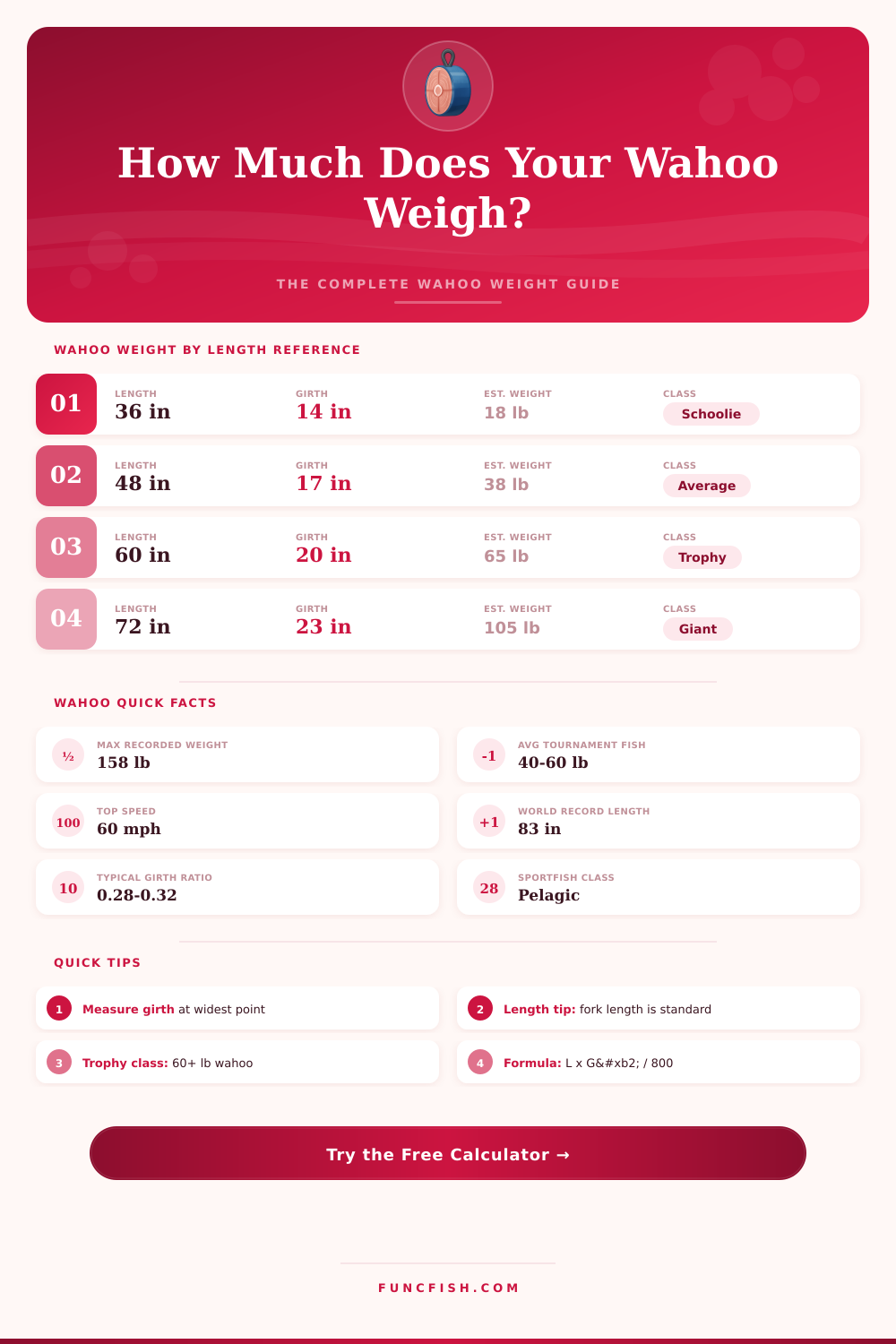
| Fork Length (in) | Fork Length (cm) | Typical Girth (in) | Est. Weight (lb) | Est. Weight (kg) | Class |
|---|---|---|---|---|---|
| 30 | 76 | 12 | 13.5 | 6.1 | Juvenile |
| 36 | 91 | 13 | 21.9 | 9.9 | Schoolie |
| 42 | 107 | 15 | 35.4 | 16.1 | Small Adult |
| 48 | 122 | 16 | 48.6 | 22.0 | Average |
| 54 | 137 | 18 | 65.6 | 29.8 | Good Fish |
| 60 | 152 | 20 | 90.0 | 40.8 | Trophy |
| 66 | 168 | 21 | 108.0 | 49.0 | Big Trophy |
| 72 | 183 | 23 | 150.0 | 68.0 | Giant |
| Formula | Divisor | Best Used For | Accuracy | Example (48 in x 16 in girth) |
|---|---|---|---|---|
| Standard | 800 | General estimate | ±5% | 48.6 lb |
| Measured Girth | 900 | Actual tape girth | ±4% | 43.2 lb |
| Estimated Girth | 750 | Visual girth guess | ±8% | 51.8 lb |
| IGFA Method | 850 | Tournament records | ±4% | 45.7 lb |
| Fish Class | Est. Weight | Line Class | Leader Strength | Hook Size | Drag Setting |
|---|---|---|---|---|---|
| Schoolie | 10-25 lb | 20-30 lb | 50 lb mono | 5/0-6/0 | 6-8 lb |
| Average | 25-50 lb | 50-65 lb | 80-100 lb wire | 7/0-8/0 | 12-16 lb |
| Trophy | 50-80 lb | 80-100 lb | 150 lb wire | 8/0-9/0 | 20-25 lb |
| Giant | 80+ lb | 100-130 lb | 200 lb wire | 9/0-10/0 | 28-35 lb |
| Fork Length (in) | Estimated Girth (in) | Girth Ratio | Est. Weight (lb) |
|---|---|---|---|
| 36 | 10.1-11.5 | 0.28-0.32 | 16-22 lb |
| 48 | 13.4-15.4 | 0.28-0.32 | 38-52 lb |
| 60 | 16.8-19.2 | 0.28-0.32 | 74-104 lb |
| 72 | 20.2-23.0 | 0.28-0.32 | 128-178 lb |
Wahoo are long and lean fishes, and because they are fish that are built for speed, wahoo fish doesnt have the same body shape as many other fish species. Most fish species, such as yellowfin tuna, have a football shaped body that is very thick. However, wahoo have a long and thin body.
As a result of their body shape, a 50-inch long wahoo might only weighs 33 pounds, while a king mackerel of the same length might weigh only 25 pounds. The reason for the difference in the weight of these two fish species is that the wahoo’s mass is even across its body. This even distribution of the wahoo mass make it difficult to estimate the weight of the fish.
How to Measure Wahoo Weight
Additionally, wahoo that are 45 inches or less in length are typically light in weight, but wahoo that are 70 inches in length can weigh more than 80 pounds if the wahoo has a full belly. To estimate the weight of a wahoo fish, you must use specific measurements of the fish. You should utilize the fork length of the fish, which is the measurement from the tip of the snout to the fork in the tail of the fish, for estimating the weight of the fish.
You should use the fork length instead of the full length of the tail of the fish, which may be flare. Additionally, you should use the mid-body girth of the fish, which is the measurement of the depth of the belly of the fish in the middle of its body, instead of the depth of the belly of the fish near the gill plates. The gill plates may shrink after the fish is caught.
Finally, the tape measure that is used to measure the wahoo should also be snug against the body of the fish. Any looseness in the tape measure will lead to the weight estimate being too high. The condition of the wahoo will change the weight estimate of the fish.
Additionally, the location from which the wahoo was caught will also change the weight estimate for that fish. Wahoo that is caught using high-speed lures are often leaner than wahoo that eat live bait. Wahoo in the Atlantic Ocean are often lean.
However, wahoo in the Pacific Ocean, such as the ono, may have deeper shoulders. If the wahoo just spawned, the wahoo could be skinny because of the spawning process. A skinny wahoo will have a lower girth measurement than a well fed wahoo.
These factors must be considered in order to ensure that you accurately measure the weight of the wahoo. To accurately measure the weight of the wahoo, the correct tools must be used. A rigid board work well to measure the fork length of the wahoo.
However, a soft tape measure can provide inaccurate measurements because the tape can stretch. You can use a rope loop to measure the girth of the wahoo. However, the rope loop may wander when measuring the fish.
Apply tension to the tape to ensure that the measurement of the wahoo is accurate. However, do not compress the body of the wahoo because the girth measurement will be too small. If the wahoo has been iced, the flesh will be firm to the touch.
A firm wahoo may result in a tighter tape measurement than a freshly caught wahoo. Accuracy is important when measuring the weight of a wahoo. If you use the shoulder girth instead of the mid-body girth, you may overestimate the weight of a skinny wahoo by 10 to 15 percent.
If you do not account for the curve of the wahoo’s body when you measure the length of the fish, you will overestimate the weight of the wahoo by approximately 8 percent. Only using the visual estimate to determine the weight of the wahoo isnt accurate. However, using the fork length, the mid-body girth, and the body condition of the wahoo will result in a much more accurate weight measurement than if only one of these measurement is used to determine the weight of the wahoo.