Hook Size for Walleye Calculator
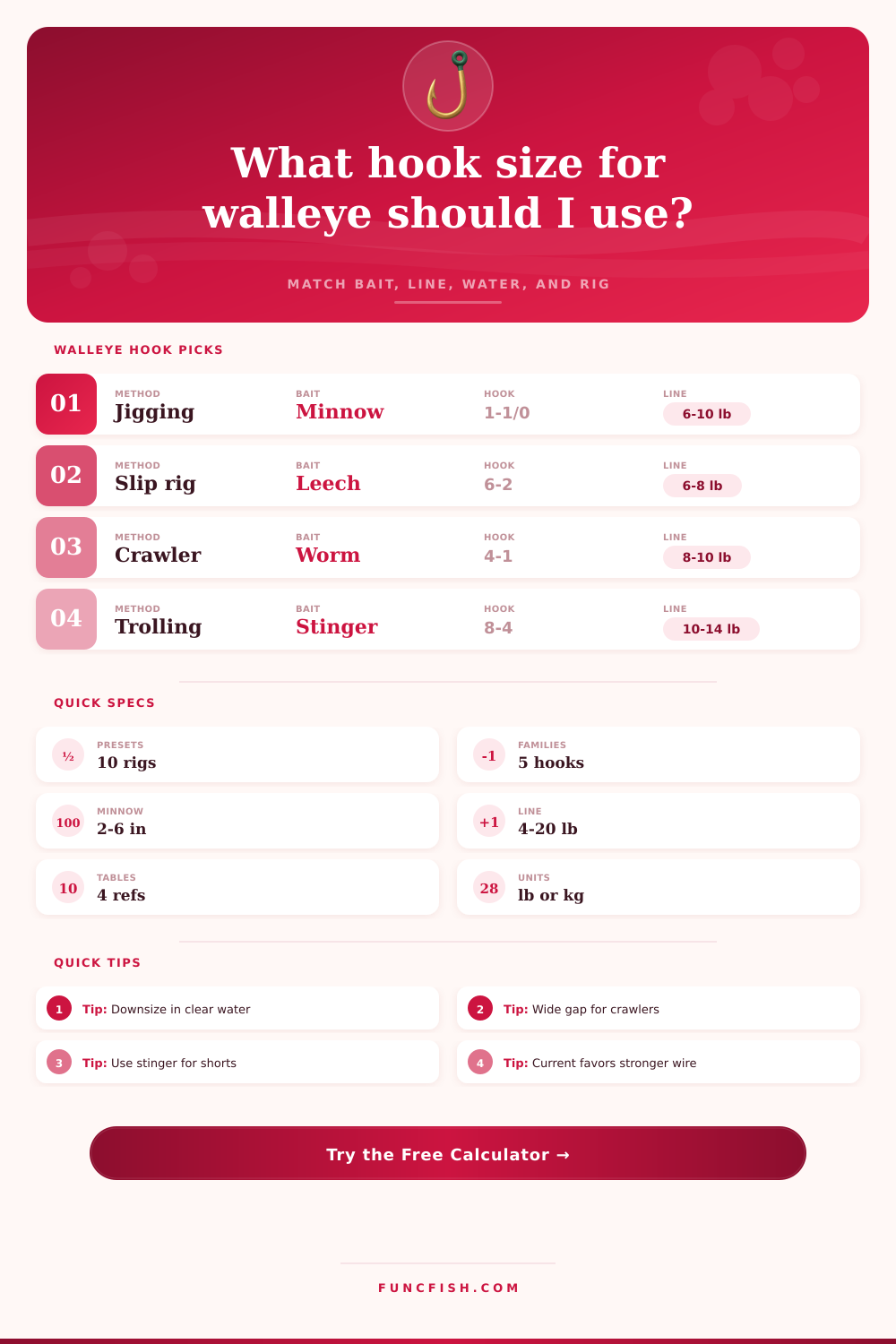
Match walleye hook size to jigging, live bait, or trolling rigs with minnow, leech, crawler, hook family, line test, water clarity, current, and fish size.
📌Walleye hook presets
⚙Walleye rig inputs
Recommended walleye hook setup
The calculator weighs bait profile, hook family, line pressure, clarity, current, and fish class.
Detailed sizing breakdown
📊Walleye bait, hook, and line comparison grid
Jig Minnow
Best when the jig hook gap clears the minnow shoulder.
Slip Leech
Small octopus hooks keep a leech swimming naturally.
Crawler Rig
Use more gap when the crawler bunches around the bend.
Trolling Stinger
Treble sizes run smaller than single-hook live bait picks.
🪝Hook family notes
Octopus
Compact gap for leeches, minnows, slip rigs, and cold-front live bait.
Live Bait
Longer shank and simple bend for minnows, redtails, suckers, and rigging.
Stinger Treble
Small trailing hook for short strikes behind jigs, spoons, or trolling baits.
Jig Hook
Matched to head weight and bait profile for vertical jigging and pitching.
Slow Death
Curved crawler hook that needs enough gap for rolling bait action.
📘Walleye reference tables
| Bait profile | Common size | Single hook range | Treble range | Line match |
|---|---|---|---|---|
| Small fathead minnow | 2-3 in / 5-8 cm | #4 to #2 | #10 to #8 | 4-8 lb / 1.8-3.6 kg |
| Medium shiner | 3-4 in / 8-10 cm | #2 to #1 | #8 to #6 | 6-10 lb / 2.7-4.5 kg |
| Large redtail or sucker | 5-6 in / 13-15 cm | 1/0 to 2/0 | #6 to #4 | 8-14 lb / 3.6-6.4 kg |
| Leech | 2-4 in / 5-10 cm | #6 to #2 | Not common | 4-8 lb / 1.8-3.6 kg |
| Crawler section | 3-5 in / 8-13 cm | #4 to #1 | #8 to #6 | 8-12 lb / 3.6-5.4 kg |
| Scenario | Best hook family | Starting size | Adjustment | Why it fits |
|---|---|---|---|---|
| Vertical jigging | Jig hook | #1 to 1/0 | Upsize in current | Keeps point clear of minnow or plastic |
| Slip rig leech | Octopus | #6 to #2 | Downsize in clear water | Light hook lets leech pulse naturally |
| Live bait rig minnow | Live bait | #2 to 1/0 | Match minnow shoulder | Long shank manages larger baitfish |
| Crawler harness | Slow-death | #4 to #1 | Use wider gap when bunched | Curved bend spins crawler section |
| Short-strike trolling | Stinger treble | #8 to #4 | Use smaller than single hook | Trailing points catch nips behind bait |
| Condition | Hook move | Wire move | Line cue | Common result |
|---|---|---|---|---|
| Clear, calm water | One size smaller | Fine to medium | 4-8 lb / 1.8-3.6 kg | Better bait look and fewer refusals |
| Moderate stain | Base size | Medium | 6-10 lb / 2.7-4.5 kg | Balanced visibility and control |
| Muddy or night bite | One size larger | Medium strong | 8-12 lb / 3.6-5.4 kg | More positive contact on aggressive bites |
| Strong river current | One size larger | Strong | 10-14 lb / 4.5-6.4 kg | Point stays exposed under load |
| Trolling crankbait | Small treble | Medium strong | 10-20 lb / 4.5-9.1 kg | Hook holds through steady pull |
| Walleye class | Length range | Hook bias | Gap target | Line test cue |
|---|---|---|---|---|
| Eater | 14-18 in / 36-46 cm | #6 to #2 | 6-9 mm / 0.24-0.35 in | 4-8 lb / 1.8-3.6 kg |
| Keeper | 18-23 in / 46-58 cm | #4 to #1 | 8-11 mm / 0.31-0.43 in | 6-10 lb / 2.7-4.5 kg |
| Big | 23-28 in / 58-71 cm | #2 to 1/0 | 10-14 mm / 0.39-0.55 in | 8-14 lb / 3.6-6.4 kg |
| Trophy | Over 28 in / 71 cm | #1 to 2/0 | 12-17 mm / 0.47-0.67 in | 10-20 lb / 4.5-9.1 kg |
💡Hook sizing tips
Live bait fit: A walleye hook should expose the point cleanly without pinning the bait stiff. If a minnow rolls sideways or a leech stops swimming, use the next smaller hook or lighter wire.
Current and trolling load: When the rig pulls hard, hook bend strength matters as much as number size. Keep the same nominal size if bait action is right, but move to medium-strong wire.
Walleye hook selections is a process of considering a number of different variable. The hook that you select for use with your bait is important because if the hook is too large or if it is too small for the bait, you will have difficulty in succesfully catching walleye fish with that bait. If the hook is too large for the bait, the bait may appear to be move unnaturally when being fished.
If the hook is too small for the bait, the bait may slide incorrect on the hook. The hook should be selected such that it balance with the bait being used and the conditions of the water in which the walleye live. The size and shape of the bait being used is one of the first variable to consider in the selection of the proper hook.
How to Choose the Right Hook for Walleye
If using three-inch fathead minnows as bait, the hook gap should be selected large enough to allow the minnows to pass over the shoulder of the walleyes head once the walleye has the minnow in its mouth. If using nightcrawler bait, the gaps in the hook should be wide enough to allow the nightcrawler to not bunch up around the hook when being fished; if the nightcrawler does bunch around the hook it may not be visible to the walleye. If using leech bait, the hook should be light in weight and compact in size; the leech should be able to swim natural without the hook weighting down the bait.
The other factors to consider include the type of water in which the walleye live and the strength of the current in those waters. If the water is clear, the angler will be able to more easily view the bait being fished. In these cases, the hook should be smaller in size such that the bait can move more free in the water to encourage more strikes from the walleye.
In waters that are muddy and stained, the walleye rely on the feel of the bait to be caught by the walleye; in these conditions, larger hooks with stronger wire should be used. If the waters has a strong current, the current will pull the bait; in these cases, the hook should have stronger wire so that the current does not bend the hook when it is being pull. The type of fishing line that you use also indicates what type of hook should be used.
If using monofilament line, the hook can have lighter wire; the monofilament line will cushion the walleye if it should hit the hook. If using fluorocarbon leaders, the hook should be strong enough to stand the strength of the fluorocarbon leader. If using a braided fishing main line and fluorocarbon leader, the hook should have strong wire to stand the strength of the braided fishing line.
The size of the walleye may also need to be considered once the other factor have been determined. If the walleye in the area are small, the hook will not need to have large gaps or thick wire; the smaller the walleye, the less pressure that there will be on the hook. Larger walleye will require a hook with thicker wire to stand the strength of the walleye’s powerful jaw.
While it is possible to catch a large walleye with a small hook, the risk is that the fish will not achieve proper initial purchase on the hook; thus, anglers may keep different hook size in their fishing boxes to allow for the change of hook size according to the size of the walleye that may be encountered. These different factor interact with one another; they do not act independently of one another. Due to the interaction of these factor, it is difficult to remember the perfect hook for any situation.
A hook calculator is one tool that can help the angler decide which size of hook to use in what situations. A hook calculator will take into account the dimension of the bait that is to be fished with, the type of fishing rig that is to be used, the conditions of the water, the type of line that is to be used, and the size of the walleye to be targeted, and it will recommend to the angler the size of hook that should be used. These recommendations will help the angler to establish the size of the hook, the gap of the hook, and the strength of the wire of the hook.
By understanding how the walleye interact with the bait, an angler can understand whether or not the hook that is being used is working effective. If the bait moves naturally and the walleye strike the bait, the hook is likely the correct size. If the walleye appear to be interested in the bait but then swim away, the angler should fish the bait with a smaller hook or a hook that is lighter in weight.
If the walleye take the bait but the fish is lost when reaching the net, the hook should have a more stronger wire or the hook point should have a wider gap. By understanding how each of these factor interact, the angler can more effectively choose the correct hook for that specific fishing situation.