Weight to Reach Bottom Calculator
Estimate the sinker weight needed to reach bottom from depth, current, line drag, bait profile, rig style, bottom type, and allowed drift.
📌Scenario presets
⚙Depth, current, and rig settings
Bottom contact forecast
Full breakdown
📋Sinker and line reference grid
Drop Shot Cylinder
Bank Sinker
Pyramid Sinker
8-Strand Braid
📊Reference tables
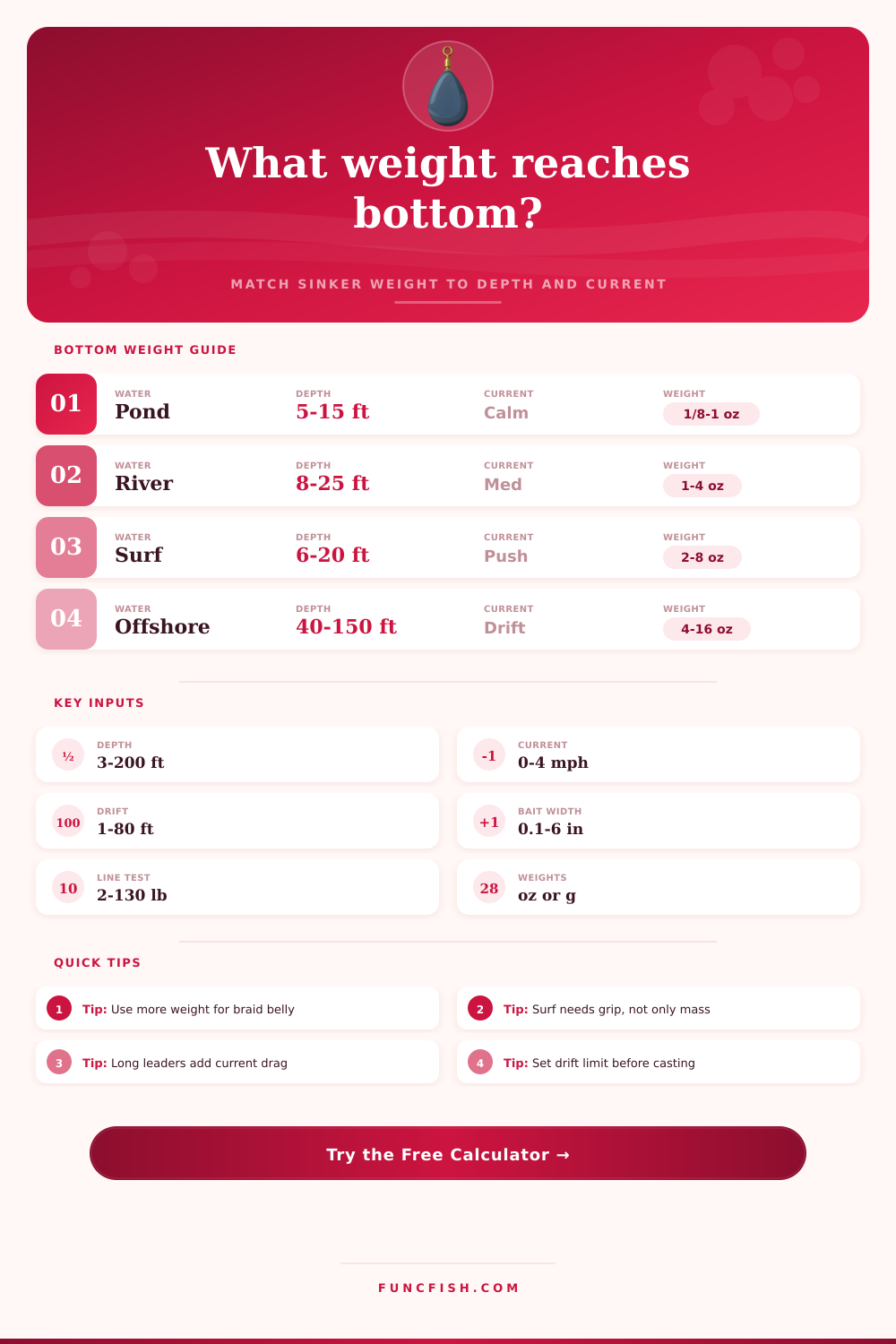
| Situation | Depth range | Current range | Starting weight |
|---|---|---|---|
| Panfish pond split shot | 3-12 ft / 0.9-3.7 m | Calm to 0.2 mph | 1/32-1/8 oz / 0.9-3.5 g |
| Trout stream drift | 2-8 ft / 0.6-2.4 m | 0.4-1.5 mph | 1/16-3/8 oz / 1.8-10.6 g |
| Bass drop shot | 8-35 ft / 2.4-10.7 m | 0-0.8 mph | 1/8-3/4 oz / 3.5-21 g |
| River catfish rig | 8-40 ft / 2.4-12.2 m | 0.8-3.0 mph | 1-8 oz / 28-227 g |
| Surf bait rig | 5-25 ft / 1.5-7.6 m | Wave surge | 2-8 oz / 57-227 g |
| Offshore bottom drop | 40-200 ft / 12-61 m | 0.3-2.0 mph | 4-24 oz / 113-680 g |
| Sinker style | Bottom contact | Current behavior | Use when |
|---|---|---|---|
| Split shot | Light touch | Moves easily | Shallow streams and small baits |
| Egg sinker | Rolling contact | Moderate lift | Carolina rigs and live bait |
| Bank sinker | Stable drop | Good compromise | Rivers, piers, boat bottom rigs |
| Pyramid sinker | Digging hold | High grip | Sand, surf, or moving tide |
| Sputnik sinker | Anchor hold | Very high grip | Surf sweep or hard lateral pull |
| Jig head | Direct feel | Depends on lure | Vertical and cast-and-drop fishing |
| Line material | Relative drag | Bottom feel | Adjustment note |
|---|---|---|---|
| Monofilament | High | Soft | Add weight for stretch and belly |
| Fluorocarbon | Medium | Medium | Sinks well but thicker tests drag |
| 8-strand braid | Low | Sharp | Often reaches bottom with less weight |
| 4-strand braid | Medium low | Sharp | Texture adds a little water grip |
| Wire leader | Medium | Firm | Leader length matters in current |
| Lead-core line | Low lift | Damped | Line mass helps depth but dulls feel |
💡Practical checks
Tip: If the calculator recommends more weight than the rod or rig casts comfortably, reduce drag first by using thinner line, a shorter dropper, or a smaller bait profile.
Tip: In surf or heavy river current, bottom hold is often controlled by sinker shape. A lighter gripper can hold better than a heavier round sinker.
When a person is using a fishing rig and doesnt feel the weight of a fish biting on the line, the weight of the sinker that is attached to the fishing line often causes the problem. If a person uses a sinker that is too light for the types of water in which they are fishing, the current in which the fish are swimming may move the sinker. Additionally, using a light sinker will cause the fishing line to form a bow before the fishing hook can reach the fish on the ocean floor.
In contrast, if a person uses a sinker that is too heavy for the type of bottom and fish in which they are fishing, the excessive weight will reduce the sensitivity of the fishing rod, and it may become difficult for the angler to feel when a fish is taking the bait. Thus, a person must choose a sinker weight that is somewhere in between these two extremes to allow the sinker to reach the bottom of the ocean floor yet allow the angler to feel each fish that is biting on the bait. The factors that influences the weight of the best sinker for an angler include the depth of the water, the speed of the current in the water, and the diameter of the fishing line that is being used.
How to Pick the Right Sinker Weight for Fishing
Each of these factors will influence the distance that the sinker must travel to the ocean floor, the force of the current that will push against the fishing line, and the amount of water that the line will grab as it is being reeled in. Additionally, the size of the bait that is being used will also influence the current of the line, as will the type of ocean floor that the angler is targeting. Finally, a calculator that determines the proper sinker weight will process each of these specific variables to allow the angler to understand the tradeoffs of each possible sinker weight.
The material of the fishing line will also impact the behavior of the sinker when an angler uses it. For instance, monofilament fishing lines will often develop a belly in the line when the person is reeling in the line, causing the current to push the line away from the ocean floor. Braided fishing lines are less likely to push the line away from the ocean floor, though the movement of the line is still transmitted to the anglers fishing rod.
Fluorocarbon fishing lines will sink at a faster rate than monofilament lines, but thick fluorocarbon lines may act as a sail if the current is particularly strong. While each of these line types may exhibit small differences in their behavior in calm water, each of these differences can be significant in rivers or areas where the current is moving at a faster rate. The shape of the sinker will impact the ability of the sinker to remain on the ocean floor once it reaches the ocean floor.
Round egg shaped sinkers will roll on the ocean floor in areas with currents. Pyramid sinkers will bite into the sand on the ocean floor. Sputnik sinkers use wires to act as anchors on the ocean floor in areas with strong currents (surf).
Each of these different shapes will impact the weight of the sinker necessary for the sinker to remain on the ocean floor. The calculator for the best sinker weight will account for these different shapes of sinkers. The time that it takes for the sinker to reach the ocean floor can also have an impact on the strength of the current that pushes the fishing line away from the ocean floor.
If the sinker takes longer to reach the ocean floor, the current may have more time to push the fishing line away from the ocean floor. Conversely, if the sinker descends more quickly to the ocean floor, the fishing line will be exposed to less time with strong currents. Additionally, if a sinker descends too quickly, it may create the illusion that the sinker is not moving on the ocean floor.
Therefore, the time that it takes for the sinker to reach the ocean floor is another variable that must be considered when choosing the weight of the sinker. For instance, sinkers will descend more quickly when an angler is vertical jigging the line, but sinkers will move more slowly when drifting a Carolina rig. These variables will not necessarily account for the real world conditions of the ocean floor.
For instance, there may be variables like the surge of the waves and the wind acting upon the fishing line that the calculator cannot measure. Thus, because the sinker calculator cannot consider each and every variable of the ocean floor, the calculator will provide the angler with a starting weight for the sinker and a hold score for the sinker, instead of the perfect sinker weight. Thus, the angler will have to watch the fishing rig for the first few drops of the fishing line, and adjust the weight of the sinker based off what is seen in the fishing rig.
On the page with the sinker calculator are also provided a series of reference tables that list the weights of sinkers that have been successful in other fisheries. These reference tables are another tool that can be used in conjunction with the calculator. Each of these reference tables will not replace the sinker calculator, but will provide an overview of the range of sinker weights that is normal within each of the specific situations.
Thus, if the calculator provides a suggested sinker weight that lies outside of these normal ranges, the angler should inspect the parameters that were entered into the calculator to ensure they are all correct. Thus, this tool allows the angler to worry less about the calculations of each of the parameters of sinker weight, and to focus upon the fishing rig to make adjustments as necessary. The person should of checked their gear too.