🐟 Yellow Perch Weight Calculator
Estimate yellow perch weight from length & girth — imperial & metric supported
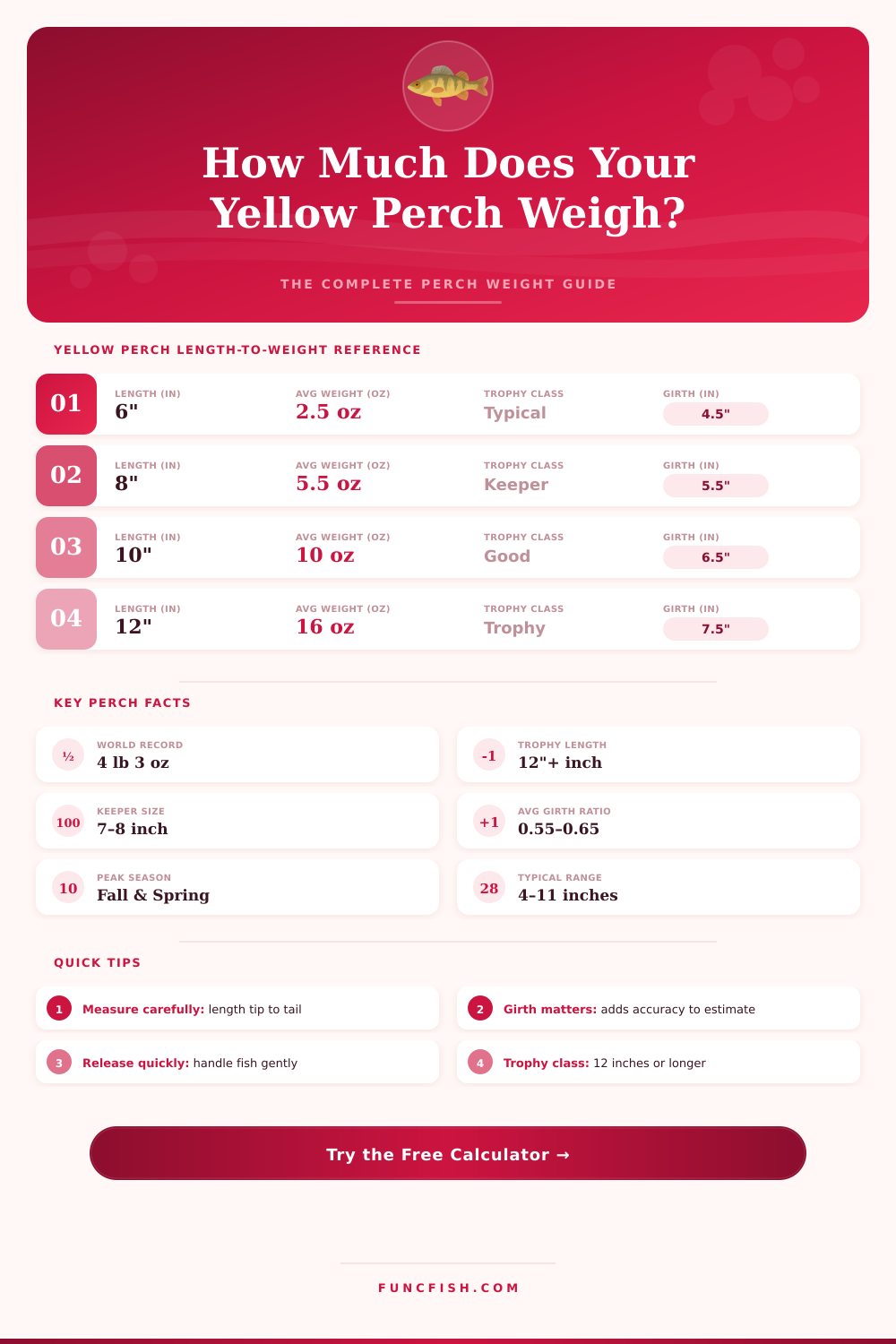
| Length (in) | Length (cm) | Avg Weight (oz) | Avg Weight (g) |
|---|---|---|---|
| 4" | 10.2 cm | 0.9 oz | 25 g |
| 5" | 12.7 cm | 1.7 oz | 48 g |
| 6" | 15.2 cm | 2.8 oz | 79 g |
| 7" | 17.8 cm | 4.3 oz | 122 g |
| 8" | 20.3 cm | 6.2 oz | 176 g |
| 9" | 22.9 cm | 8.8 oz | 249 g |
| 10" | 25.4 cm | 12.0 oz | 340 g |
| 11" | 27.9 cm | 15.8 oz | 448 g |
| 12" | 30.5 cm | 20.5 oz | 581 g |
| 13" | 33.0 cm | 26.0 oz | 737 g |
| Class | Length | Weight | Girth (est.) |
|---|---|---|---|
| Juvenile | 3–5" | < 1.5 oz | 2.0–3.5" |
| Typical | 6–7" | 2–5 oz | 4.0–4.8" |
| Keeper | 7–9" | 4–9 oz | 4.8–6.0" |
| Good | 9–11" | 9–16 oz | 6.0–7.0" |
| Trophy | 11–13" | 1–2 lb | 7.0–8.5" |
| Jumbo | 13"+ | 2+ lb | 8.5"+ |
| Perch Size | Line Weight | Hook Size | Jig Weight | Rod Action |
|---|---|---|---|---|
| Juvenile (3–5") | 2–4 lb | #10–#12 | 1/64–1/32 oz | Ultralight |
| Typical (6–7") | 4–6 lb | #8–#10 | 1/32–1/16 oz | Ultralight |
| Keeper (7–9") | 6–8 lb | #6–#8 | 1/16–1/8 oz | Light |
| Good (9–11") | 6–10 lb | #4–#6 | 1/8–3/16 oz | Light–Med |
| Trophy (12"+) | 8–12 lb | #2–#4 | 3/16–1/4 oz | Medium |
| Formula | Inputs | Best Use | Accuracy |
|---|---|---|---|
| Length & Girth | L (in), G (in) | Field measurement | ★★★★★ |
| Length Only (standard) | L (in) | Quick estimate | ★★★☆☆ |
| Carlander Cubic | L (in) | Scientific biometric | ★★★★☆ |
| Field Estimate | L (in) | On-water guess | ★★☆☆☆ |
To estimate the weight of a perch, an understanding of the relationship between the length of the perch and the weight of the perch are required. Many use a tape measure to measure the length of a perch. However, teh length of the perch wont provide an accurate measurement of the weight of the perch.
It is possible for two perches of the same length to have a different amounts of weight; the difference in the amount of weight between the two perch of the same length is the condition of the perch. The concept of standard weight is used to estimate the weight of a perch. Standard weight are calculated as the mathematical average of the weight of a number of perches of different lengths but similar conditions.
How to Estimate the Weight of a Perch
The relative weight score (Wr score) of a perch is calculated as the percentage of the weight of the perch in comparison to the standard weight of the perch. If the relative weight score of a perch is 100, the perch weigh the same as the standard weight. If the relative weight score is more than 100, the perch is considered to be heavy; it has a broad body.
If the relative weight score is less than 100, the perch is lean; it has a narrow body. While length is one of the measurements of a perch, length alone is not enough to determine the weight of a perch due to lengths inability to account for the volume of the perch. Other measurements, such as girth and depth of the body of the perch, is important in determining the weight of the perch because these measurements account for the thickness of the perch.
Perch with a large girth will weigh more than perch with a small girth. Thus, including the measurement of the girth of the perch is necessary to provide a legitimite estimate of the weight of the perch. Beyond length, there are also biological factor in relation to the weight of a perch.
For instance, female perch will have an egg mass during the late winter months. This egg mass will increase the weight of the female perch. After spring spawn, however, the female perch will lose the egg mass and will weigh less and appear more thinly due to this loss of weight.
These biological factors will change the weight of a perch in a way that is dependent upon the season in which the perch is evaluated. The environment of the lake in which the perch is found will also impact the weight of the perch. In lakes with abundant food source for the perch, such as minnows and mayflies, the perch will grow to be heavy and deep.
In lakes with little food for the perch, the perch will grow to be long and narrow. Thus, the productivity of the lake basin will impact the relative weight of the perch; the more food available for the perch, the more weight the perch will gain. It is possible to use a tape measure to determine the length of the perch.
However, you can also use a drawing of the perch or even memory to estimate the length of the perch. The tool provides an estimate band around the length of the perch; this is provided since the length of the perch is not always measured with precision. The estimate band allow for the weight estimate to account for the inaccuracies of the length and weight measurements of the perch.
Understanding the weight of the perch will allow an individual to understand the health of the lake in which the perch live. For instance, if the relative weight of the perch within a lake is decreasing each year, it is possible that the lake is overpopulated with perch, or that the food source for the perch within the lake is collapsing. Thus, the weight of the perch will allow an individual to gain an understanding of the life of the perch within that lake.