Match the Hatch Size Calculator
Size flies, small lures, and baitfish imitations from observed hatch or forage length, fish selectivity, water clarity, current speed, and presentation style.
📌Scenario presets
⚙Hatch match inputs
Hatch size match
Full breakdown
📋Pattern size data grid
Midge
BWO
Caddis
Minnow
📏Hatch and forage reference tables
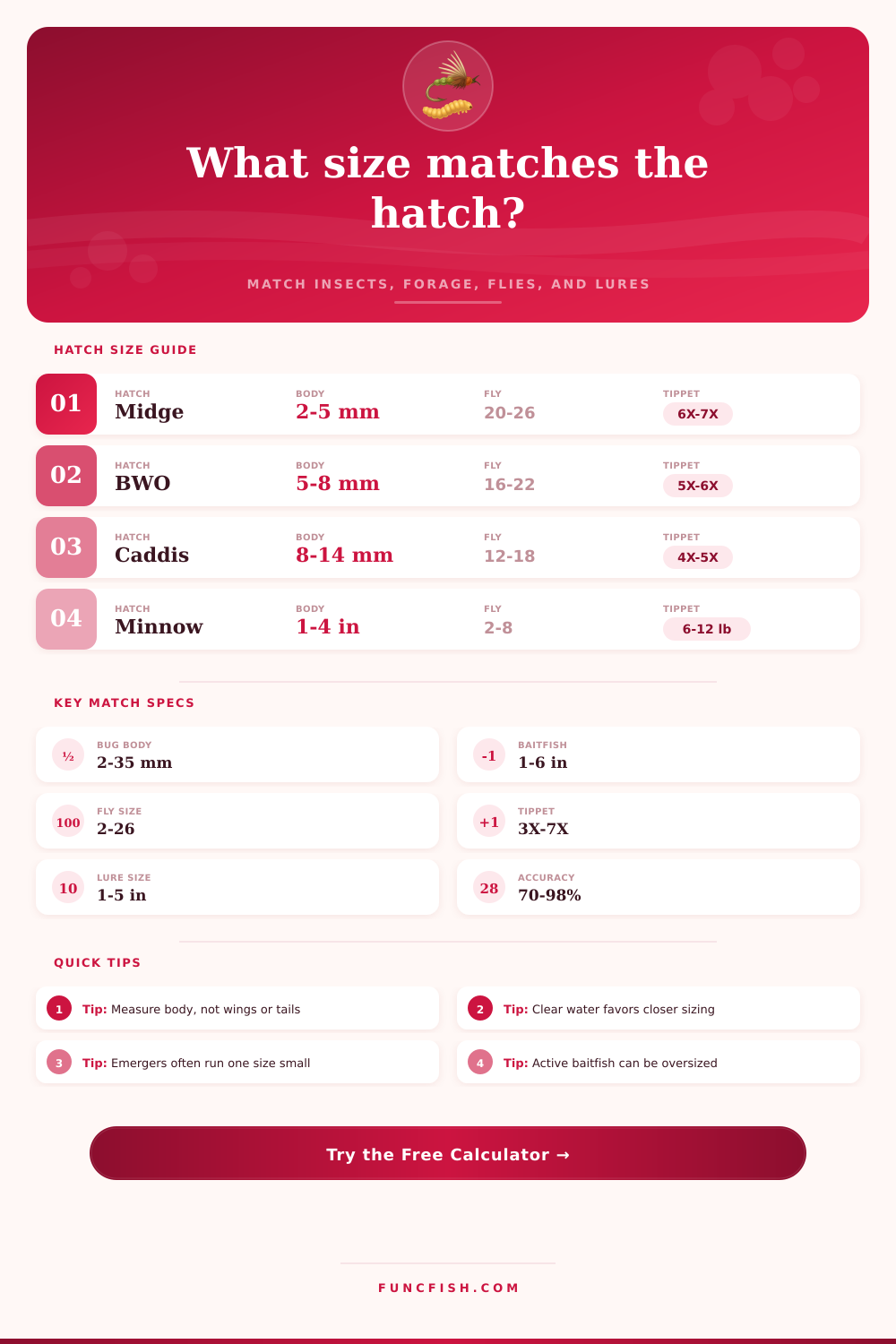
| Hatch or forage | Natural body length | Typical match | Shape cue |
|---|---|---|---|
| Midge / tiny gnat | 2-5 mm / 0.08-0.20 in | Fly #20-26 | Very slim |
| Blue-winged olive | 5-8 mm / 0.20-0.31 in | Fly #16-22 | Slim abdomen |
| Caddis adult | 8-14 mm / 0.31-0.55 in | Fly #12-18 | Tent wing |
| Mayfly dun | 7-18 mm / 0.28-0.71 in | Fly #10-18 | Upright wing |
| Stonefly / salmonfly | 20-50 mm / 0.79-1.97 in | Fly #2-10 | Flat body |
| Terrestrial insect | 10-35 mm / 0.39-1.38 in | Fly #6-14 | Bulky profile |
| Crayfish | 35-90 mm / 1.38-3.54 in | Jig 1.5-3.5 in | Wide claws |
| Minnow / shiner | 25-100 mm / 1-4 in | Lure 1-4 in | Slim baitfish |
| Target fish | Selective match | Search match | Line or tippet range |
|---|---|---|---|
| Trout | 90-105% of natural | 105-120% of natural | 3X-7X / 3-8 lb |
| Grayling | 85-100% of natural | 100-110% of natural | 5X-7X / 2-5 lb |
| Panfish | 95-115% of natural | 115-130% of natural | 4X-6X / 3-6 lb |
| Smallmouth bass | 95-115% of natural | 120-150% of natural | 0X-3X / 6-12 lb |
| Largemouth bass | 100-125% of natural | 130-170% of natural | 0X-2X / 8-17 lb |
| Walleye | 95-115% of forage | 115-140% of forage | 6-12 lb |
| Striped bass | 100-120% of forage | 120-160% of forage | 10-20 lb |
| Northern pike | 110-140% of forage | 140-190% of forage | 20-40 lb |
| Condition | Size shift | Visibility shift | Matching note |
|---|---|---|---|
| Gin clear slick | -5% to -12% | Low | Exact body size matters most |
| Broken riffle | 0% to +8% | Medium | Slight oversize helps tracking |
| Pocket water | +8% to +18% | High | Use a stronger silhouette |
| Stained water | +10% to +22% | High | Profile can be larger |
| Aggressive chase | +15% to +35% | High | Streamer or lure may exceed hatch |
| Refusing fish | -8% to -15% | Low | Downsize before changing color |
💡Practical checks
Tip: Measure the solid body of the insect, nymph, baitfish, or crayfish. Wings, tails, hackle, and claws influence silhouette, but body length drives the first size choice.
Tip: When fish refuse a close match in clear water, move one size smaller before changing the entire pattern style or lure shape.
When you are fishing, teh size of the fly or lure that you use is a critical factor in your fishing success. The size of the fly or lure will determine whether the fish that you are fishing for will accept the fly or refuse the fly. For many anglers, it can be dificult to choose the correct size of fly or lure to use when they is fishing.
However, there are a variety of different variables that you can consider when making such a choice, each of which will impact the size of the flies that is accepted by the fish. One of the variables that you should consider is the length of the natural insect. However, the length of the natural insect is not the only measurement that you should take into account.
How to Choose the Right Fly or Lure Size
Additionally, you should also consider the thickness and the depth of the natural insect that is falling into the water and being targeted by the fish. For instance, a slim insect that is falling into the water in clear conditions will require a smaller size of fly than the same type of natural insect that is falling into stained water. Calculators are available that will allow you to determine the size of the hook that you should use based off the measurements of the natural insect.
In addition to the length, thickness and depth of the natural insect, the clarity of the water and the movement of the water can play a major role in the size of the flies that is accepted by the fish. In clear water, the fish will easily reject flies that do not match the natural insect. However, the fish can accept flies in areas of moving water where the movement of the water hides any mistakes in the size of the artificial fly.
Finally, in stained water the fish have more difficulty seeing the artificial flies so larger size of flies should be used in these areas of the water. Another set of variables to consider is the species of the fish that you are targeting, as well as the feeding mood of the fish. For instance, trout that are present in technical areas of the river may require that the size of your artificial fly is precisely the same than the size of the natural insects in that portion of the river.
In comparison, smallmouth bass may accept flies that are larger in size if those smallmouth bass is located in areas of pocket water. Additionally, the feeding mood of the fish will impact the size of the artificial flies that you should use; natural sizes of flies are required if the fish are in feeding mood, but the fish can accept larger sizes of artificial flies if they are in an aggressive feeding mood. In addition to the characteristics of the natural insects in the water, the style of the artificial fly or lure can also influence the size of the artificial fly that should be used.
For instance, emerger flies may work best if they are one size smaller than the dun fly. Additionally, flies like streamers or minnow plugs can be larger than the size of the baitfish that is naturaly falling into the water because the movement of these larger artificial flies create the displacement of water that the small dry fly does not create. You can use a size calculator for artificial flies to account for the different types of artificial flies so that you can determine if the size of the artificial fly should be increased or decreased in size to best emulate the natural insects that are falling into the water in your targeted area.
Additionally, the distance at which you are casting your artificial flies and the activity of the fish can have an impact upon the size of the artificial flies that should be used. For example, if you are casting your flies into areas of moving water that are relatively distant from where you are standing, the artificial flies should have a stronger silhouette and use a heavier tippet. Additionally, the activity of the fish will impact the size of the artificial flies; if the activity of the fish is high, they may accept larger sizes of artificial flies, but if they are exhibiting sparse activity, their acceptance of artificial flies will be limited to those of smaller sizes.
One of the most common mistake that many anglers make is to focus upon only one of the variables described above instead of all of the variables. For instance, the size of the artificial fly can change without consideration of the clarity of the water; the length of the natural insect can be matched but not its depth; or the wings or tail of the insect can be measured instead of the solid body of the insect. If an angler measures only the wings or the tail of the natural insect that is falling into the water, they may select a size of artificial fly that is too large to be accepted by the fish that are present in the water.
A size calculator for artificial flies will allow an angler to consider all of these different variables so that they can make an informed decision about the size of the artificial fly that they use when fishing.