Dissolved Oxygen by Temp Calculator
Estimate oxygen saturation from water temperature, salinity, elevation, and measured dissolved oxygen so fishing water can be checked against fish-specific oxygen needs.
📌Scenario presets
⚙Water oxygen settings
Dissolved oxygen forecast
Full breakdown
📋Fish oxygen target grid
Trout / Char
Bass
Walleye
Catfish
📊Temperature saturation reference
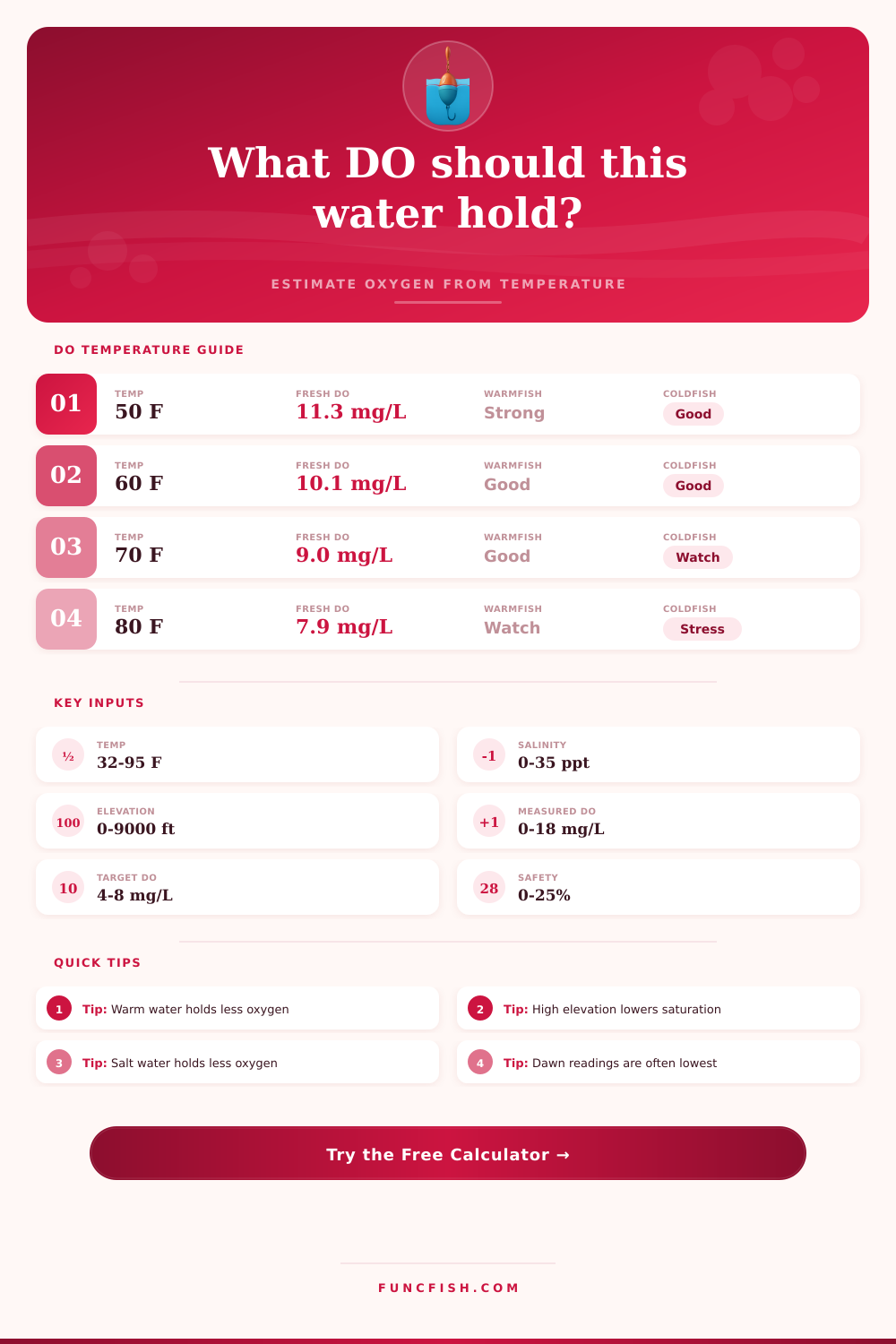
| Temperature | Freshwater saturation | Approx saltwater 35 ppt | Fishing reading |
|---|---|---|---|
| 32°F / 0°C | 14.6 mg/L | 11.5 mg/L | High oxygen capacity |
| 50°F / 10°C | 11.3 mg/L | 9.1 mg/L | Coldwater comfort range |
| 60°F / 15.6°C | 10.1 mg/L | 8.2 mg/L | Strong for most species |
| 70°F / 21.1°C | 8.9 mg/L | 7.3 mg/L | Good warmwater window |
| 80°F / 26.7°C | 8.0 mg/L | 6.6 mg/L | Watch dawn and crowding |
| 90°F / 32.2°C | 7.3 mg/L | 6.0 mg/L | Thin margin for active fish |
| Water profile | Default salinity | Respiration shift | Best comparison |
|---|---|---|---|
| Fresh pond / small lake | 0 ppt | -0.2 mg/L | Dawn versus afternoon |
| Cold stream / riffle | 0 ppt | +0.3 mg/L | Pool versus riffle |
| Reservoir / basin | 0 ppt | -0.4 mg/L | Surface versus thermocline |
| Brackish marsh | 12 ppt | -0.3 mg/L | Incoming versus outgoing tide |
| Salt bay / inlet | 32 ppt | -0.1 mg/L | Flat versus channel |
| Livewell / bait tank | 0 ppt | -0.8 mg/L | Fresh fill versus crowded hold |
| Ice-covered water | 0 ppt | -0.6 mg/L | Clear ice versus snow cover |
| Slow canal / backwater | 1 ppt | -0.5 mg/L | Open bend versus dead end |
🎣Species and condition reference
| Fish group | Comfort DO | Minimum DO | Temperature sensitivity |
|---|---|---|---|
| Trout / char | 8.0 mg/L | 6.5 mg/L | High; warm water adds stress |
| Salmon / steelhead | 8.5 mg/L | 7.0 mg/L | High; prefer cold high flow |
| Walleye / perch | 7.0 mg/L | 5.5 mg/L | Moderate; avoid low layers |
| Bass / sunfish | 6.5 mg/L | 5.0 mg/L | Moderate; dawn can be limiting |
| Catfish / bullhead | 5.5 mg/L | 4.0 mg/L | Lower; still avoid severe lows |
| Coastal gamefish | 6.0 mg/L | 4.8 mg/L | Salinity reduces capacity |
| Percent saturation | Likely meaning | Fishing check | Next reading |
|---|---|---|---|
| 95-110% | Near equilibrium | Healthy mixed water | Retest after temperature shift |
| 80-95% | Mild oxygen drawdown | Normal in warm ponds | Compare dawn and afternoon |
| 60-80% | Meaningful deficit | Fish may avoid the layer | Check shallows and inflows |
| Below 60% | Strong oxygen stress | Use caution with live fish | Increase mixing or relocate |
| Above 110% | Supersaturation | Often algae or heavy turbulence | Watch for nighttime drop |
💡Practical checks
Tip: The lowest dissolved oxygen reading in ponds and weedy backwaters is often near dawn, before plants and algae begin producing oxygen again.
Tip: If percent saturation is low at a safe temperature, compare surface, mid-depth, and bottom readings before moving fish or bait.
Water temperature and dissolved oxygen levels is directly related. The warmer the water, the less dissolved oxygen that water can hold. Fish begin to feel the effects of low levels of dissolved oxygen well before the dissolved oxygen levels can be felt on the waters surface.
For instance, bass may begin to experiencing difficulty breathing during the afternoons when the water temperatures rises, while trout may begin to experience stress and begin to seek out deeper water in which to live because trout requires cooler temperatures and higher level of dissolved oxygen to survive. The relationship between dissolved oxygen and water temperature is also influenced by the salinity, the elevation of the water, and the activity of the plants in the water. Each of these factors will affect how much dissolved oxygen is available in the water.
How Water Temperature Affects Dissolved Oxygen and Fish
For instance, the amount of dissolved oxygen that is require in the water must meet the requirements of the fish that live in that water. Coldwater species tend to contain high metabolic rate, even in the cooler temperatures, while the hardy fish species can tolerate lower amount of dissolved oxygen in the water. Even a slight increase in the water temperature can move the dissolved oxygen levels from a comfortable breathing range for the fish to a marginal range.
The dissolved oxygen calculator utilizes a few different input variables to calculate the amount of dissolved oxygen that can be present in the water. One of the most important is the temperature of the water. The salinity of the water is another important variable, as salinity can reduce the amount of dissolved oxygen that the water can hold.
Elevation is another important input into the calculator, as well, since dissolved oxygen levels in water at high elevations will generaly be lower than in water at sea level. Different water profiles, such as a weedy pond as compared to a riffle in a river, will exhibit different levels of dissolved oxygen in the water. For instance, a weedy pond will lose dissolved oxygen levels while plants cover the pond overnight, while a riffle will exhibit higher level due to the movement of water into the riffle.
The activity levels of the fish will impact the amount of dissolved oxygen that the fish require. Fish that are resting will require less dissolved oxygen than fish that are actively swimming. Fish that are fighting or packed into a livewell will require more dissolved oxygen than fish that are resting.
Thus, the dissolved oxygen level required for fish that are active will differ from that of fish that are resting. The safety margin for dissolved oxygen can be used to provide a buffer for changing conditions in the water, whether those changes are the result of an algae bloom that crashes at dusk or warm water that enters a water body after it rains. The calculator provides several different outputs to explain the levels of dissolved oxygen in the water.
The calculator calculates the saturation of dissolved oxygen in the water. The percent saturation of the dissolved oxygen in the water is another output of the calculator, as is the percent saturation of dissolved oxygen of the fish. The fish safety margin is another output of the calculator, which calculates the amount of dissolved oxygen that remains before the fish begin to experience stress.
The status of the dissolved oxygen levels in the water is another output, which combines the percent saturation of dissolved oxygen and the fish safety margin to provide an explanation of the state of the dissolved oxygen levels in the water. The levels of dissolved oxygen in the water are not steady all day. The levels of dissolved oxygen in the water tend to be the lowest at dawn in areas that contain plants, as the plants stop producing oxygen into the water at night, and begin to consume the dissolved oxygen in the water while the plants are active during the night.
Wind can have a positive effect upon the levels of dissolved oxygen in the water, as the movement of the water will allow the water to reach the saturation levels of dissolved oxygen. Thus, a calm afternoon when the water temperature rises can lead to low levels of dissolved oxygen in the water. While salinity and elevation of the water do not fluctuate frequently, they do help to determine the maximum amount of dissolved oxygen that can be present in the water.
Anglers may find that the fish are active at dawn, but become inactive later in the day, when the levels of dissolved oxygen in the water have dropped due to the rising water temperatures. Checking the levels of dissolved oxygen in the water prior to moving the bait fish or loading a livewell will help anglers to manage the fish more appropriately. This calculator can assist anglers in the management of the fish in the water.
Anglers can also apply the principles that are used in this calculator to ice-covered water bodies, since snow will cover the plants and prevent the processes of photosynthesis from taking place. Finally, dissolved oxygen levels in brackish marshes may change due to the change in salinity that occurs with the tide. The goal of this calculator is to help anglers understand how close the dissolved oxygen levels in the water are to the point at which the fish will stop feeding in the water.
With knowledge of the safety margin for dissolved oxygen in the water, anglers can make better decisions regarding whether aeration should be used in the water body, how deep the fish should be targeted, or even whether the fish should be moved altogether. Even if the water temperature rises or the wind dies down, knowing the levels of dissolved oxygen in the water will allow anglers to understand the impact that these changes will have upon the fish in the water.