Secchi Disk Visibility Calculator
Average disappearance and reappearance depths, correct for field conditions, and estimate light penetration for fishing, sampling, and water clarity logs.
📌Scenario presets
⚙Visibility reading
Secchi visibility forecast
Full breakdown
📊Clarity class reference
Muddy
Stained
Clear
Very Clear
📋Secchi and fishing reference tables
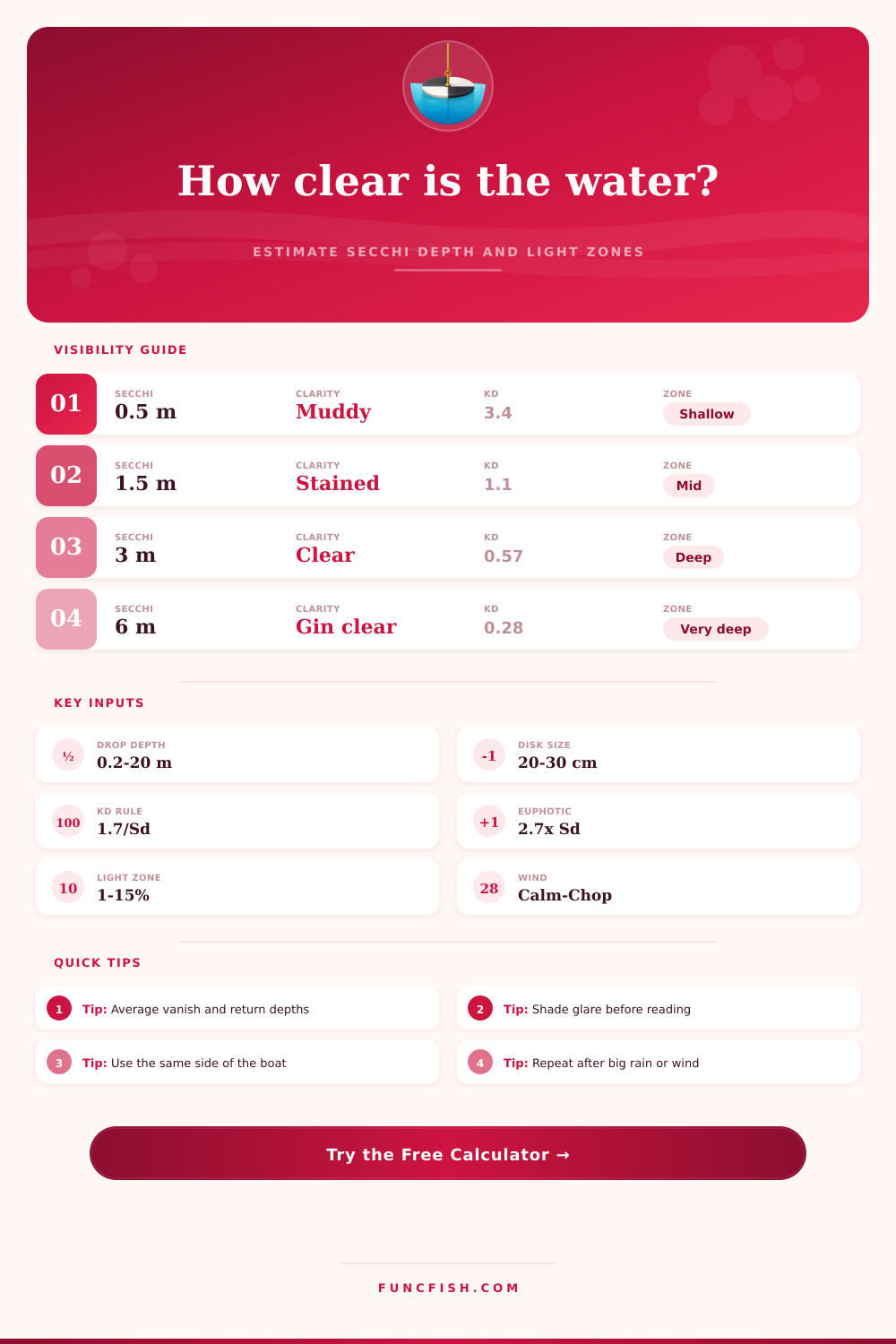
| Corrected Secchi | Water clarity class | Kd estimate | Euphotic depth | Fishing read |
|---|---|---|---|---|
| Under 1.6 ft / 0.5 m | Muddy / heavy bloom | Above 3.40 per m | Under 4.4 ft / 1.35 m | Short sight window, use shallow targets |
| 1.6-4.9 ft / 0.5-1.5 m | Stained | 1.13-3.40 per m | 4.4-13.3 ft / 1.35-4.05 m | Good low-light cover bite |
| 4.9-9.8 ft / 1.5-3.0 m | Moderately clear | 0.57-1.13 per m | 13.3-26.6 ft / 4.05-8.1 m | Balanced depth range for many species |
| 9.8-16.4 ft / 3.0-5.0 m | Clear | 0.34-0.57 per m | 26.6-44.3 ft / 8.1-13.5 m | Finesse and longer casts often matter |
| Over 16.4 ft / 5.0 m | Very clear | Under 0.34 per m | Over 44.3 ft / 13.5 m | Deep light penetration and spooky fish |
| Target light | Approximate meaning | Depth formula | Use in fishing |
|---|---|---|---|
| 50% light | Bright upper water | 0.41 x Secchi | Topwater, sight casting, shallow weed tops |
| 25% light | Comfortable contrast | 0.82 x Secchi | Spinnerbaits, swimbaits, visible forage edges |
| 15% light | Lower strike window | 1.12 x Secchi | Jigs, suspending baits, stained water edges |
| 10% light | Dim but useful | 1.35 x Secchi | Walleye, trout, shaded cover, low-angle light |
| 1% light | Euphotic limit | 2.7 x Secchi | Plant growth limit, plankton layer estimate |
| Scenario | Useful Secchi range | Typical lure visibility | Planning note |
|---|---|---|---|
| Bass reservoir | 3-10 ft / 0.9-3.0 m | 1.0-1.8 x Secchi | Match shade lines, weed tops, and suspended bait |
| Trout lake | 8-25 ft / 2.4-7.6 m | 1.2-2.2 x Secchi | Clear water supports deeper feeding lanes |
| Walleye basin | 2-8 ft / 0.6-2.4 m | 1.4-2.4 x Secchi | Dim edges are often more useful than bright water |
| Catfish river | 0.5-4 ft / 0.15-1.2 m | 0.6-1.1 x Secchi | Scent and bottom contact matter when Kd is high |
| Inshore flat | 3-15 ft / 0.9-4.6 m | 0.8-1.6 x Secchi | Tide, wind, and bottom color shift visibility fast |
💡Practical checks
Tip: Record both the disappearance and reappearance depth, then average them. If the two readings differ by more than 15 percent, repeat the drop before trusting the light-zone estimate.
Tip: Secchi-to-turbidity and Secchi-to-light conversions are field estimates. Use them to compare spots and conditions, not as a replacement for a calibrated turbidity meter.
A Secchi disk is a tool that scientists use to measuring the clarity of the water. The Secchi disk will help to determine how deep the light travel through the water. To use a Secchi disk, the black and white plate are lowered into the water until it is no longer visible.
The depth at which it dissapears are recorded, as well as the depth at which it reappears as the disk is pulled towards the surface. The two measurements is often not the same, so the two depths are average together to find the average Secchi disk reading for that body of water. This average reading can then be entered into the calculator.
Measuring Water Clarity with a Secchi Disk
In some case, the depth at which the disk disappears from view may not be the same than the depth at which it reappears. This difference in depth can be caused by factors like chop on the water’s surface, glare from the sun, or the instability of the person using the Secchi disk. The difference in these two depth can be used as a means of measuring the accuracy of the measurement of the waters clarity; the greater the difference in depth between the measurement in which the disk disappears and reappears, the less accurately the measurement.
Thus, the uncertainty band around the calculated Secchi value indicates the accuracy of that value. The type of water that is being measured and the types of particle that are present in that water can impact the readability of the Secchi disk. For instance, the depth at which the Secchi disk disappears at in clear mineral water may be different than the depth at which it disappears in tannin-stained water or water that is home to colony of algae.
The type of water can be selected in the calculator, which allow for the adjustment of the light attenuation coefficient in the equation that calculates the Secchi value. As a result, the same Secchi value will indicate different level of light penetration into the water based off the type of water being measured. For instance, stained water will cause the light to drop off quick with depth, while clear water will allow for the light to travel further into the water.
The conditions of the waters surface and the angle of the sun can also have an impact on the readability of the Secchi disk. Chop on the waters surface and glare from the sun can make it difficult to properly view the Secchi disk, and may make it difficult to properly track the disk as the person lowers it into and pulls it out from the water. A field correction for these condition can be entered into the calculator prior to calculating the Secchi value.
This field estimate will not be a laboratory measurement of the waters clarity, but will represent a more accurate representation of the conditions that a fisherman experience while fishing at that location. The corrected Secchi disk value can help to determine the depth of the euphotic zone within that body of water. The euphotic zone is the depth at which one percent of the light that fall on the waters surface remains in the water at that location, and it is the limit of how deep plants and plankton can grows in the ecosystem.
Based upon the corrected Secchi disk value, the calculator can estimate the depth of the euphotic zone within the water. Furthermore, the calculator can also estimate the percentage of light that reaches the depth at which the fisherman is fishing. If the percentage of light is low at the fisherman’s fishing depth, it is unlikely that the fish can see the fisherman’s bait; thus, the fisherman might need to use techniques like vibration and scenting of the bait instead of relying on the fishs ability to visually find the bait.
Reference table can be used to determine the type of bait that should be used based upon the clarity of the water. For instance, muddy water indicate that the fisherman should utilize targets in the shallowest part of the lake and ensure that his bait makes contact with the lake bed, whereas clear water suggest that he should use light and care for his fishing line and bait to avoid deterring the fish from eating it. These tables are not strict rule, but they do provide a starting point for fisherman approaching a new body of water.
There are technique that may be used to improve the readability of the Secchi disk. For instance, the fisherman can use the same side of the boat to minimize the amount of glare upon the Secchi disk, or he can shade the disk with his body or hat to prevent the light from reflecting off it. The measurement can be made after big wind or rain event when the turbidity of the water may have change.
By using these techniques, the Secchi disk will provide a more useful measurement of the waters clarity. A single measurement of the water’s clarity using the Secchi disk provide information about the water at a single moment in time. However, logging the depths at which the Secchi disk disappeared and reappeared over time can reveal information about how the clarity of the water change over time.
For instance, the lake may be logged to reveal how deep and how far the Secchi disk traveled before disappearing after significant rainfall. Such a log can be easily maintain with the calculator provided, and it can provide both the corrected Secchi disk value and the percentage of light that reaches the fisherman’s fishing depth. Additionally, maintaining such a log of the Secchi disk value allow for the fisherman to determine if the clarity of the water at certain spot in the lake changes more than at others; determining these patterns of water clarity will allow the fisherman to determine which fishing spot in the lake are the most reliable.