Dipsy Diver Depth Calculator
Estimate running depth and target lead from diver size, base-plate setting, ring, line, trolling speed, leader length, and lure drag.
📌Dipsy trolling presets
⚙Diver settings
Use this after checking one pass with a Fish Hawk, Smart Troll, marked rigger cable, or bottom contact.
Dipsy depth estimate
Full breakdown
📋Dipsy size reference grid
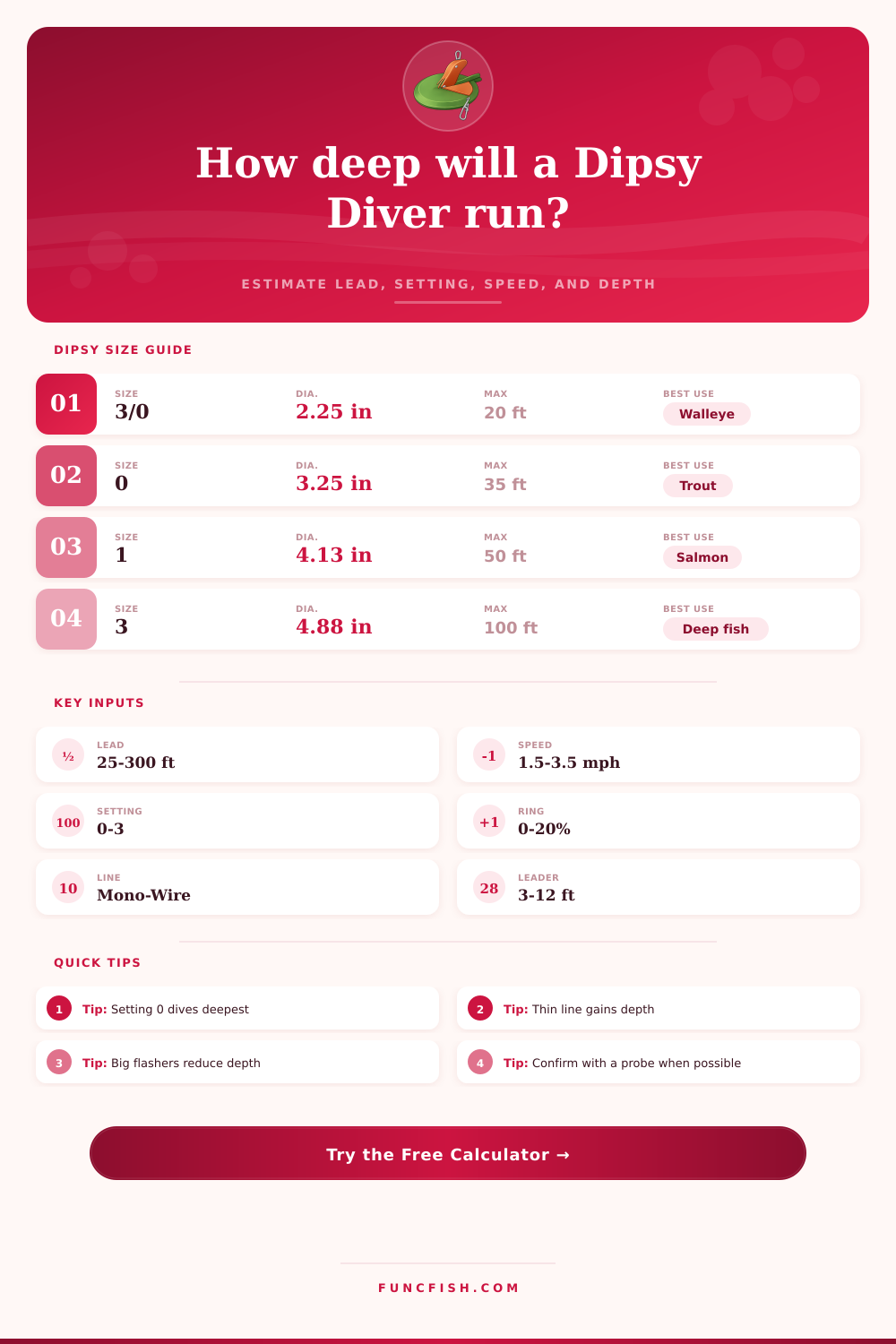
Mini 3/0
Size 0 / 000
Size 1 / 001
Magnum 3 / 003
📐Reference depth tables
| Dipsy size | 25 ft lead | 50 ft lead | 75 ft lead | 100 ft lead | 125 ft lead | Notes |
|---|---|---|---|---|---|---|
| 3/0 mini, setting 0 | 8 ft | 14 ft | 18 ft | 20 ft | 25 ft | High-water small diver |
| Size 0, setting 0 | 13 ft | 21 ft | 27 ft | 31 ft | 34 ft | Compact mid-depth diver |
| Size 0, setting 3 | 7 ft | 14 ft | 19 ft | 23 ft | 28 ft | Widest side angle |
| Size 1, setting 0 | 18 ft | 32 ft | 44 ft | 53 ft | 60 ft | Main salmon diver |
| Size 1, setting 3 | 14 ft | 24 ft | 32 ft | 40 ft | 45 ft | High outside diver |
| Magnum target | Setting 0 lead | Setting 1 lead | Setting 2 lead | Setting 3 lead | Chart basis |
|---|---|---|---|---|---|
| 20 ft | 25 ft | 27 ft | 30 ft | 32 ft | 20 lb mono |
| 40 ft | 56 ft | 68 ft | 80 ft | 85 ft | 2.5-3.0 mph |
| 60 ft | 100 ft | 110 ft | 120 ft | 140 ft | No O-ring |
| 80 ft | 140 ft | 155 ft | 175 ft | 195 ft | Interpolate between rows |
| 100 ft | 180 ft | 195 ft | 220 ft | 250 ft | Maximum base chart |
🧮Adjustment reference
| Adjustment | Depth effect | Why it changes | Calculator handling |
|---|---|---|---|
| Base setting 0 | Deepest | Diver tracks straight behind boat | Uses the deepest chart curve |
| Base setting 3 | Shallower | Side planing trades depth for spread | Interpolates shallow side curve |
| Standard O-ring | Up to +20% | More planing surface pulls down | Applies size-aware ring factor |
| Thin braid or wire | Deeper | Less water drag and belly | Adjusts by diameter ratio |
| Large flasher | Shallower | Attractor drag lifts the system | Applies lure drag multiplier |
| Speed change | About 10% per mph | Planing force changes with speed | Uses 2.75 mph as baseline |
💡Depth check notes
Tip: Treat any Dipsy depth number as an estimate. Current, turns, wave surge, lure pull, and exact line diameter can move the running depth several feet.
Tip: If your probe or bottom tap shows a repeatable difference, set the calibration field once and keep the same spread notes for the day.
Dipsy diver are tools that a person can use to manage the position of the fishing lure in the water. A person use a Dipsy diver when they want their fishing lure to be deep in the water and as far away from the boat as possible. A Dipsy diver achieves these goal due to the fact that a Dipsy diver planes downward and outward at the same time.
The depth that a Dipsy diver will reach in the water will depend on several variable. These variables has the potential to interact with one another in such a way that makes it impossible for the person who is using the Dipsy divers to accurately estimate the depth that the Dipsy divers will achieve in the water. One of the primary factor that will impact the depth that a Dipsy diver achieves is the size of the Dipsy diver.
How to Get Your Dipsy Diver to the Right Depth
A small 3/0 size Dipsy diver is light and easy for the person to manage while fishing. However, a 3/0 Dipsy diver will only achieve a depth of around twenty feet of the water. A size 1 or a magnum 3 Dipsy diver will add more weight to the fishing lure and enable it to travel deeper into the water than a 3/0 Dipsy diver with the same length of leader attached to the Dipsy diver.
There are different kind of fish that live at different depths in the water column. Therefore, a person must find the appropriate size of Dipsy diver for the specific depth at which the fish of interest lives. Another factor that will change the depth and position of the fishing lure is the setting of the base plate.
If the base plate is set to zero, the Dipsy diver will track behind the fishing boat. Furthermore, when the base plate is set to zero, a Dipsy diver will travel the deepest path into the water. However, if the base plate is clicked to the setting of three, the side angle of the Dipsy will change.
This change in angle will reduce the depth of the Dipsy but will increase the horizontal spread of the divers. This is helpful when a person is using several fishing rods. However, the horizontal spread will lift the Dipsy divers towards the surface of the water.
For this reason, many people will find that their outside Dipsy divers will come short of the depth to which they are targeting the fish. The type of fishing line that a person use can impact the depth of the Dipsy divers. If the fishing line is monofilament in nature, it will stretch.
This stretch of the line will reduce the depth of the Dipsy divers. If a person changes to thin braid or wire fishing lines, the Dipsy divers will maintain their depth. For instance, a person changes from twenty pound monofilament fishing line to thirty pound braid fishing line; the depth of the Dipsy divers will increase by several feet.
The type of fishing lure and any attractors will also impact the depth of the Dipsy divers. Small spoon will create little lift for the Dipsy divers. However, if a person uses an eight inch flasher or a meat rig, the Dipsy divers will be shallower in the water.
The pull on the line from a flasher or meat rig will make the Dipsy divers plane up. Therefore, a person who add a flasher to their fishing line will find that their Dipsy divers will travel to shallower depths than if they use only a spoon lure. For instance, a lead that ensures a spoon lure reaches fifty feet will not be able to retain a flasher to forty feet in the same depth of the water.
The speed at which a person is trolling their fishing boat will change the depth at which the Dipsy divers travel in the water. If a person is traveling faster on the water, the lift that the Dipsy divers will experience on their face will cause them to travel to shallower depths in the water. By contrast, if a person is traveling at a slower rate, the weight of the Dipsy divers will travel deeper into the water.
If a person changes their trolling speed by half a mile per hour, the depth at which the Dipsy divers travel will change by at least ten percent. The length of the fishing leader attached to the Dipsy divers will change the depth at which the fishing lure travels in the water. The longer the fishing leader, the more lift that the lure will experience; this will cause the fishing lure to travel to a shallower depth in the water.
If a person uses a short leader to connect the Dipsy divers and the fishing lure, the depth of the lure will come closer to the depth of the Dipsy divers. However, if a person uses a longer leader between the Dipsy divers and the fishing lure, the fishing lure will travel to a shallower depth than the Dipsy divers. The difference in depths between a short and long leader may be only a few feet.
However, a few feet in the depth of the fishing lure may be important to find the fish of interest. Finally, the current and the action of the waves in the water will alter the path of the Dipsy divers. A Dipsy diver can use a probe or a downrigger cable with marked depths to understand the actual depth of the Dipsy divers in the water.
Using this depth reading with a probe, a person can calibrate their Dipsy divers so that all of the Dipsy divers in their fishing spread travel to the same depths. The main value of a depth tool like a Dipsy diver is that it allows a person to compare the different setups that they can use when fishing with their Dipsy divers. For instance, they can change the size of their Dipsy divers or the type of fishing line that they use and find solid starting points for fishing success.