Range to Fishing Grounds Calculator
Estimate how far your boat can run to fishing grounds after fuel reserve, usable tank, cruise burn, current, sea state, trolling time, idle time, and return-leg margin are included.
📌Scenario presets
⚙Range settings
Reserve stays untouched after usable-capacity and route adjustments. For electric setups, treat capacity as a full-charge equivalent and burn as capacity units per hour.
Fishing grounds range forecast
Full breakdown
📋Boat range reference grid
📊Reference tables
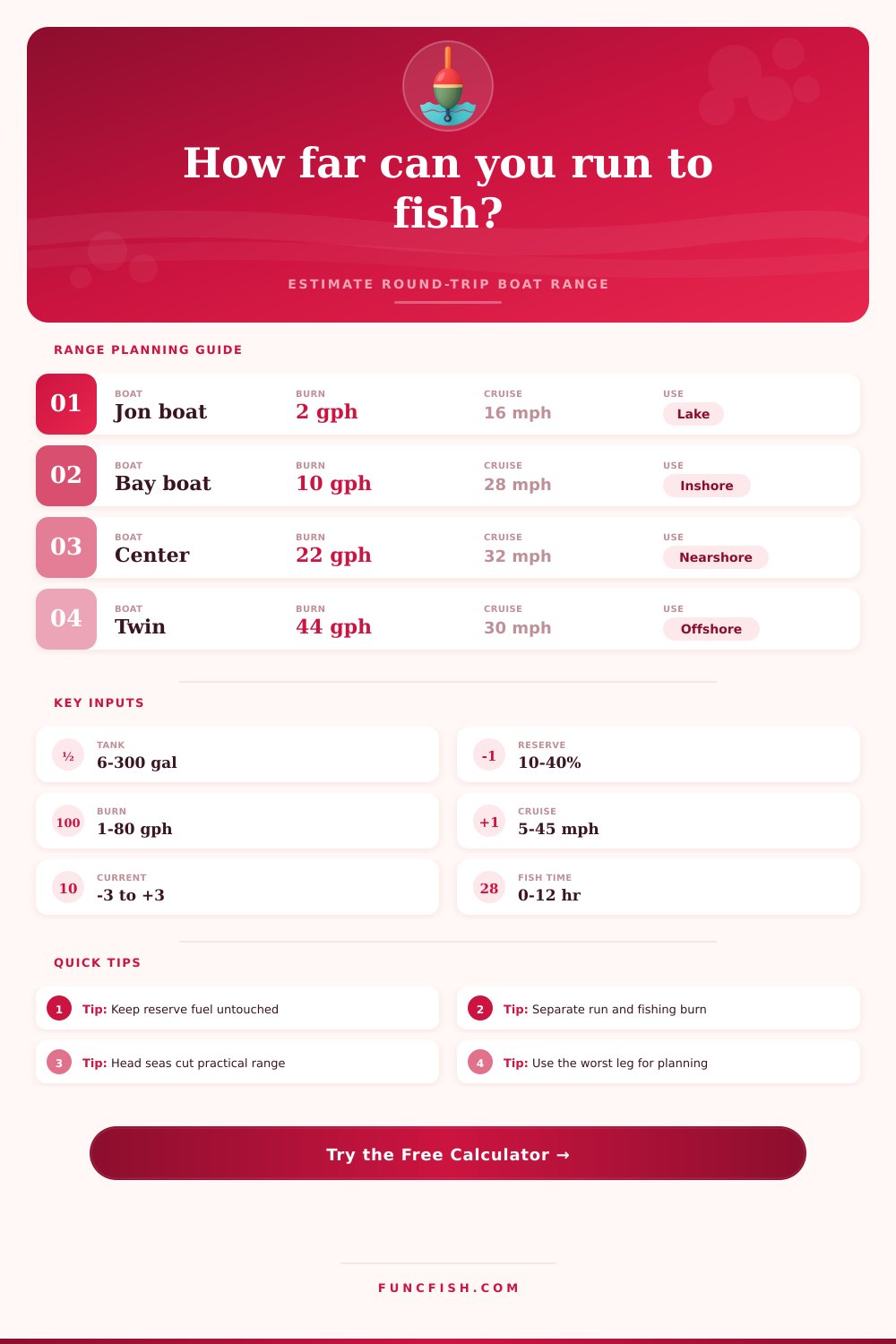
| Boat profile | Typical cruise | Typical burn | Best range use | Planning note |
|---|---|---|---|---|
| Electric kayak motor | 3-5 mph / 5-8 km/h | 0.10-0.25 capacity/hr | Ponds and calm coves | Battery voltage sag reduces final miles |
| 15 hp jon boat | 14-18 mph / 23-29 km/h | 1.4-2.3 gph / 5-9 L/h | Small lakes and rivers | Load weight changes burn quickly |
| 150 hp bass boat | 26-38 mph / 42-61 km/h | 8-15 gph / 30-57 L/h | Large lake ledges | Fast cruise is not always best range |
| 150 hp bay boat | 24-34 mph / 39-55 km/h | 8-13 gph / 30-49 L/h | Flats and bays | Wind tide can change each leg |
| Single 250 center console | 28-36 mph / 45-58 km/h | 18-28 gph / 68-106 L/h | Nearshore reefs | Inlet and sea-state margins matter |
| Twin 150 offshore boat | 26-34 mph / 42-55 km/h | 36-52 gph / 136-197 L/h | Offshore grounds | Plan the return as the harder leg |
| Adjustment | Speed factor | Burn factor | When to use | Effect on range |
|---|---|---|---|---|
| Calm or helping current | 1.04x | 0.96x | Following sea, slack tide, smooth lake | Best practical range |
| Normal chop | 1.00x | 1.00x | Typical day with small wind chop | Baseline range |
| Head current or head wind | 0.92x | 1.10x | Running into tide, wind, or river flow | Shorter range |
| Rough water | 0.82x | 1.22x | Slower cruise and more throttle work | Much shorter range |
| Heavy chop with detours | 0.72x | 1.35x | Crossing bars, inlets, or open fetch | Use conservative stops |
Range tip: Treat the outbound and return legs separately. A small head current or rougher return can turn a comfortable one-way distance into a tight round trip.
Fuel tip: Keep final reserve out of the working fuel budget. The calculator subtracts reserve first, then accounts for fishing-time burn before estimating run range.
Fuel planning require calculating how much fuel a boat will use during an entire trip. To calculate fuel for a boat, find the fuel need for a trip to the fishing grounds and the fuel needed for a trip back to the dock. Even if the boat has a large fuel tank, the size of the tank isnt the only consideration in determining how far a boat can travels.
Some fuel must be set aside for the boat to operate in case of unexpected condition. Subtracting this reserve fuel from the total fuel tank capacity will reveal the amount of fuel that is useable during the trip. Several factor will change how much fuel a boat consume during a trip.
How to Calculate Fuel for a Boat Trip
The wind, the tide, and the current all play a role in the fuel consumption of a boat. A head current will use up fuel at a more fast rate and take longer to travel a certain distance. The sea state and the roughness of the water will force a boat to travel at a slow rate.
By requiring a boat to move at a slower pace, the rough water can change the miles per gallon a boat can achieve. The speed a boat travels and the rate at which it burns fuel is two variable that are directly relate. By increasing the speed of a boat, the rate at which it burns fuel will increase.
By burning fuel at a higher rate, a boat can travel a shorter distance. By decreasing the speed at which a boat travels, the fuel burn rate will decrease. However, by traveling at a slower rate, the boat will spend more time on the water.
The rate at which a boat travels will have to account for the conditions of the water and the weather for the return trip. Fishing activity will consume fuel during a trip even when a boat is not traveling to some fishing destination. Activities such as trolling, drifting, and idling will use up the fuel in a boats tank.
Fuel must be accounted for when trolling for fish and when idling the boat at a fishing spot. These fuel calculation happen after arriving at the fishing grounds and will reduce the amount of fuel available for the return trip to the boat dock. Fuel must be account for in calculating the fuel needs of a boat.
The route a boat take can change the total amount of fuel that is used during a trip. The straight line distance between two points is more short than the route that a boat must travel. There may be inlets, channels, or no wake zones that may force a boat to take a longer route.
These extra miles will require the boat to use up more fuel then it would for a straight-line distance. Adding a percentage of extra miles for these route adjustment ensures that a boat has enough fuel to complete the trip. If the fuel calculation for a boat do not account for these route adjustments, its possible that a boat will run out of fuel before it reach its destination.
Calculate the fuel needs of a boat prior to beginning a trip. Start with the total amount of fuel that the tank can hold. Subtract the fuel needed for the reserve to leave enough fuel to operate the boat.
Subtract the fuel that will be used for the trip out to the fishing spot. Subtract the fuel used while fishing. Subtract the fuel used for the trip back to the boat dock.
What is left after these calculation will show whether or not there is enough fuel for the boat to complete the trip. If there is not enough fuel, choose a different fishing spot that is closer to the boat dock. If there is changes in the weather or conditions of the water, recalculate the fuel that is needed for the boat.
Through recalculating how much fuel a boat will use during a trip, boat operator can make certain that their fuel-related decision are based on the actualy amount of fuel in the tank.