Fishing Gear Depreciation Calculator
Estimate current value, retained percentage, annual wear, and remaining service life for rods, reels, electronics, kayaks, waders, line systems, and other fishing gear.
📌Scenario presets
⚙Gear details
Depreciation forecast
Full breakdown
📋Gear depreciation data grid
Rod
Reel
Electronics
Kayak
📊Reference tables
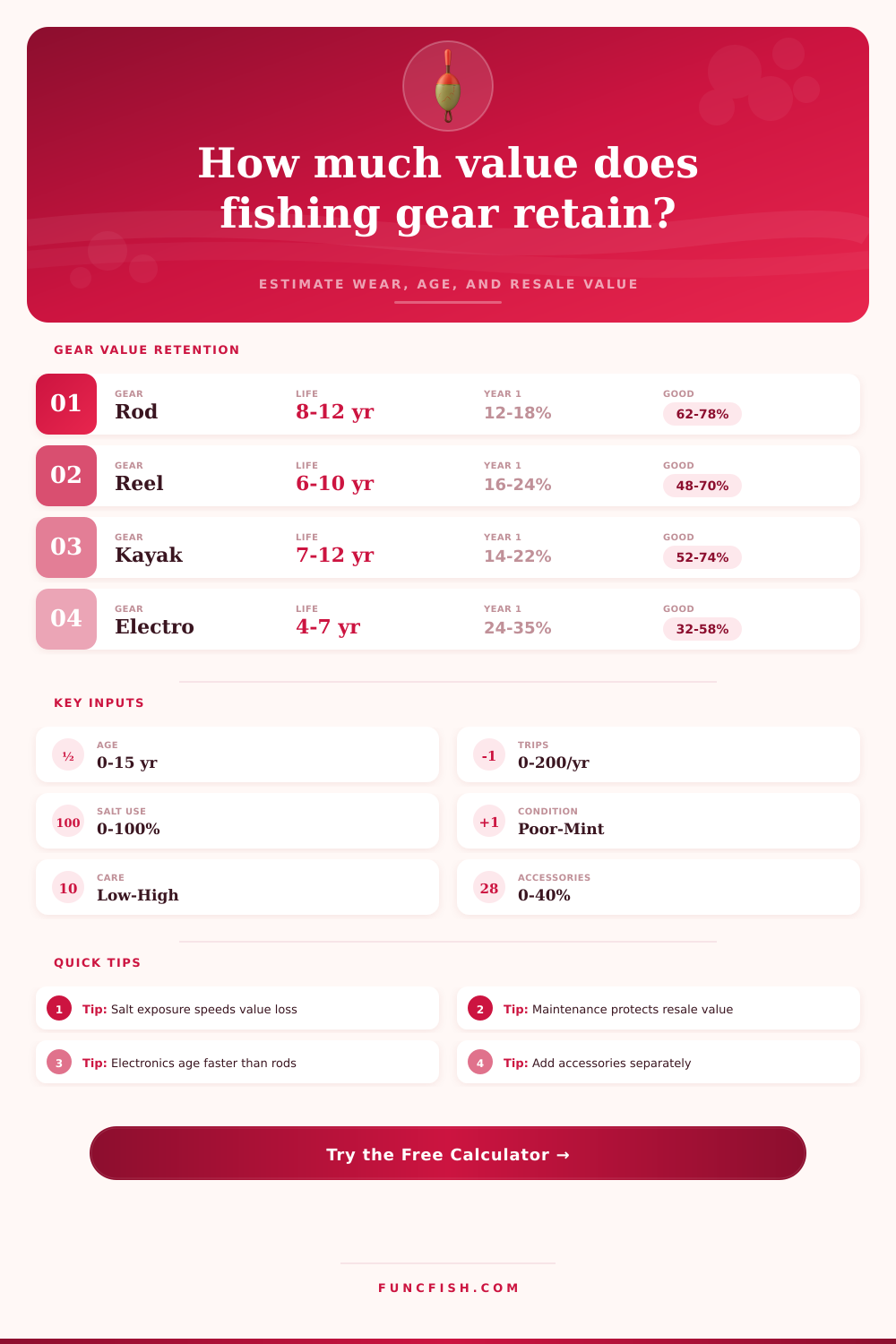
| Gear category | Typical service life | First-season drop | Annual wear after year 1 | Notes used by calculator |
|---|---|---|---|---|
| Fishing rod | 8-12 years | 12-18% | 5-8% | Blanks retain value when guides and cork are clean. |
| Fishing reel | 6-10 years | 16-24% | 7-11% | Bearings, drag, and salt exposure drive most loss. |
| Rod and reel combo | 6-9 years | 18-25% | 8-12% | Combo value usually follows the faster-wearing component. |
| Fish finder / electronics | 4-7 years | 24-35% | 12-18% | Feature age and screen condition matter heavily. |
| Trolling motor | 5-8 years | 22-30% | 10-15% | Battery system, shaft wear, and mount play matter. |
| Fishing kayak | 7-12 years | 14-22% | 6-10% | Hull gouges, UV, seat condition, and drive system matter. |
| Waders / boots | 3-5 years | 20-30% | 15-22% | Leaks and seam condition dominate value. |
| Fly line / specialty line | 2-4 years | 22-34% | 18-28% | Coating cracks and memory shorten useful life. |
| Condition | Multiplier | Typical signs | Value effect |
|---|---|---|---|
| Mint / box-kept | 1.14 | Minimal wear, original packaging, full parts | Raises retained value |
| Excellent | 1.06 | Light signs, clean function, no damage | Slight positive adjustment |
| Good | 1.00 | Normal use, clean function, minor marks | Baseline condition |
| Fair | 0.84 | Visible wear, older line, scratches, loose fittings | Moderate reduction |
| Rough but usable | 0.66 | Heavy wear, corrosion, patched components | Strong reduction |
| Needs repair | 0.42 | Broken guides, noisy reel, leak, failed electronics | Repair-adjusted value |
| Fishing environment | Wear adjustment | Best-fit gear examples | Calculator treatment |
|---|---|---|---|
| Freshwater casual | 0.90x-1.00x | Bass rods, panfish reels, landing nets | Lower corrosion load |
| Brackish mixed use | 1.05x-1.18x | Inshore reels, kayaks, electronics | Salt percentage adds wear |
| Heavy saltwater | 1.20x-1.42x | Surf rods, offshore reels, trolling motors | Higher corrosion and service demand |
| Travel / tournament use | 1.10x-1.30x | Combos, electronics, pedal kayaks | Trip and handling factors rise |
💡Depreciation notes
Tip: Treat accessories as a separate retained amount. Spare spools, mounts, batteries, covers, and cases rarely depreciate at the exact same rate as the main item.
Tip: Saltwater exposure compounds with maintenance. A rinsed reel can remain in a good bracket, while an identical neglected reel can fall into fair or repair-adjusted value.
Fishing gear do not lose it’s value in a straight line, and the value of fishing gear depend on many different factors. The person using the fishing gear, the storage of the fishing gear, and how well the fishing gear are maintained determine the value of fishing gear. The age of the fishing gear is one of the factors that will impact the value of the fishing gear.
However, the age of the fishing gear dont tell the whole story. For example, two fishing reels of the same age may have different values if one of the reels was rinsed after every fishing trip and the other fishing reel were stored in a truck. Salt exposure is another factor that will impact the value of fishing gear.
What Affects the Value of Used Fishing Gear
Salt exposure is especially true for fishing reels. Salt exposure will cause corrosion on the fishing gear’s bearings, drags, and electronics. Salt exposure does more damage to fishing gear than freshwater does to fishing gear.
Using the calculator, you can input the percentage of time the fishing gear was exposed to saltwater because saltwater impacts the value of the fishing gear. A fishing reel may look as though it is in great condition when viewed from the side, but the internal parts of the reel may be corroded due to saltwater exposure. The condition and maintenance of the fishing gear will impact its value.
These two factor interact with each other. Fishing gear that is well maintained will have a higher value than newer fishing gear that isnt well maintained. For example, a fishing rod that has good guides and good cork will have a higher value than a fishing rod that was stored in a damp garage.
Waders and boots that have leaks or seam issue will have a low value for the gear. The calculator considers these factors because the calculator does not use a blanket rate to determine the value of used fishing gear. The intensity with which the person use the fishing gear will also impact its value.
The intensity of use depends on how often the fishing gear is used. A kayak used for short trips will have a higher value than a kayak used for heavy surf use. The condition of the kayak will wear down with increased use.
The life of the kayaks drive system will decrease with increased use of the kayak. Additionally, the electronics on the kayak will lose its value quickly because technology changes quick. Even if the electronics are in good working order, they will lose value quickly.
The value of fishing gear accessories is calculated separately from the main piece of fishing gear. Fishing gear accessories includes spare spools, cases, transducers, and mounts. These accessories will not depreciate at the same rate as the main fishing gear.
Using the calculator, you can value these accessories separately from the main fishing gear. This separates the value of the accessories that a buyer will recieve. The remaining service life of fishing gear is another important measurement of the value of the fishing gear.
The remaining service life of fishing gear will vary by the category of fishing gear. For example, the remaining service life of fly lines and waders will be shorter than the remaining service life of fishing rods or kayaks. Knowing the remaining service life of fishing gear will allow an individual to make a decision about whether to keep or sell the fishing gear.
Storage environment will impact the value of fishing gear. Fishing gear exposed to high level of UV radiation or stored in an environment that experiences significant temperature differences or vibrations will degrade in value over time. For example, a fishing rod stored in a dock box will lose more of its value over time than a fishing rod stored in a climate controlled rack.
These storage details will impact the value of the fishing gear because these details can be mentioned when comparing the value of different used fishing gear options. Using the calculator will help an individual make decisions regarding their fishing gear. For example, the calculator will show an individual if their fishing gear has enough remaining service life for them to continue using it or if the value of the fishing gear indicates a good time to sell their fishing gear.
The calculator allows an individual to understand the value of their used fishing gear without having to guess how each factor will impact the value.