Cost Per Fish Caught Calculator
Compare trip spend against total catch, kept fish, kept weight, angler hours, driving, boat fuel, and shared party costs.
📌Scenario presets
⚙Trip cost settings
Cost per fish forecast
Full breakdown
📊Cost model reference cards
Bank / Pier
Kayak / Canoe
Bass Boat
Offshore
📋Trip cost and catch tables
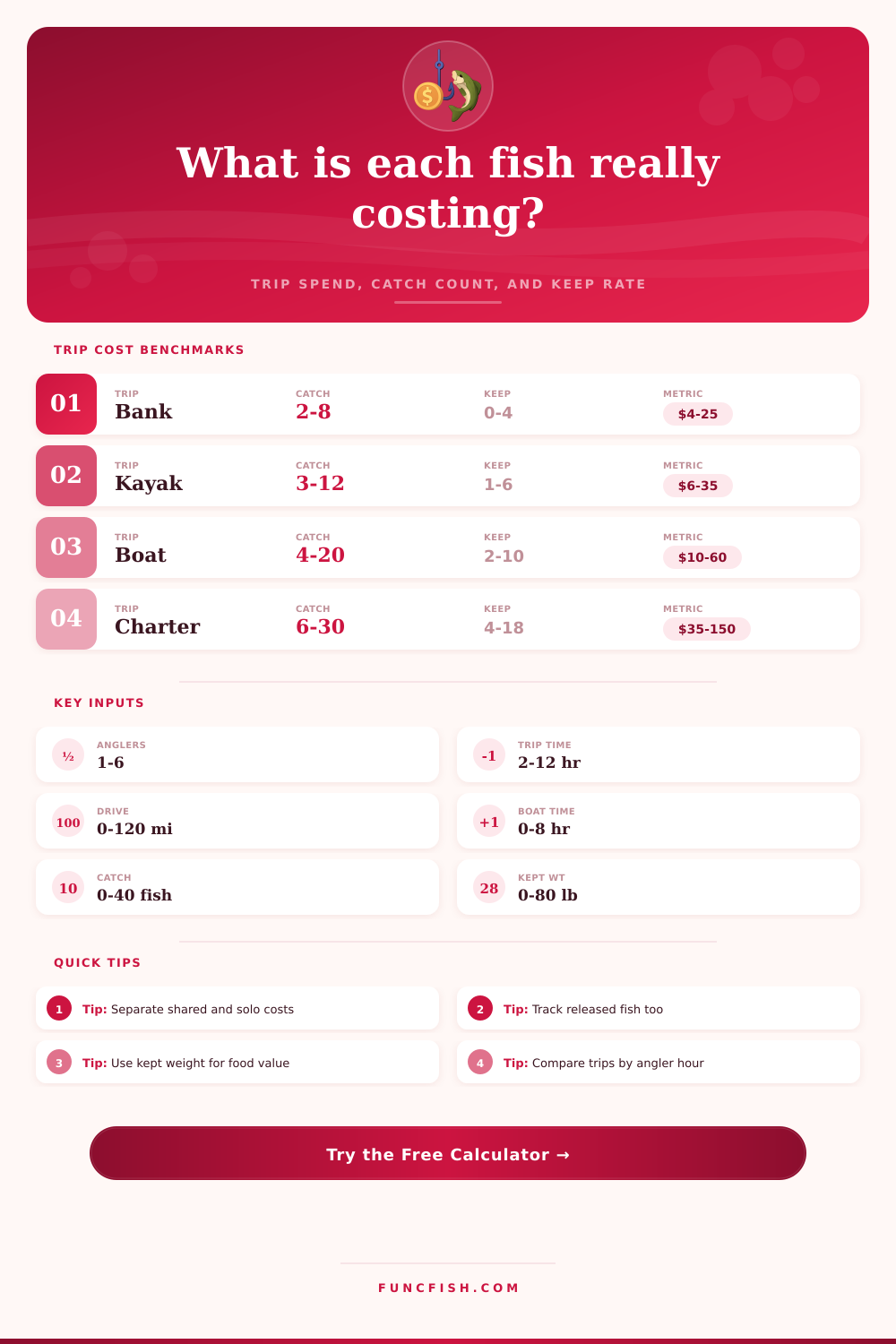
| Trip style | Typical shared costs | Best divisor | Useful output |
|---|---|---|---|
| Bank or pier | Drive, bait, parking | Total fish caught | Cost per catch |
| Kayak inshore | Drive, bait, launch | Angler hours | Fish per hour |
| Small boat lake | Road fuel, boat fuel, ramp | Party split | Cost per angler |
| Offshore or charter | Fee, tip, fuel, ice | Kept weight | Cost per lb |
| Technique | Catch expectation | Keep weight note | When cost per fish jumps |
|---|---|---|---|
| Trout stream | 1-8 fish | Often low keep | Long drive, few fish |
| Bass casting | 2-15 fish | Catch-release common | Boat fuel is high |
| Panfish bait | 8-40 fish | Best by kept count | Bait or access fees |
| Walleye jigging | 2-12 fish | Best by kept weight | Short bite window |
| Catfish bottom rig | 1-10 fish | Weight matters | Long soak, low action |
| Offshore trolling | 4-30 fish | Weight matters most | Fuel, fee, weather |
| Metric | Formula | Best for | Watch-out |
|---|---|---|---|
| Cost per fish caught | Allocated cost / caught | Action trips | Skewed by tiny fish |
| Cost per kept fish | Allocated cost / kept | Harvest trips | Zero keep needs backup |
| Cost per weight | Allocated cost / kept weight | Food trips | Use same weight basis |
| Fish per angler hour | Caught / angler hours | Trip comparison | Needs honest hours |
| Weighted catch | Kept + release factor | Mixed trips | Choose one factor |
💡Practical checks
Tip: Keep shared costs separate from personal tackle purchases. Shared trip math should usually include fuel, launch fees, bait, ice, rentals, and guide fees.
Tip: For catch-and-release trips, compare cost per fish caught and fish per angler hour. For harvest trips, compare cost per kept fish and cost per kept weight.
Anglers may not think of fuel and bait costs when planning there fishing trip. When divided by the number of fishes caught on a fishing trip, however, the total cost of a fishing trip can be more expensive than the angler anticipate. The total cost of a fishing trip includes costs like fuel, bait, ramp fees, and driving distance.
By knowing the total cost of a fishing trip per fish caught, an angler can make a decision between taking a drive to a new lake or staying at a local lake. Additionally, if an angler is considering using a charter boat instead of a kayak, the cost per fish can help an angler decide which trip is more efficient. The calculator included in this article allows an angler to input information from a single fishing trip to determine the total cost of the fishing trip.
How to Calculate the Cost Per Fish
This total cost is calculated by considering shared cost and personal cost for the fishing trip. Additionally, the calculator can calculate the total cost by considering driving distance and boat hour. Based on these costs, the total cost of the fishing trip per fish can be calculated.
Furthermore, the calculator can calculate the cost of the fishing trip per each kept fish. The cost of the fishing trip per each kept fish is another cost that may be of interest to anglers who intends to use the fish that are caught in their fishing trip. Additionally, the total cost of the fishing trip per each kept weight of fish can also be calculated.
This cost is helpful for anglers who are interested in the size of the fish that are caught during their fishing trip. Each of these costs can be calculated by entering information about each of the different aspect of each fishing trip. Each of the inputs into the calculator is based off the details of the fishing trip.
For example, the type of fishing trip can impact the cost of fuel for trips like offshore boat trips compared to kayak trips. Additionally, the setting for the different fishing techniques can help to make sure that comparisons between fishing trips account for the different type of fishing trips. Additionally, the release value can be used to account for the value of the fish that are released back into the water.
Setting a value for the release of the fish ensures that trips that focus on catch and release are not considered to have high costs for fishing trips. Additionally, the allocation mode for the fishing trip allows anglers to select whether the results of the calculation represent the cost for one angler or for the whole group of anglers on the fishing trip. These inputs allow anglers to compare the costs of two different fishing trips.
For instance, using the calculator, an angler can decide whether the long drive to a new fishing spot will provide more fish than a trip to a local fishing spot. Additionally, the calculator allows anglers to compare the efficiency of trips using a charter boat compared to a kayak fishing trip. The calculator makes these comparisons by performing the same calculation for each fishing trip scenario.
The results of the fishing trip calculations provide anglers with an understanding of whether the extra distance to a new fishing spot resulted in a better rate of fish caught. Additionally, anglers can use the calculator to understand if a shorter fishing trip is more efficient then a longer fishing trip. Many anglers make mistake when calculating the cost of their fishing trips.
One common mistake that anglers may make is to forget to include the time spent fishing on a fishing trip. For instance, a five-hour fishing trip for two anglers includes ten angler hour of fishing. Including these angler hours allows anglers to compare the efficiency of each fishing trip.
Another mistake anglers may make is to include personal gear cost in the shared costs of a fishing trip. The allowance for wear and tear on fishing gear is separate from fuel and bait costs so that anglers with expensive fishing gear are not disadvantaged compared to others who use less expensive gear. Although the cost calculator aims to determine a total cost for each fishing trip, there are other variable to fishing costs that this calculator does not measure.
Variables like the changes in weather and the changes in how fish bite in the water may impact the length of a fishing trip. For instance, if the weather was bad for an eight-hour fishing trip the trip may have lasted only four hour of actual fishing. Similarly, if fish are biting bad during a fishing trip, the trip might have ended before the desired length of the fishing trip.
These variables are beyond the scope of this calculator, but they is another aspect of fishing trips that anglers should consider once they have determined the base cost of their fishing trip. The reference tables included within this article help to provide information about the typical costs for each type of fishing. These reference tables are not meant to replace an angler’s records of the trips they take, but they do provide context for anglers regarding how typical fishing trip costs are.
Anglers can use these tables to determine if the cost per fish for their own fishing trip is above the typical cost for that type of fishing spot. If the cost is higher than those tables indicate, the cost breakdown will help anglers to determine if their high cost for the fishing trip resulted from high fuel costs, a low rate of fish caught, or a high cost for a fishing guide. Using the cost calculator for fishing trips often will change the way that anglers plan their fishing trip.
Anglers may notice which fishing spots are more efficient than others. Additionally, anglers may also be able to notice which fishing technique work better for certain groups of anglers than others. By making these costs visible to anglers, the calculator aims to provide anglers with a way to make decisions without relying on their gut feeling.
While the purpose of the calculator is not to teach anglers how to account for fishing trip costs, the purpose of this calculator is to provide anglers with a way to judge the value of their fishing trip. Once anglers have established the costs of their fishing trips under baseline scenario, they can begin to make decisions about whether to go on a longer fishing trip to a new spot, or to stick to their local fishing spots.