Nightcrawler Quantity Calculator
Estimate how many nightcrawlers, packs, and reserve worms to bring based on anglers, rods, hours, target species, rig style, bite pace, and storage conditions.
📌Scenario presets
⚙Trip and bait settings
Nightcrawler quantity forecast
Full breakdown
📋Nightcrawler use reference grid
Whole Crawler
Half Crawler
Pinched Piece
Panfish Nips
📘Reference tables
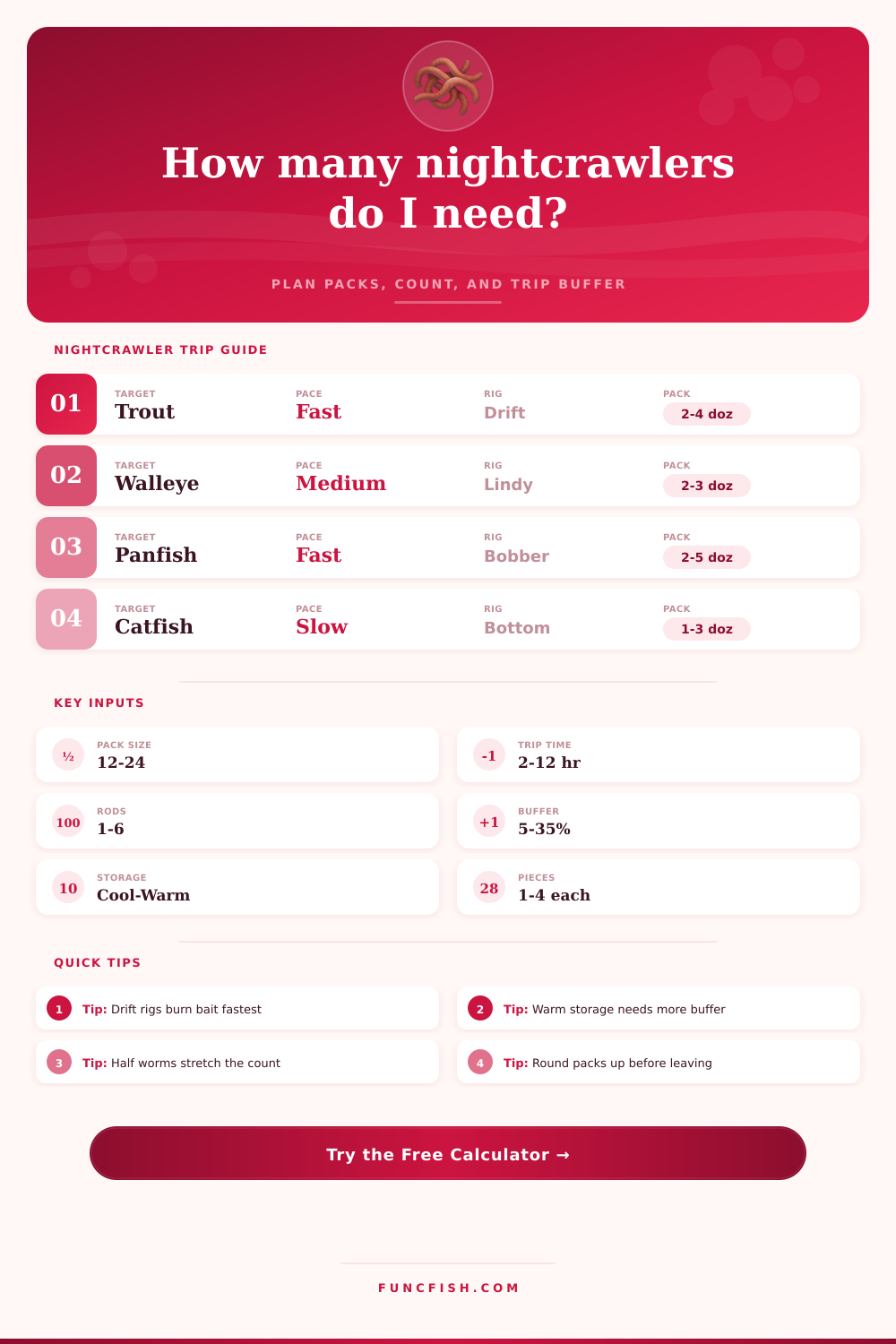
| Species target | Base baits per rod-hour | Common crawler cut | Pack planning note |
|---|---|---|---|
| Trout | 1.6 | Third or half | Current and snags raise count |
| Walleye | 1.2 | Half or tail-hooked whole | Harnesses use more worm length |
| Panfish | 1.8 | Small pinched pieces | Fast bites use many small baits |
| Catfish | 0.7 | Whole or half | Long soaks reduce rebait rate |
| Bass | 1.0 | Half or finesse piece | Moving often adds handling loss |
| Carp | 0.45 | Small bunch or piece | Slow soak, lower count |
| Sucker / redhorse | 0.9 | Half crawler | Bottom rigs need a modest reserve |
| Mixed pond fish | 1.3 | Small pieces | Kid trips benefit from a buffer |
| Condition | Multiplier | Why it changes count | Planning move |
|---|---|---|---|
| Drift rig | 1.35x | Snags and current strip bait | Pack extra |
| Bobber rig | 0.85x | Bait stays suspended | Reuse if intact |
| Crawler harness | 1.55x | Whole crawlers and speed | Use larger packs |
| Warm storage | 1.18x | More weak or unusable bait | Add cooler reserve |
| Hot bite | 1.55x | More hook checks and steals | Round packs up |
| Weekend outing | 1.12x | Longer time before final use | Plan loss buffer |
💡Practical checks
Tip: Count active rods, not owned rods. A four-rod group that usually has only three baits in the water should enter three active lines.
Tip: Warm storage, small hooks, and nuisance fish all increase the unusable-bait margin, so keep the reserve field realistic.
Planning a fishing trip require a decision to be made about how many nightcrawlers to bring along. Bringing too few nightcrawlers means that your fishing rod will be idle. Bringing too many nightcrawlers means that you will be carrying extra weight and you will spend more money on nightcrawlers than you intends to.
In order to decide how many nightcrawlers to bring on the trip, there are a variety of different factors to consider, such as the species of fish that you are targeting, how you will rig your nightcrawlers, for how many hour you will be fishing, and in what manner you will store your nightcrawlers while you are fishing. Many people will try to determine how many nightcrawlers they need by guessing the number based off there memory of their previous fishing trips or by asking their friends. Both of these options, however, are inaccurate in comparison with the number of factors that impact the number of nightcrawlers that will be needed.
How Many Nightcrawlers to Bring on a Fishing Trip
For instance, the rate at which the fish begin to bite will impact the number of nightcrawlers that are use; if the fish begin to bite at a rapid rate, then more nightcrawlers will be used than if the fish take longer to eat at the nightcrawlers. Additionally, the manner in which you rig the nightcrawlers will impact the rate at which they are used; drift rig that is set up in areas with current will lead to the nightcrawlers becoming snagged on underwater objects at a more higher rate than bobber rigs. Finally, the way in which the nightcrawlers are stored will impact the number of nightcrawlers that are used; nightcrawlers stored in a container that is kept cool with an ice pack will last longer than those store in a warm container.
The calculator included at the top of this article will help to calculate the number of nightcrawlers that will be needed for your fishing trip by obtaining information regarding the species of fish, the rigging of the nightcrawlers, the bite rate, the number of rods that will be used, the number of hours that you will be fishing, and the storage plan for your nightcrawlers. The calculator will provide a number of different value in response to the information that you enter, and it will allow you to view the impact that actions such as cutting your nightcrawlers into smaller piece will have upon the total number of nightcrawlers that are needed. Additionally, the calculator will also allow you to view the impact that purchasing an extra buffer of nightcrawlers will have upon the total number that you requires.
Cutting your nightcrawlers into smaller pieces will allow you to use fewer nightcrawlers overall, but it will also require you to rebait your hooks at a more frequent rate. Some of the different variables of fishing will have significant impact upon the total number of nightcrawlers that are needed. For instance, if the fishing trip is employing a fishing technique that utilizes nightcrawlers at a rate that is twenty percent faster than other techniques, the number of nightcrawlers that must be purchased will increase at a significant rate.
Additionally, the species of the fish that are targeted will impact the number of nightcrawlers that are used; for instance, catfish tend to eat entire nightcrawlers, but panfish may only eat the pieces of nightcrawlers that is offered to them. Thus, the calculator allows individuals to test these different scenario without having to guess at the number of nightcrawlers that are required for each scenario. Finally, it is important to consider that the fishing condition may change while fishing, which will change the number of nightcrawlers that are used.
For instance, you may have to add more fishing rods to your fishing setup, which would require purchasing additional nightcrawlers. Additionally, the weather may change while you are fishing; if it becomes warmer, for instance, you may have to change the way in which you store your nightcrawlers. The calculator cannot account for these changes, but it can help to provide an initial number of nightcrawlers that you should purchase before you begin fishing.
Based on that initial calculation, you can determine if you need to purchase additional packs of nightcrawlers, or if you need to cut your nightcrawlers into smaller pieces to allow them to last you for the entire trip. In addition to the factors described above, it is also important to account for the loss of some nightcrawlers that are not used to catch fish. For instance, nightcrawlers may become lost if they slip off of the hook while fishing, or they may become torn while rebaiting the hooks.
Additionally, the nightcrawlers may become weak if the water that is being fished in is too warmly. The calculator includes a small allowance for these lost nightcrawlers, but you may have to determine if additional nightcrawlers are needed if you plan to fish in areas with many snags. Finally, you should also consider how many nightcrawlers are contained in a single pack of nightcrawlers.
Suppose that the calculator determines the number of nightcrawlers that you need is twenty-three nightcrawlers. If the bait shop where you intend to purchase your nightcrawlers only sells packs of twelve nightcrawlers, then you will have to determine whether you would like to purchase two packs of nightcrawlers (for twenty-four nightcrawlers), or three packs of nightcrawlers (for thirty-six nightcrawlers). Thus, the calculator will indicate to you the total number of nightcrawlers that you will need, which will help you to determine the number of packs of nightcrawlers to purchase.
Knowing how many nightcrawlers you need will help to avoid the stress of running out of bait for your fishing trip, and it will also help to avoid spending too much money on purchasing extra bait for your fish.