Leader Length by Water Depth Calculator
Estimate a practical fishing leader length from water depth, target zone, rig style, clarity, current, cover, and leader material.
📌Scenario presets
⚙Leader settings
Leader length result
Full breakdown
📋Leader material data grid
Fluorocarbon
Monofilament
Coated Wire
Shock Leader
📏Water depth leader reference
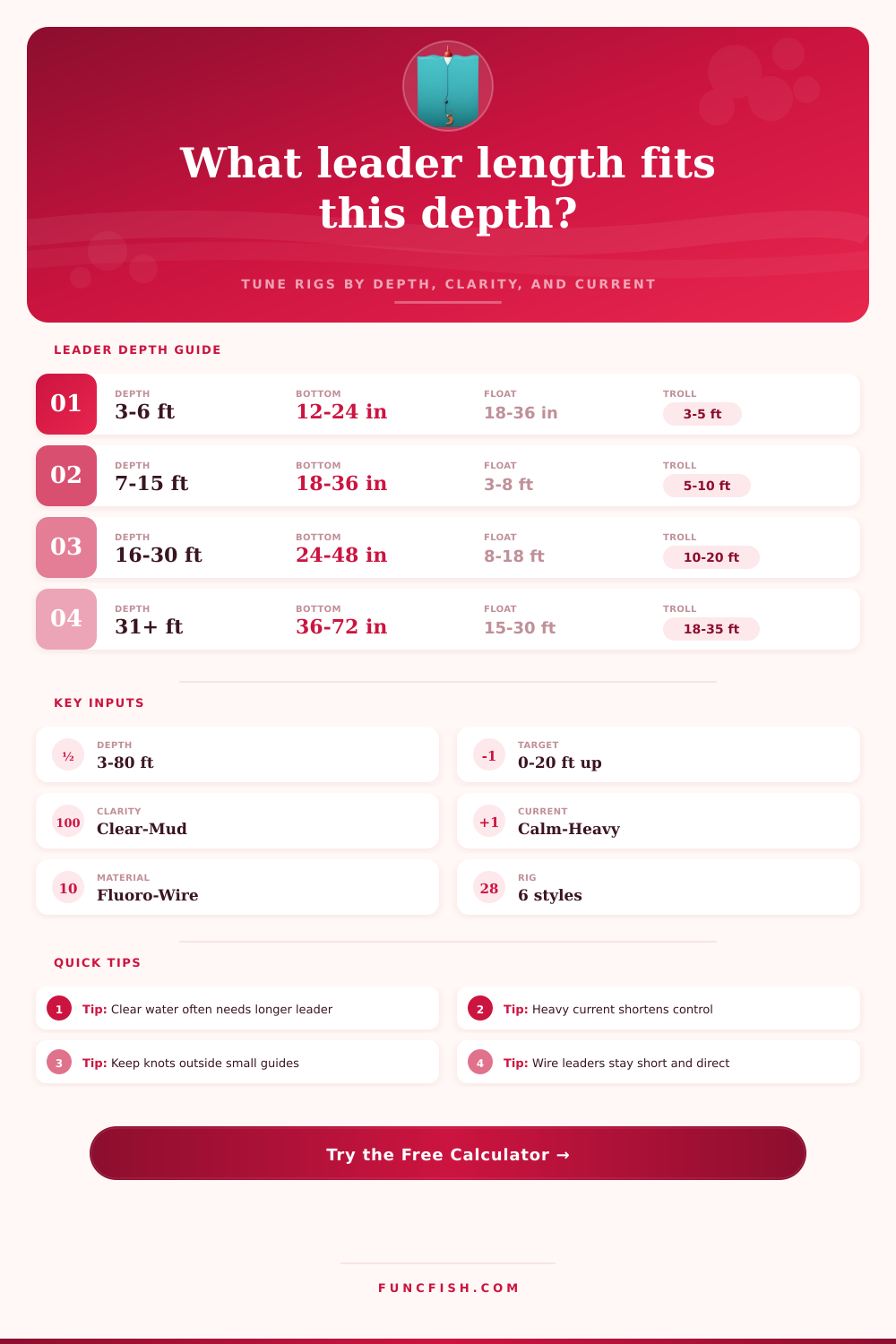
| Water depth | Bottom bait leader | Float / cork leader | Trolling leader |
|---|---|---|---|
| 3-6 ft / 0.9-1.8 m | 12-24 in / 30-61 cm | 18-36 in / 46-91 cm | 3-5 ft / 0.9-1.5 m |
| 7-15 ft / 2.1-4.6 m | 18-36 in / 46-91 cm | 3-8 ft / 0.9-2.4 m | 5-10 ft / 1.5-3.0 m |
| 16-30 ft / 4.9-9.1 m | 24-48 in / 61-122 cm | 8-18 ft / 2.4-5.5 m | 10-20 ft / 3.0-6.1 m |
| 31-60 ft / 9.4-18.3 m | 36-60 in / 91-152 cm | 15-30 ft / 4.6-9.1 m | 18-35 ft / 5.5-10.7 m |
| 60+ ft / 18.3+ m | 4-8 ft / 1.2-2.4 m | Use slip rig range | 25-60 ft / 7.6-18.3 m |
| Rig style | Depth formula basis | Normal cap | Reason to shorten |
|---|---|---|---|
| Bottom bait | Depth x 0.08 plus 18 in | 6 ft / 1.8 m | Snags, heavy current, short casts |
| Drop shot | Target above bottom plus bait gap | 4 ft / 1.2 m | Vertical control or tight cover |
| Slip float | Depth minus bottom clearance | Depth setting | Shallow weeds or casting swing |
| Trolling | Depth x 0.28 plus lure setback | 60 ft / 18.3 m | Turns, fouling, planer clips |
| Casting lure | Rod length and water clarity | Rod length x 1.4 | Knots catching in guides |
| Wire bite | Bite zone only | 24 in / 61 cm | Visibility and lure action |
🐟Species and condition adjustments
| Target group | Typical leader range | Depth behavior | Material note |
|---|---|---|---|
| Panfish / crappie | 12-48 in / 30-122 cm | Often suspended near cover | Light mono or fluoro |
| Trout | 2-9 ft / 0.6-2.7 m | Clear water extends leaders | Fine fluoro or tippet |
| Bass | 2-8 ft / 0.6-2.4 m | Cover decides shorter or longer | Fluoro for abrasion |
| Walleye | 3-8 ft / 0.9-2.4 m | Bottom-following presentations | Fluoro or mono |
| Catfish | 12-36 in / 30-91 cm | Leader often near bottom | Heavy mono or abrasion leader |
| Pike / muskie | 8-18 in / 20-46 cm | Depth matters less than teeth | Wire or heavy fluoro |
| Condition | Leader change | Control change | Use when |
|---|---|---|---|
| Clear water | +20% to +35% | Small penalty | Fish inspect bait or lure closely |
| Muddy water | -10% to -25% | Better contact | Visibility matters less than feel |
| Heavy current | -15% to -35% | Large penalty | Leader sweeps or tangles |
| Rock / shell | -5% to +10% | Abrasion penalty | Use tougher material, not just length |
| Toothy fish | Fixed short leader | Visibility penalty | Protect the first bite zone |
⚖Leader length comparison grid
Short leader
Best for heavy current, toothy fish, tight cover, vertical rigs, and lures that need crisp action. It improves contact but can look more visible in clear water.
Medium leader
Best for most bottom rigs, drop shots, bass casting, walleye live bait, and mixed clarity. It balances stealth, abrasion space, and cast control.
Long leader
Best for clear water, trolling, fly presentations, slip floats, and spooky fish. It adds separation from hardware but may reduce casting and bite feel.
💡Practical checks
Tip: Compare the recommended leader to your rod length. If the leader knot must pass through small guides, shorten the leader or retie with a slimmer knot.
Tip: For bottom rigs in current, shorten the leader until bait tracks without spinning. For clear, calm water, add length only while casts remain clean.
To determine the lengths of the leader for your fishing rig, you must consider four different variable: the depth of the water, the clarity of the water, the current in the water, the style of your fishing rig, the cover in which you will be fishing, the type of fish that you are targeting, the material of your fishing leader, and even your casting skill. Each of these factor will interact with the others to determine the best length for your leader. The depth of the water is the first variable to consider in determining your leader length.
In shallow waters, you will only need a leader length that will allow your bait to remain in strike zone but not too long that the leader may drag on the bottom or get into weeds. In deeper water, the leader length must be more longer to allow the bait to reach the fish but not so long that it may make your casting difficultly. The style of your fishing rig is another of the variables to consider.
How to Choose the Right Leader Length for Fishing
For example, if you use a bottom rig, your leader length must be more short. This is because bottom rigs will remain closer to the bottom of the water column and you want to maintain contact with the fish. Slip floats and trolling spreads will require longer leader lengths because the fishing rigs will be farther from the tip of your fishing rod.
Drop shot rigs and fish that you are targeting using vertical presentations will use the distance of the bait above the bottom as the main variable in determining leader length. Water clarity and water current has opposite impacts on leader length. In waters with high clarity, the leader length should be longer to allow for more stealth in the approach of the fish.
However, if there is strong currents in the water, this long leader length may become a problem as the current may bow the leader length when you are fishing. In stained or muddy waters, the fish have limited visibility of the bait so a shorter leader length may be used. The type of cover in which you fish and the type of fish you target will impact your leader length.
For example, if you are fishing in areas with brush or timber, long leader lengths may get caught on the cover so leader lengths must be shorter. In open water, there are no cover issues so longer leader lengths may be used. If you are fishing for species with sharp teeth, the leader length should be short to provide bite protection.
Species that feed in the upper waters of the water column will require different leader length recommendation than species that feed on the bottom of the water column. The material of your leader have an impact on leader length. Fluorocarbon leaders are good for stealth but may be stiff in cold water.
Monofilament leaders will allow for more forgiveness in casting but will not be as invisible to fish as fluorocarbon. Wire leaders are short in length to allow for bite protection but not for distance. Finally, leader length also has an impact on your casting skills.
If your leader length is too heavy, it may be difficult to cast your bait to where you want it. Additionally, there are a few ways to test your leader length. If the knots on the bait do not pass through the small guides on your fishing rod, you should shorten the length of the leader.
If the bait begins to spin when in the water due to the current in the water, the leader length should be trimmed. If the fish follow the bait but do not strike the bait in clear and calm water, the leader length should be increased. These adjustments can only be made through experience but are a matter of necessity in the fishing world.
The length of the leader must be a balance between the separation of the bait and your control of the fishing line.